Skill translation platform for professionals 50+

Natalia Bukhtiiarova


Product
A two-sided marketplace that uses AI to translate compound experience (20-30 years of tacit knowledge) into structured micro-skills, connecting experienced professionals with companies that need deep domain expertise.
The problem
Korn Ferry projects 85 million unfilled jobs by 2030 ($8.5 trillion in lost revenue). 74% of employers say they can't find talent.
The talent exists. Professionals 50+ have it. But a 2023 meta-analysis found that they receive half as many callbacks as younger applicants with identical qualifications. Over half leave career positions involuntarily. And five of six negative stereotypes about older workers are empirically unsupported (Ng and Feldman, 418 studies, 208,000 participants).
90% of large companies use ATS built for keyword matching and linear careers. Skills-based hiring was supposed to fix this. Harvard and the Burning Glass Institute found fewer than 1 in 700 hires actually changed.
The EU AI Act (2026) now classifies recruitment AI as High Risk. Fines up to 35 million euros. Companies need a new approach.
Insight
The problem isn't people. It's the language used to describe them.
"VP Supply Chain, 2005-2024." That's the whole picture a resume gives. Everything else disappears: the 11-country vendor network, the FDA recall managed without a citation, the team built from scratch. Eraut's research found that workers can't articulate skills they've never been asked about. O*NET maps 19,000+ task statements. A 25-year career contains hundreds of micro-skills. None fit in a job title.
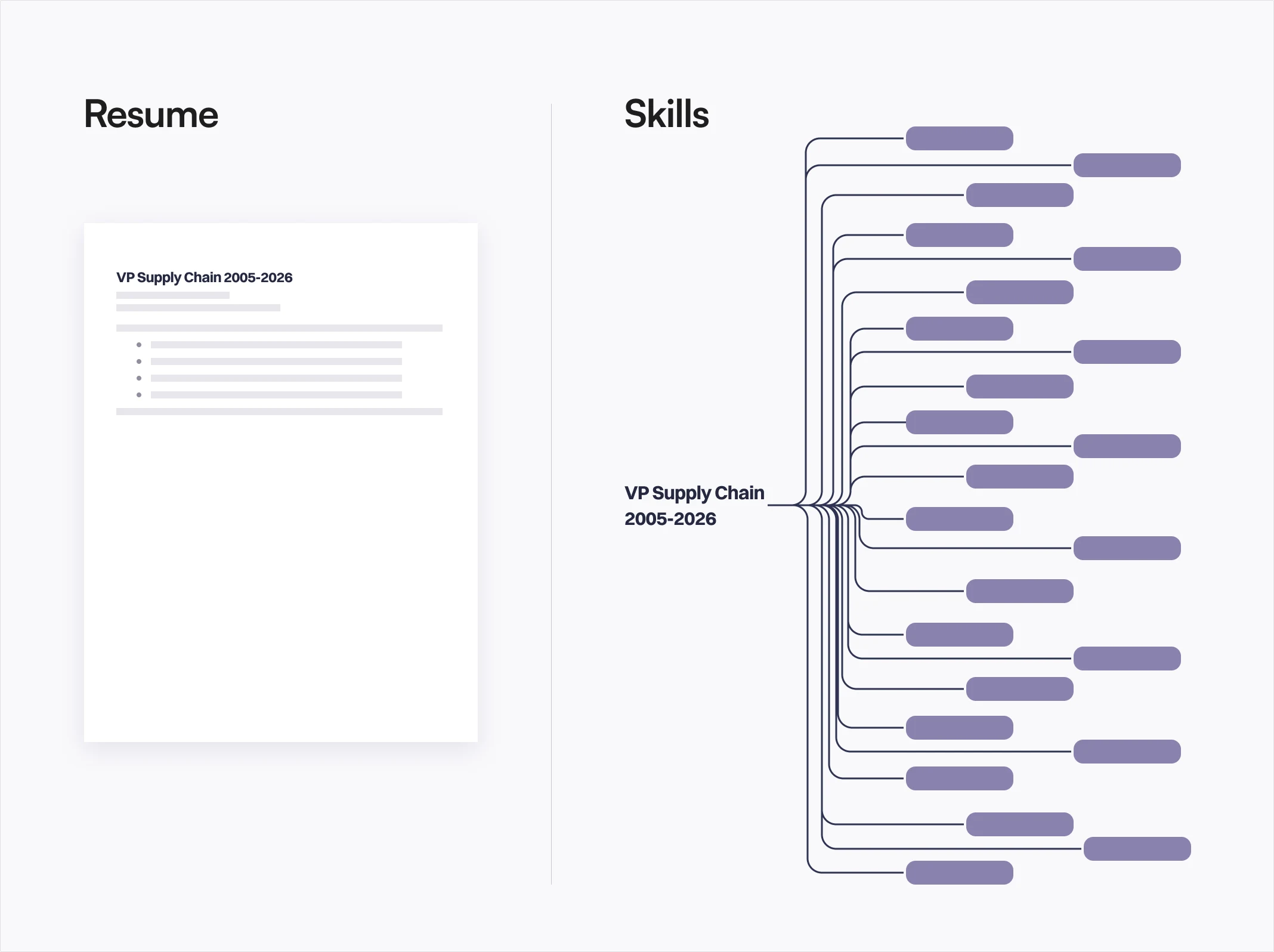
Same person. Same 25 years. Different language.
Personas, user stories, and general user flows
Talents
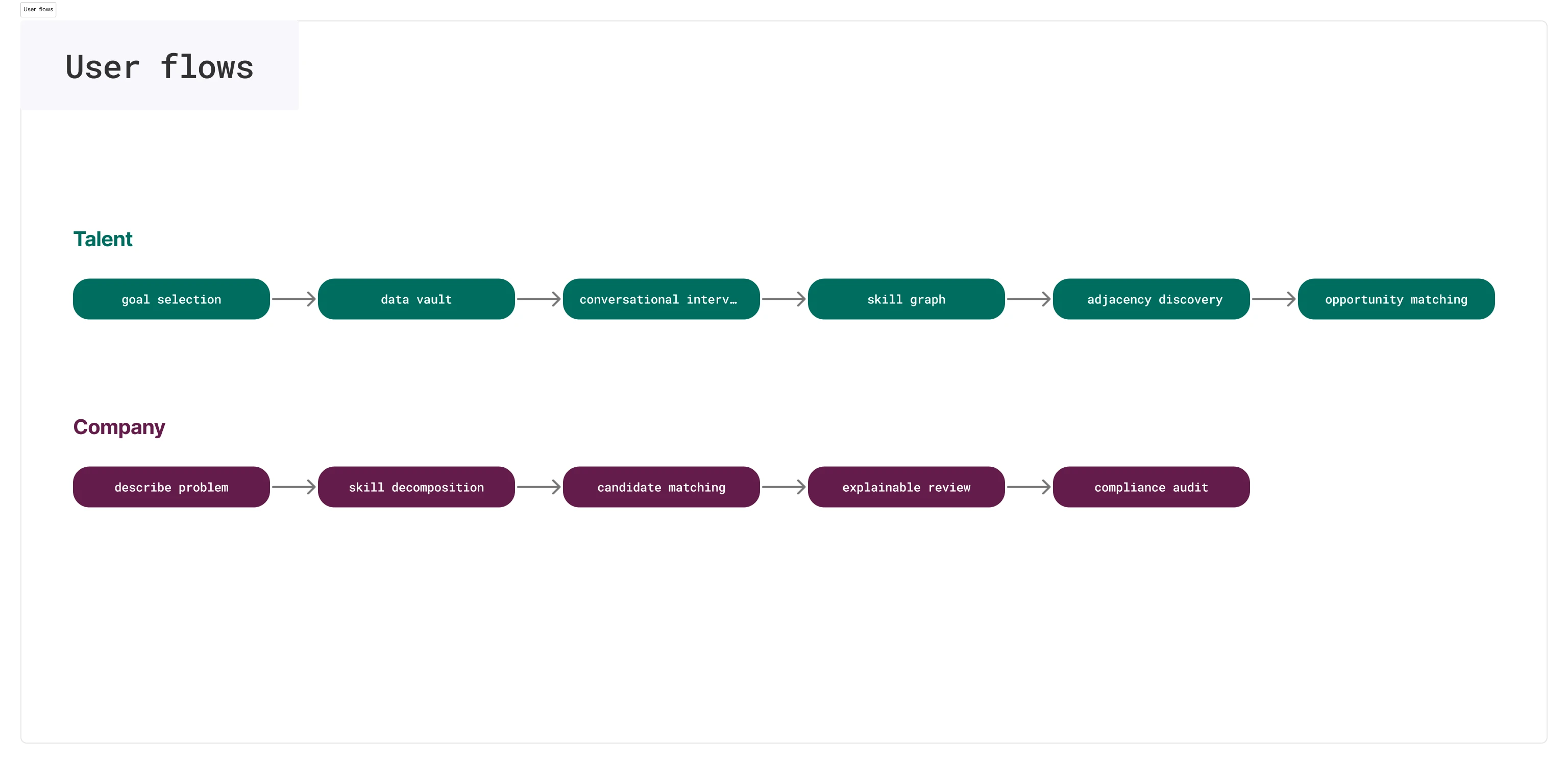
Margaret Chen, 56. Laid off after 23 years as VP Supply Chain in pharma. Applied to 80+ jobs, got 3 callbacks. She managed product recalls across 11 countries but doesn't call that "crisis management." She calls it Tuesday. She has skills in crisis ops, FDA compliance, vendor networking, team leadership, and more, but she doesn't recognize them as distinct skills.
David Okafor, 62. Retired CTO from an energy utility. 30 years of grid reliability knowledge. Three climate tech startups nearby would pay for what he knows. He doesn't know they exist. Wary of AI, very wary of sharing data.
Company
Novus Bio recruiter. Series B biotech. Needs someone who has navigated an EMA submission. ATS surfaced 200 applicants, mostly junior. Margaret exists. The ATS scored her low because her title was VP, not "Regulatory Affairs Specialist." And in 2026, she isn't scanning 200 profiles anyway, her hiring agent does the first pass.
Design decisions
Decision 1: Conversational interview over resume parsing
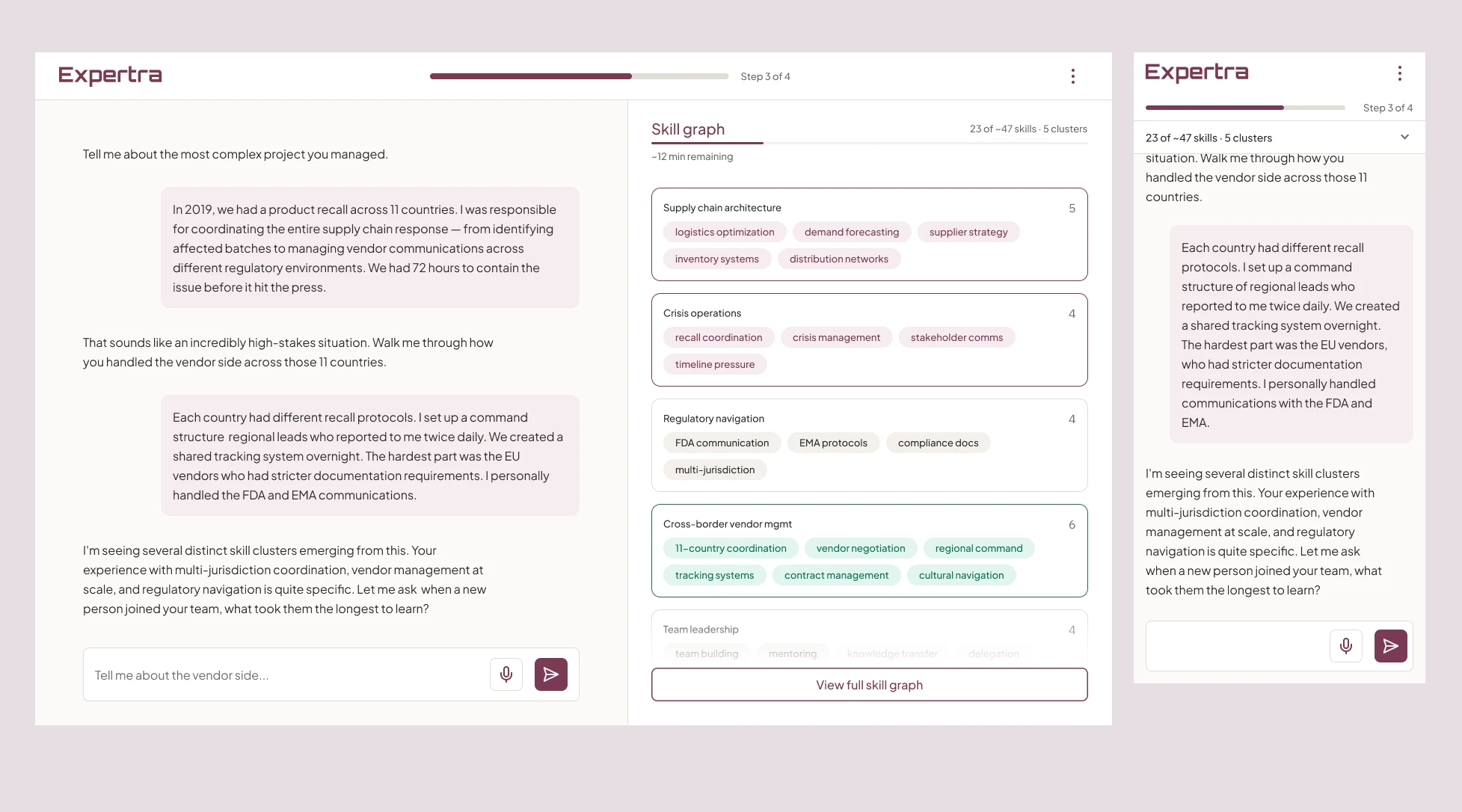
Professionals 50+ don't recognize their skills as separate competencies. Margaret managed a recall across 11 countries and calls it "just doing my job." A resume upload loses 80% of that. A 47-field form won't capture it either.
I chose an AI-guided conversation that draws out skills through stories. Eraut confirmed self-assessment alone is insufficient. The SECI model points to the same conclusion: tacit-to-explicit conversion works through dialogue, not forms.
Conversational interview
Decision 2: Progressive disclosure for the skill graph
47 skills, hundreds of connections, five domains. Showing everything at once creates cognitive overload, especially for an audience where 60% say "tech is not designed for us."
I chose three levels. Snapshot: 5 cluster cards, readable in 10 seconds. Cluster detail: tap any card, see individual skills with interview context, edit what feels wrong. Full graph: interactive visualization with timeline. NNG's 87 design guidelines for older adults and a systematic review of 27 evidence-based recommendations both point to progressive disclosure as the way to manage complexity without hiding value.
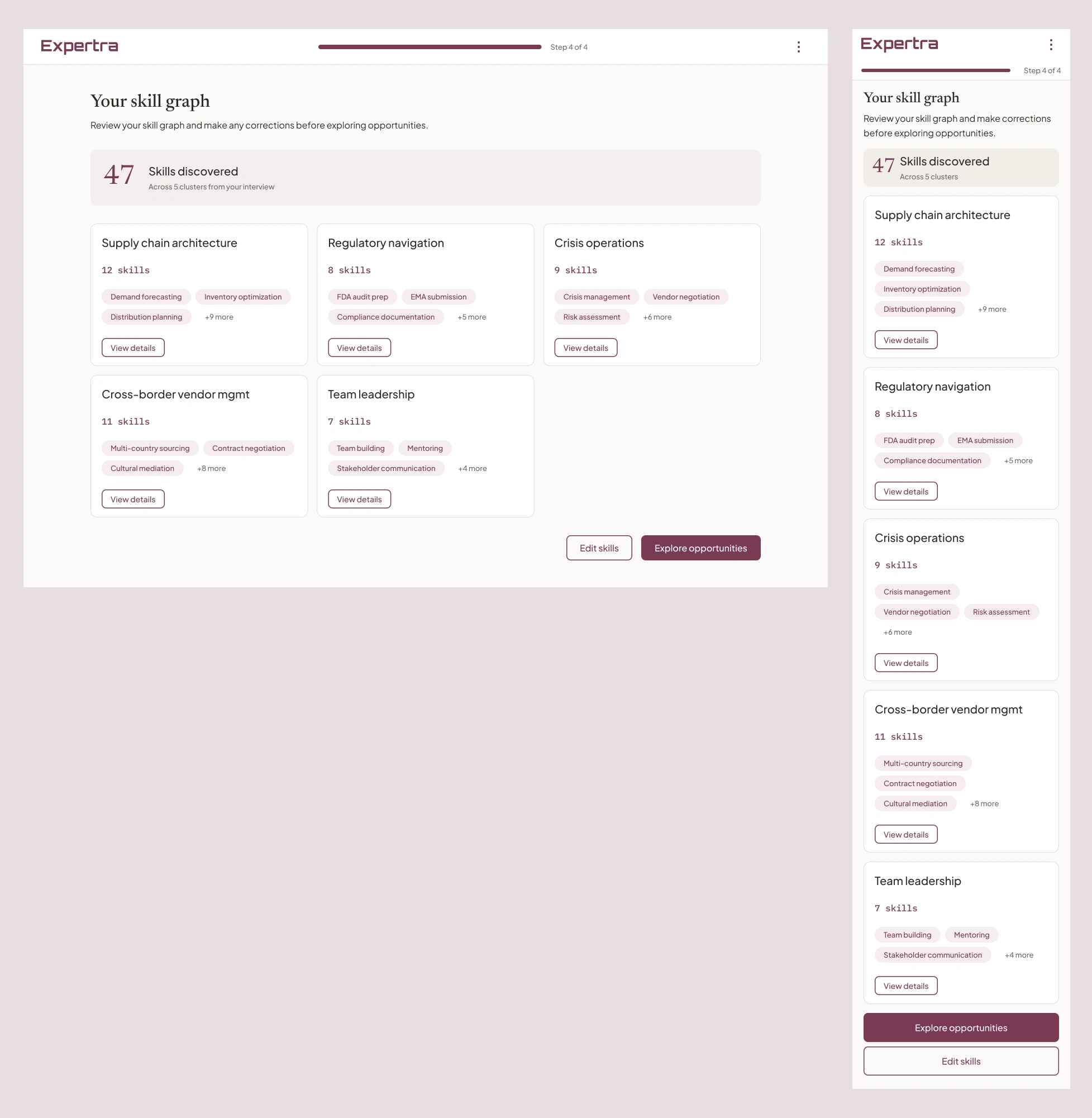
Skill graph snapshot
Decision 3: Trust architecture
3% of adults 50+ aren't confident their online activity stays private. 59% have no interest in generative AI. If trust isn't built before the interview, David won't talk. The entire product breaks at step one.
I chose a data vault with three visibility layers, shown before the interview starts. What AI sees: full narrative, used for skill extraction only, never shared. What employers see: skill graph, no graduation dates, no exact years, proxy scrubbing active by default. What stays hidden: anything the user toggles off. "Talk to a human" button visible at every stage.
The precedent: financial apps that show exactly which data goes where (Plaid-style transparency).
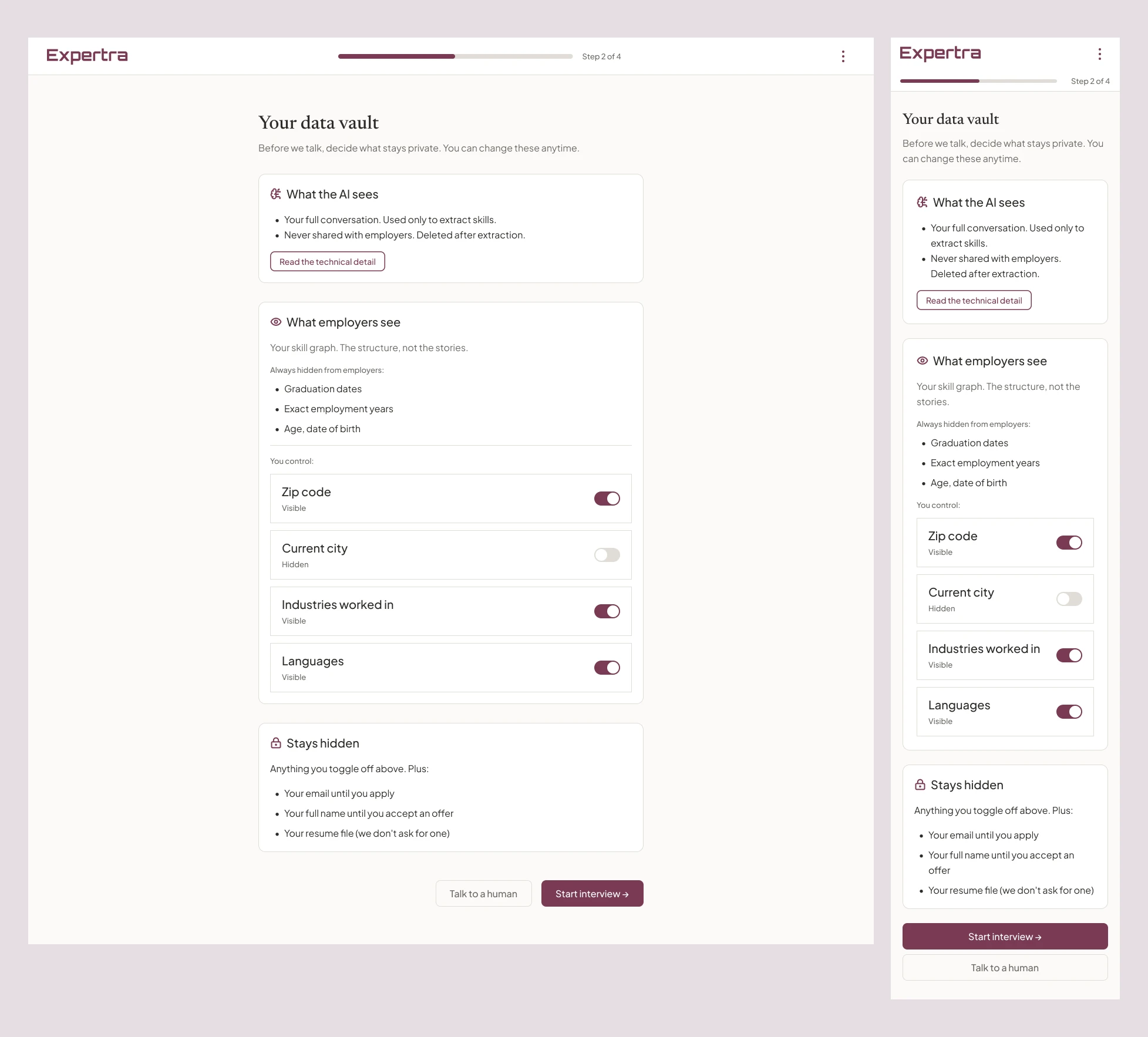
Data vault setup
Decision 4: Compliance as entry point
Everyone talks about skill-based hiring. Fewer than 1 in 700 hires changed. Education doesn't convert. The market already agrees in principle but doesn't follow through.
I chose compliance as the forcing mechanism. EU AI Act, Mobley v. Workday, and rising EEOC enforcement create real liability for companies using biased AI in recruitment. The platform becomes a "safe harbor." Skill-based matching is the technical requirement for proving your hiring isn't discriminatory.
This narrows launch to regulated industries (pharma, finance, manufacturing), but those are where cost of vacancy is highest. I'm not sure this wedge works the same everywhere. In Japan, the entry is post-retirement career extension. In South Korea, it's bridging the pension gap. Four markets, four different hooks.
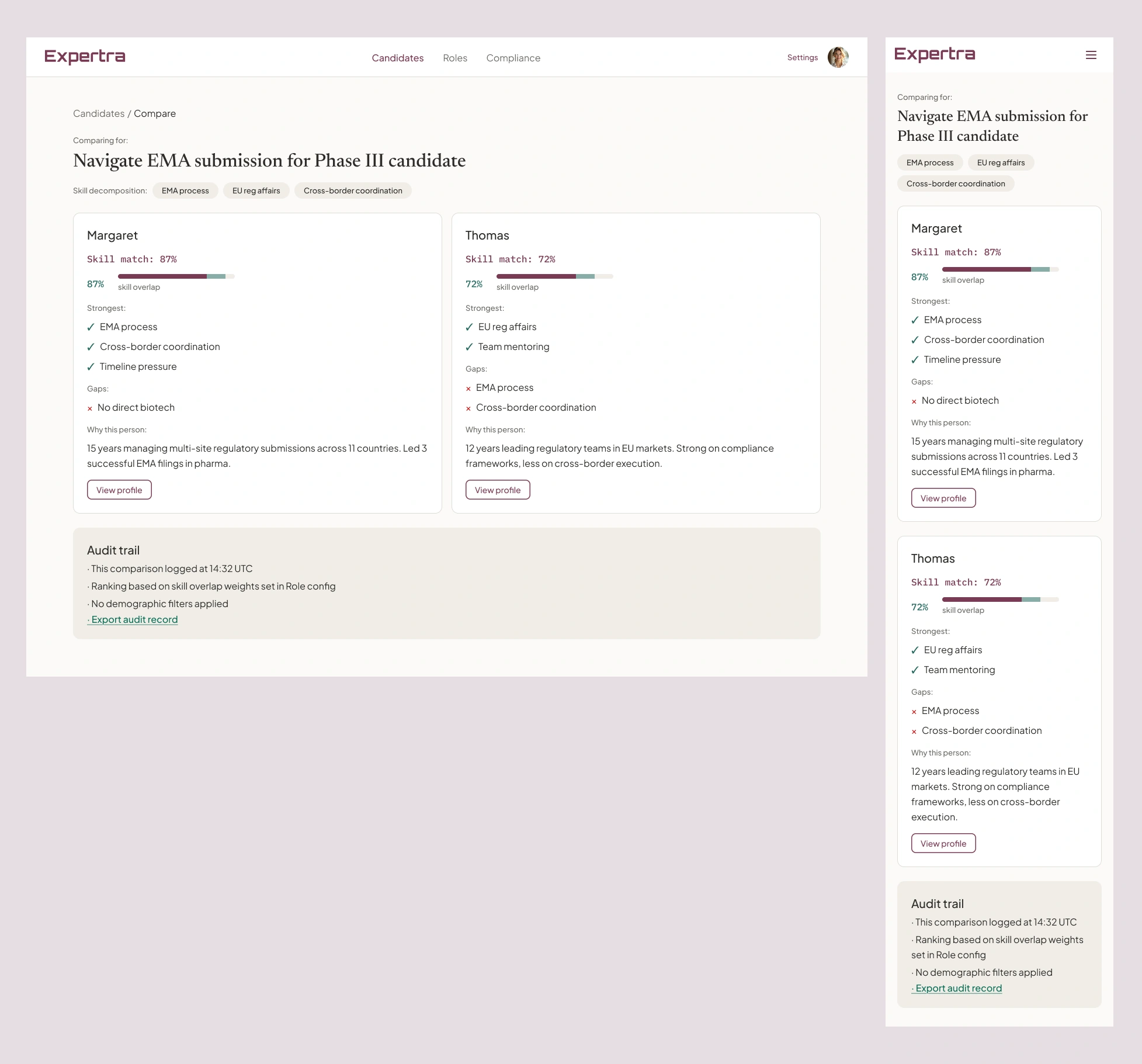
Candidate comparison (company side)
Decision 5: Asset framing, no age in the UI
This platform is built for people 50+. But adults with 25 years of professional experience don't want to be a charity case. "It's not too late!" is condescending.
I chose asset framing. No mention of age anywhere in the interface. The value proposition is depth, not age. Ng and Feldman's meta-analysis (418 studies) found five of six negative stereotypes unsupported. AARP research showed older adults outperformed younger adults on 12 tasks. And 59% of adults 50+ have no interest in generative AI, so the technology stays invisible. Sell the outcome (find the right role), not the tool (AI matching).
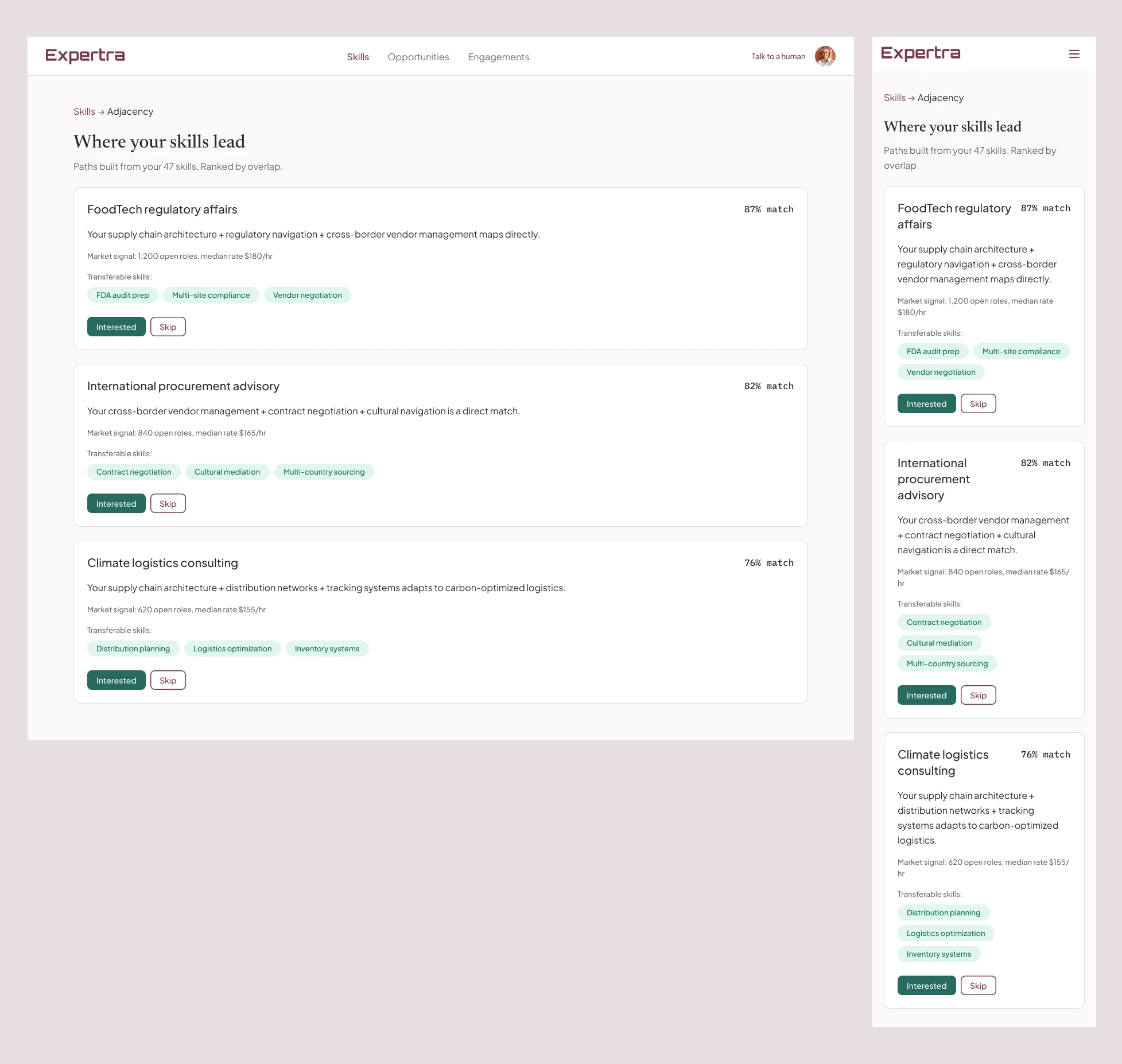
Adjacency discovery
Decision 6: Dual-audience architecture
Recruiters in 2026 don't scan 200 profiles. Their agents do. If the skill graph is only visual, the agent wastes tokens interpreting HTML and risks miscategorizing Margaret again, the ATS problem at a different layer.
I chose dual-audience architecture: one profile, two representations. Human recruiters see narrative and context. Their agents see structured skill graphs with taxonomy paths, confidence scores, and schema.org markup. Same data, different surfaces. Structured data forces clarity, which improves human readability too.
This decision extends the trust architecture from Decision 3 to a second user. Margaret's data vault governs both views. She also sees a log of every agent interaction, who accessed her profile, what they parsed, and what their recruiter saw.
On the company side, the recruiter sets agent autonomy per task type: search freely, confirm before contacting. When the agent finds a match, an intent preview shows the action, the rationale (tied to confidence scores), and a draft message. Send, edit, or skip.
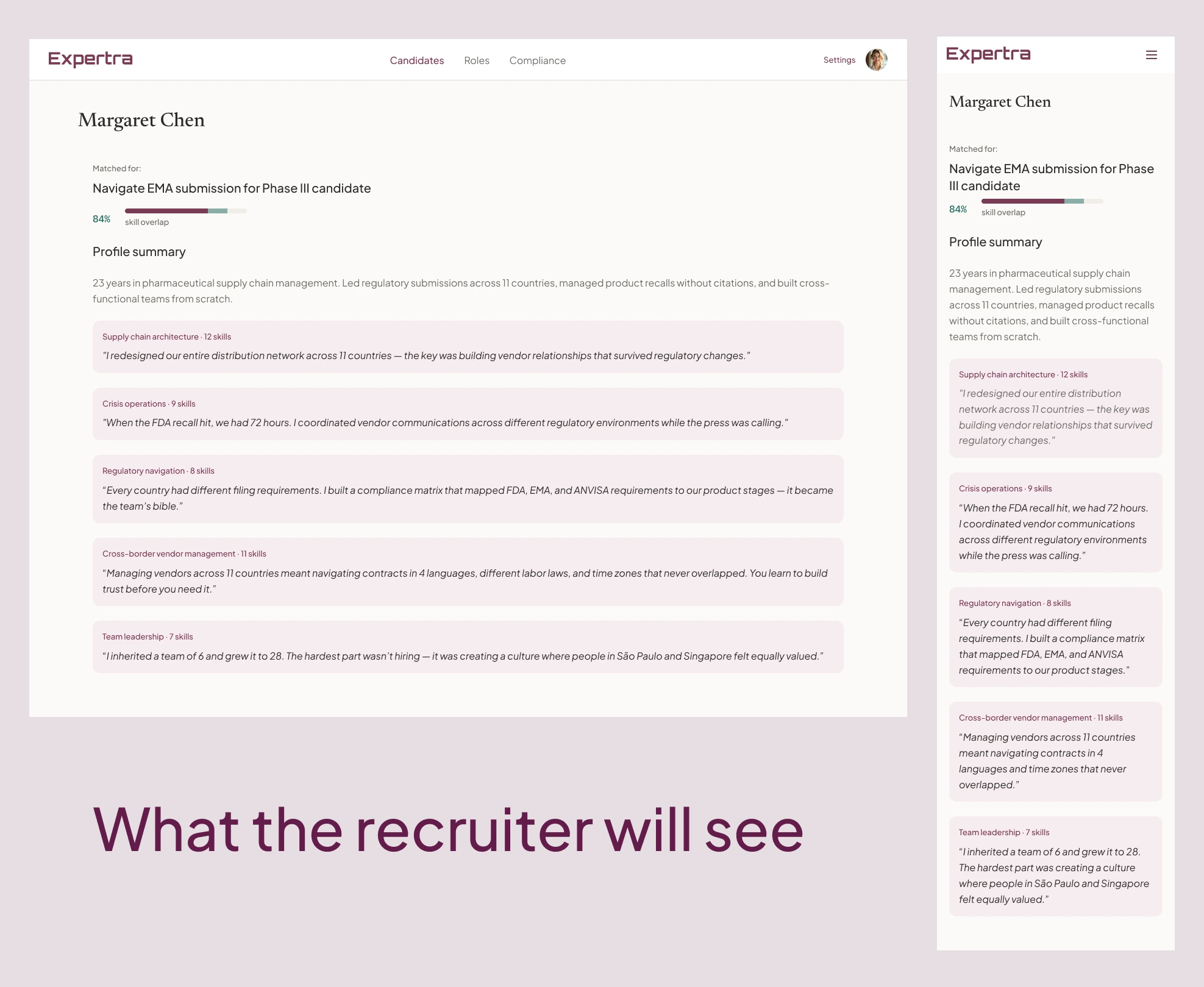
Recruiter sees talent's story
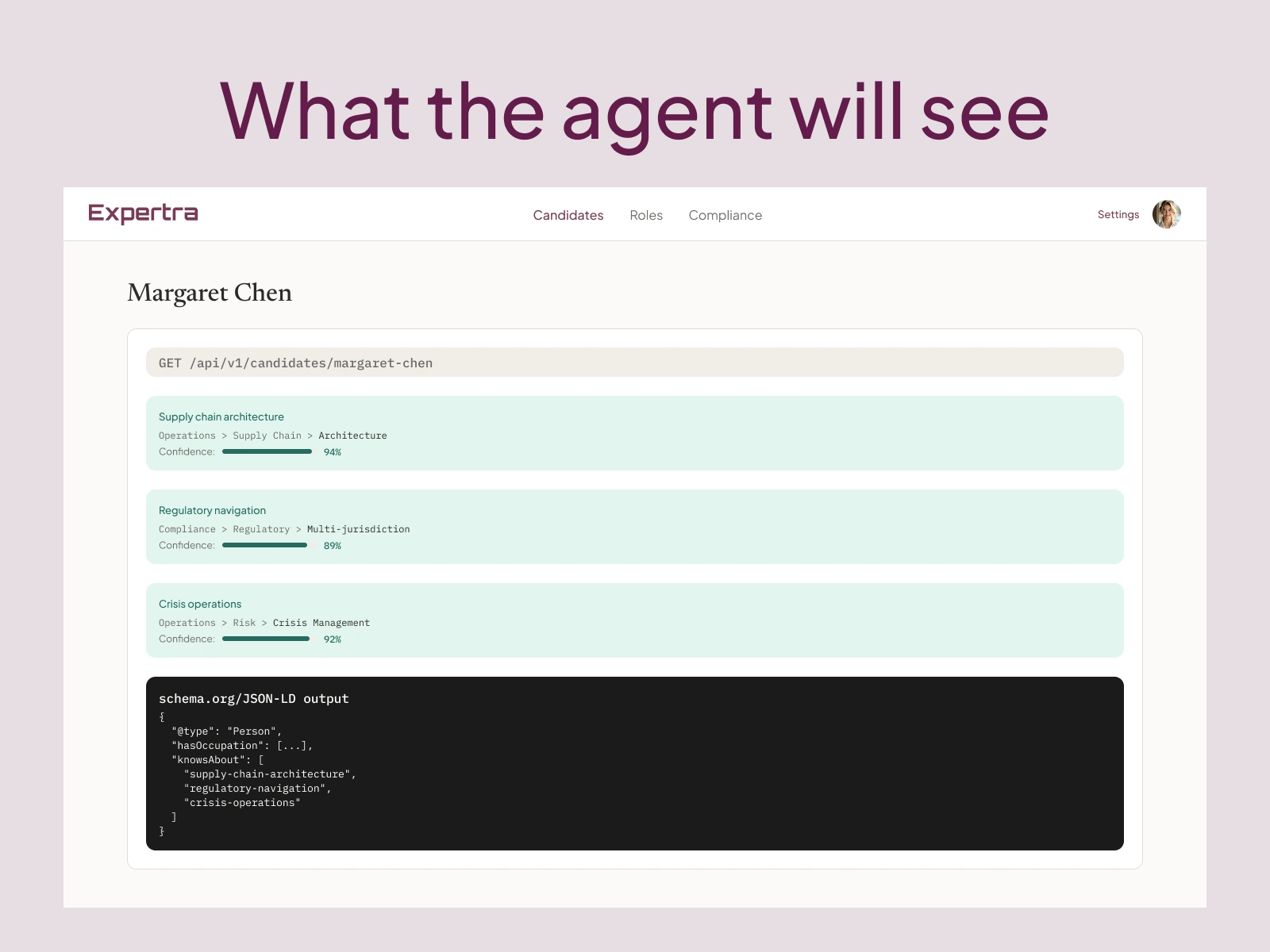
Agent sees structured skill graph nodes, taxonomy paths, confidence bars, JSON-LD schema output
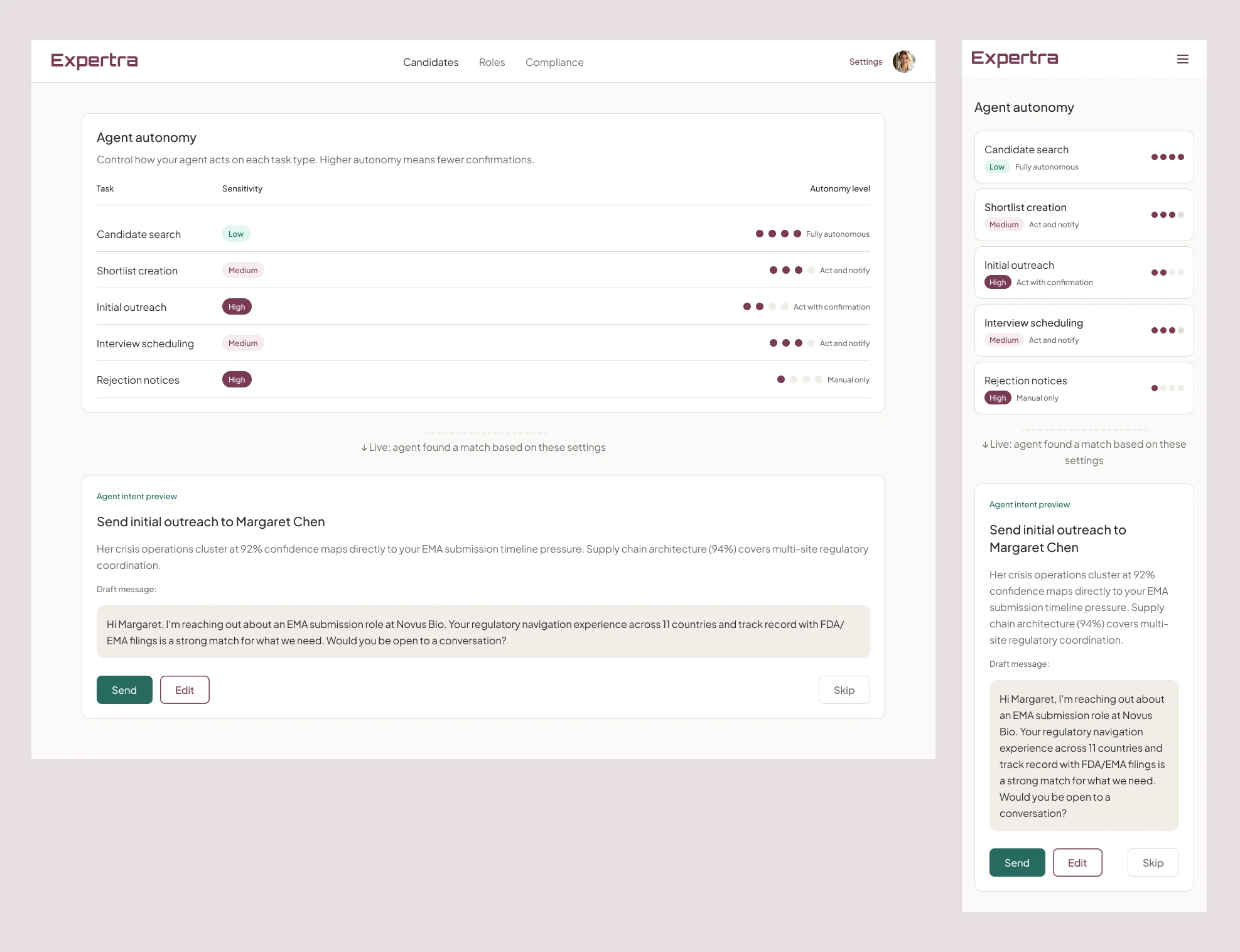
Autonomy dial + intent preview
System view
The product connects five roles (talent, company, coach, compliance officer, admin) across three launch phases: fractional and advisory-first (seeded from 110K+ existing fractional executives on LinkedIn), then project and full-time, then a skill portfolio as an industry standard.
Four regional markets. USA: fractional liquidity, vendor-as-agent liability. EU: compliance-as-a-service, AI Act safe harbor. Japan: post-65 career extension. South Korea: Bridging the income gap between retirement and pension.
The design system was built to be ready to code first. All color combinations pass WCAG, tokens carry codeSyntax for direct CSS variable generation, and components have full state coverage (default, hover, focused, pressed, disabled). Moving from mockup to working code takes days, not weeks of rework.
What I'd validate first
Six hypotheses. Four that matter most:
Trust. Will David share his career story with an AI after seeing the data vault? If fewer than 40% complete the interview, the conversational approach needs fundamental rethinking.
Behavior change. Do companies actually evaluate candidates differently when shown skill graphs instead of resumes? If shortlists are identical in 80%+ of cases, this is a compliance tool, not a matching tool. Those are very different products.
Supply. Is the fractional executive community (72.8% with 15+ years of experience) willing to sign up for another platform? If fewer than 25% complete onboarding, the supply seeding strategy fails, and I need a different source.
Agent friction. Do recruiters actually use the autonomy controls, or do they set everything to "confirm" and revert to manual review? If 80%+ keep all tasks at "Act with confirmation," the agent is adding a step, not saving one. Simplify to search-only.
Like this project
Posted Apr 16, 2026
Skill translation marketplace for career changers 50+. Structured skill graphs, AI-guided interviews, and dual-audience architecture for human and agent users.