Built with Rive
FreshHouse AI Property Memory System In Rive

Victor Onah

💈FreshHouse AI Property Memory System
Transforming Rive from a Static Animation Tool into a Procedural System Capable of Animating Any Uploaded House
Overview🚩
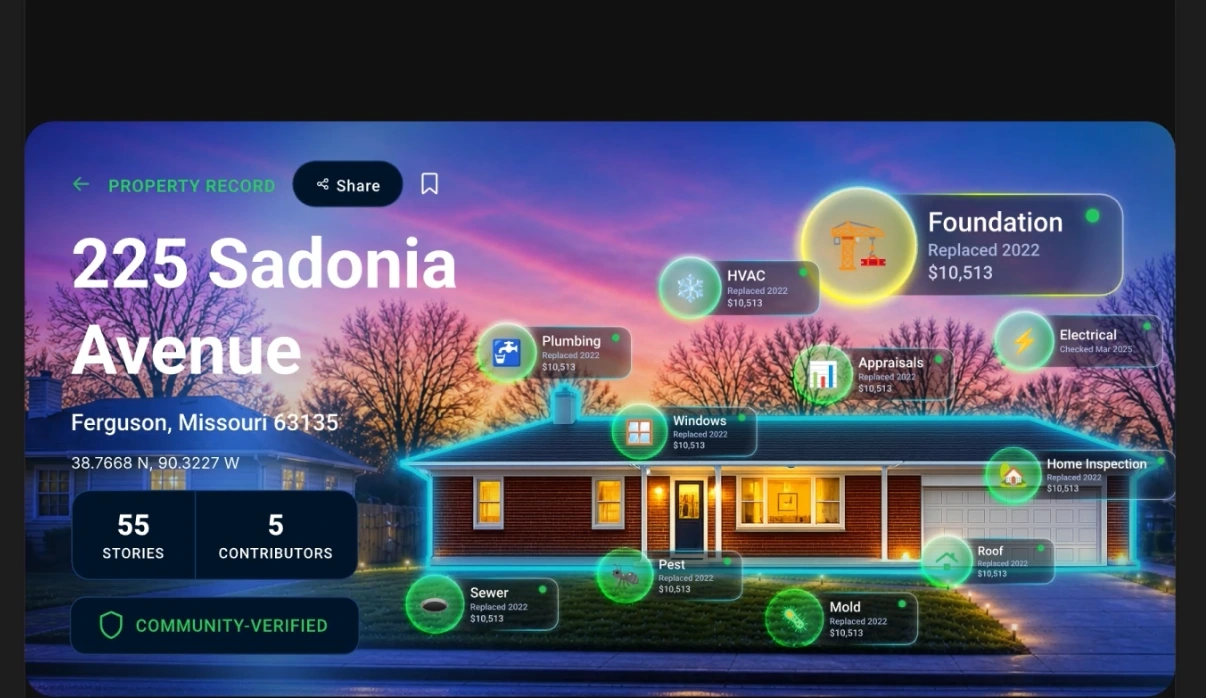
FreshHouse is a property intelligence platform designed to help homeowners and buyers discover verified records about a home's history. The goal was to create an interactive AI experience that transforms an ordinary property photo into a living data entity. When users activate the "Ask This Home" feature, the house enters an AI-powered state where its structure is analyzed, highlighted, and connected to verified property records. While the original concept focused on animating a single predefined house, the challenge quickly evolved into something much more ambitious: How could we create a system capable of animating any house uploaded by a user? The final solution combined JavaScript contour tracing, Rive Data Binding, procedural path generation, custom scripting, and dynamic UI components to create a reusable animation system that could adapt to virtually any property silhouette.
The Challenge👷🏼
Traditional Rive workflows are built around predefined artwork. A designer creates paths, animations, and interactions ahead of time, and those assets remain static once exported. FreshHouse required something different. The platform needed a way to: • • • • • • Accept arbitrary house uploads Detect the shape of the house automatically Rebuild the outline dynamically Animate an AI scanning effect around the structure Display contextual property information Maintain smooth performance inside a web application The biggest technical obstacle was that Rive does not natively support tracing arbitrary uploaded images.The system needed to generate animation data dynamically at runtime
Designing the Solution
The solution was split into two systems:
1. JavaScript Shape Extraction
When a user uploads a house image: • • • • • JavaScript analyzes the image The house silhouette is detected The outline coordinates are extracted The coordinates are normalized into the Rive artboard space X and Y coordinate arrays are generated These coordinates become the blueprint that drives the animation
2. Procedural Path Reconstruction in Rive
Instead of animating a predefined path, Rive receives coordinate information through View Models and Data Binding.
The coordinate data is passed into dedicated properties:
• outlinePointsX
• outlinePointsY
When the tracing trigger is activated:
• Rive rebuilds the shape
• A procedural outline is generated
• The tracing animation follows the uploaded house geometry
• Glow effects activate
• AI particles begin responding around the structure This transforms static image data into a living animation system.
Building the AI Activation Experience
The experience was designed around multiple interaction states.
Idle State
The property remains in its normal visual state.
No glow. No particles. No AI activity.
Activation State
When the user enters AI mode: • • • • The outline begins tracing itself Energy travels around the house perimeter The structure becomes illuminated Window highlights begin to appear This creates the feeling that the property is being analyzed.
Processing State
Once activated:
The outline remains energized
Custom particle systems become active
Glow effects pulse continuously
The house feels alive and responsive
One of the most interesting parts of the project was creating particle behavior that communicated ongoing AI analysis rather than decorative visual effects. The particles were designed to subtly orbit, pulse, and react around the structure to reinforce the concept of an intelligent system reading property history
Records Available State
After processing completes:
Interactive property system icons appear around the house.
Examples include: HVAC Plumbing Sewer Roof Electrical Foundation
These act as data nodes connected to verified property records
Engineering Dynamic UI Components
The icon system was built as reusable Rive components.
Each icon was converted into a component architecture that could be instantiated multiple times throughout the interface. To support dynamic property records:
• Component instances were controlled independently
•Boolean-driven visibility states were created
•Icons could be enabled or disabled individually
•Hover and interaction states were built into each component
A master activation system was also implemented to coordinate icon visibility and transitions throughout the experience. This allowed the developer to control which property systems appeared based on available records.
This allowed the developer to control which property systems appeared based on available records
Also, The Tracing path Effect properties are exposed to the developer at runtime, Developer can makes changes to real time on how the particles and tracing such as speed, glow is affecting any uploaded image.
Leveraging Rive's Runtime Capabilities;
Several advanced Rive features were used throughout the project:
Data Binding;
Used to pass coordinate information from JavaScript into Rive.
View Models;
Used to manage dynamic data and runtime interactions.
Runtime Scripting;
Custom scripts were written to generate procedural behavior and drive visual effects
Path Effects;
Used to reconstruct and animate dynamic house outlines.
State Machines;
Used to coordinate activation, processing, and interaction states
Cross-ViewModel Communication;
Multiple View Models communicated with one another to synchronize UI states and animation logic. This architecture allowed the animation system to remain flexible while keeping developer integration straightforward
Technical Breakthrough
The most significant achievement of this project was proving that Rive could be extended beyond traditional static animation workflows. Instead of animating a single predefined asset, the system became capable of responding to user generated content. The final architecture demonstrated how Rive can function as a procedural animation engine that reacts to data supplied at runtime.
This approach opens possibilities far beyond property visualization, including:
• Dynamic product visualization
• Interactive mapping systems
• AI-assisted interfaces
• Data-driven experiences
• User-generated content workflows
TEST THE LIVE INTERACTION HERE 👇🏽👇🏽👇🏽
Outcome
Check out the Interaction live, click on trace ai to start https://www.freshhouse.co/property/6317-jackson-avenue-berkeley-mo-63134
FreshHouse began as an animation brief.
It evolved into a procedural animation system capable of transforming uploaded property imagery into an interactive AI experience.
By combining contour extraction, Data Binding, runtime scripting, procedural path generation, and reusable UI components, the project pushed Rive beyond its traditional use case and demonstrated how animation can become a responsive part of a product's logic rather than simply a visual layer.
he result is a framework capable of turning static property imagery into an intelligent, interactive, data driven experience
Thanks for Viewing
Like this project
Posted Jun 7, 2026
Transforming Rive from a Static Animation Tool into a Procedural System Capable of Animating Any Uploaded House
Likes
1
Views
25
Clients
Fresh House