Silicon Valley Breaker & Control, A Rebuild and Revenue Demo

Supreme Dream


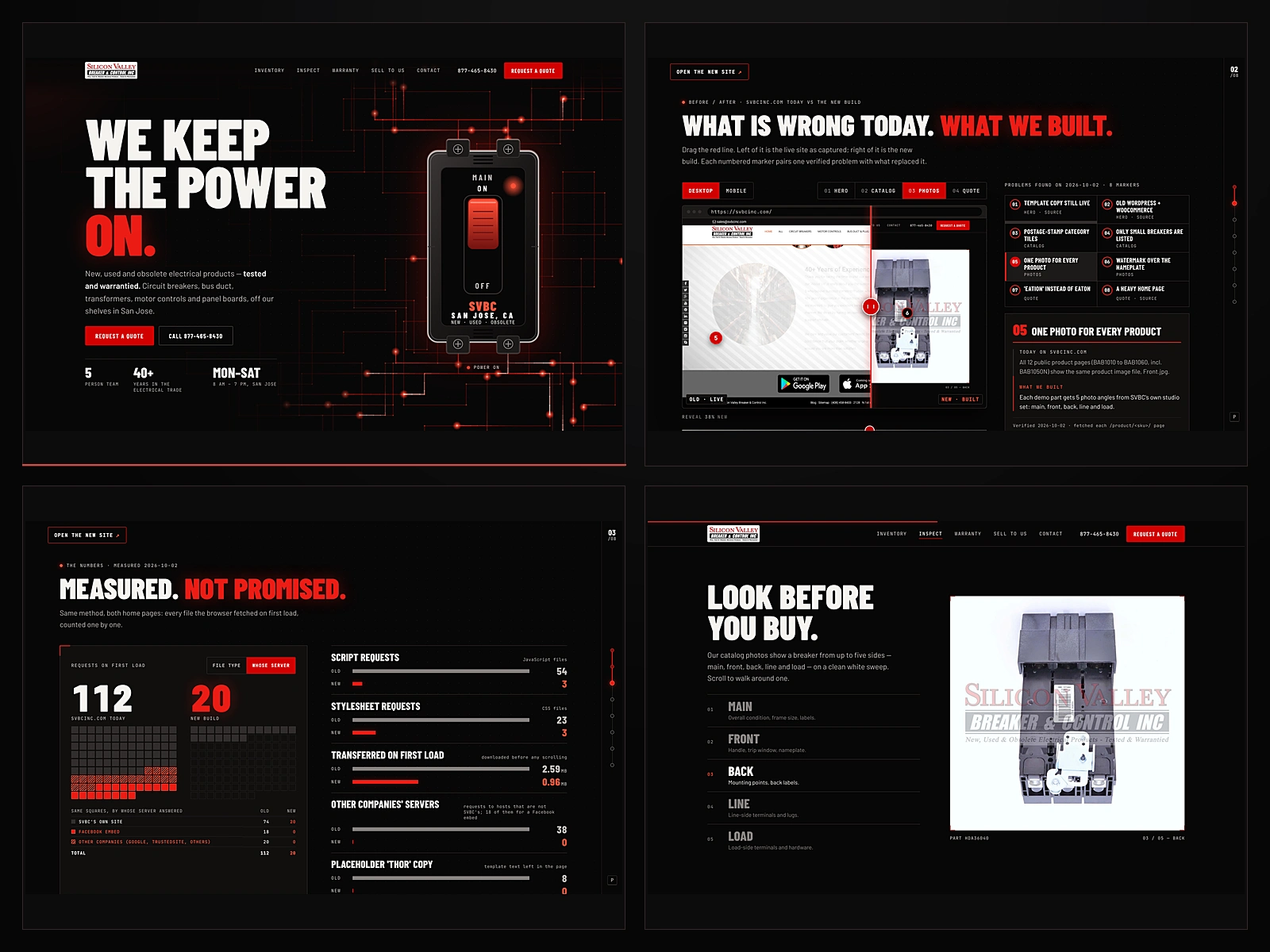
A San Jose electrical parts seller was running a site with template copy still live in production, twelve product pages sharing one photograph, and a home page asking other companies' servers for a third of its files. We rebuilt the site and built a demo that shows the client exactly what changed, scene by scene, with the numbers on screen.
Both pieces are demos we prepared for Silicon Valley Breaker & Control Inc. They are not live on svbcinc.com.
The rebuilt site
The new build keeps the client brand intact: new, used and obsolete electrical products, tested and warranted, with the San Jose shelf as the whole point. The hero is a disconnect switch in the ON position rather than a stock photo, the inventory sections use the client's own warehouse and studio photography, and every product view walks a breaker from five sides.
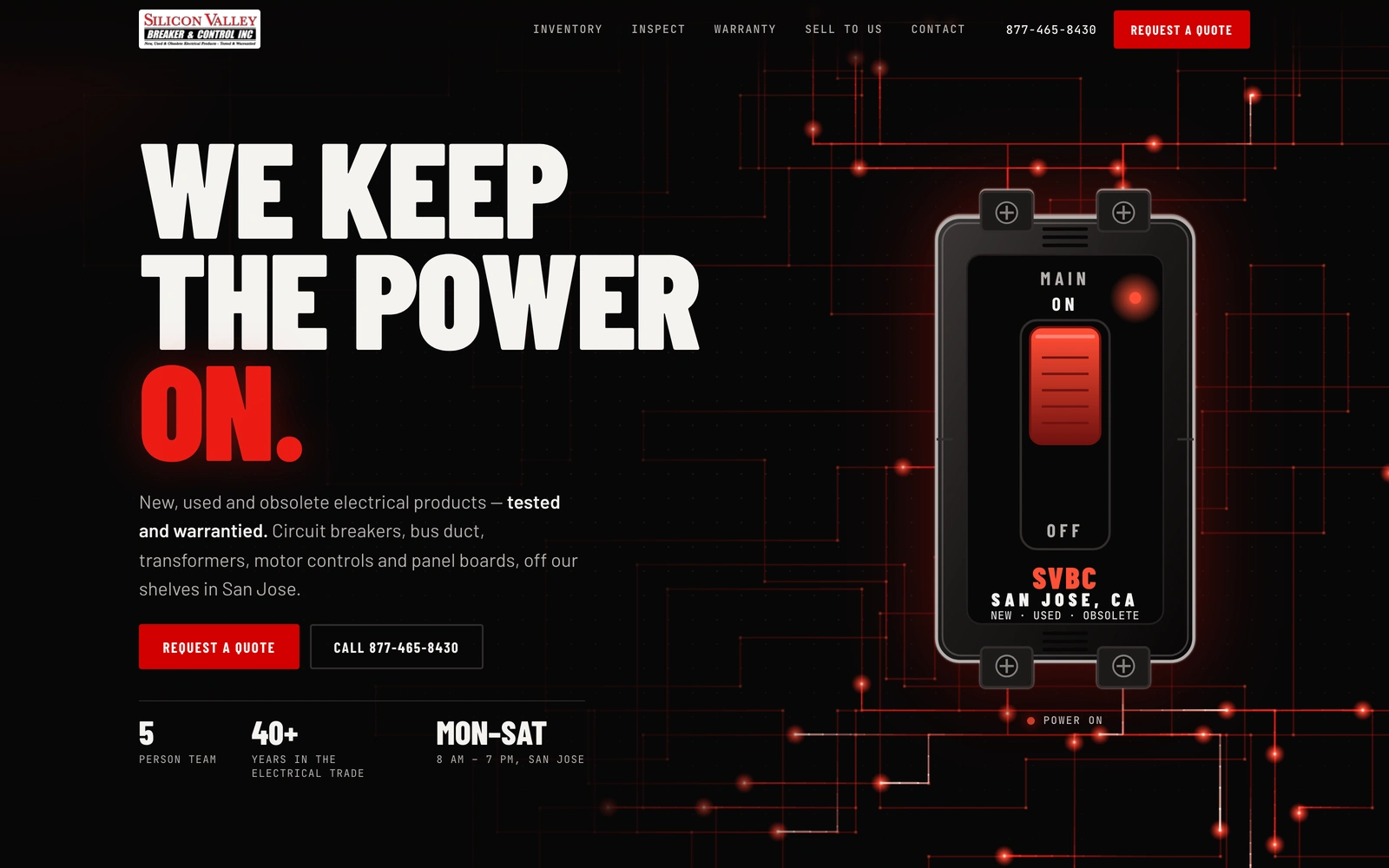
The rebuilt home page: a disconnect switch illustration on a circuit grid, the Keep The Power On headline, and the tested and warranted product line
Measured, not promised
Every claim in this package comes from a measurement, not an opinion. The old home page makes over 110 requests on first load in a representative desktop run. The new build makes 20. Of the old page's total, 38 requests went to other companies' servers, including a Facebook embed, Google Tag Manager, Google Analytics, a TrustedSite badge, Google Fonts and an Amazon S3 host. The new build makes zero requests to anyone else.
Script requests drop from 54 to 3. Stylesheets from 23 to 3. Bytes on first load from 2.59 MB to 0.96 MB. The old page source still contains eight mentions of template placeholder copy about lightning bolts and Thor, in an area labelled Inventory Ready To Ship. The new build has zero.
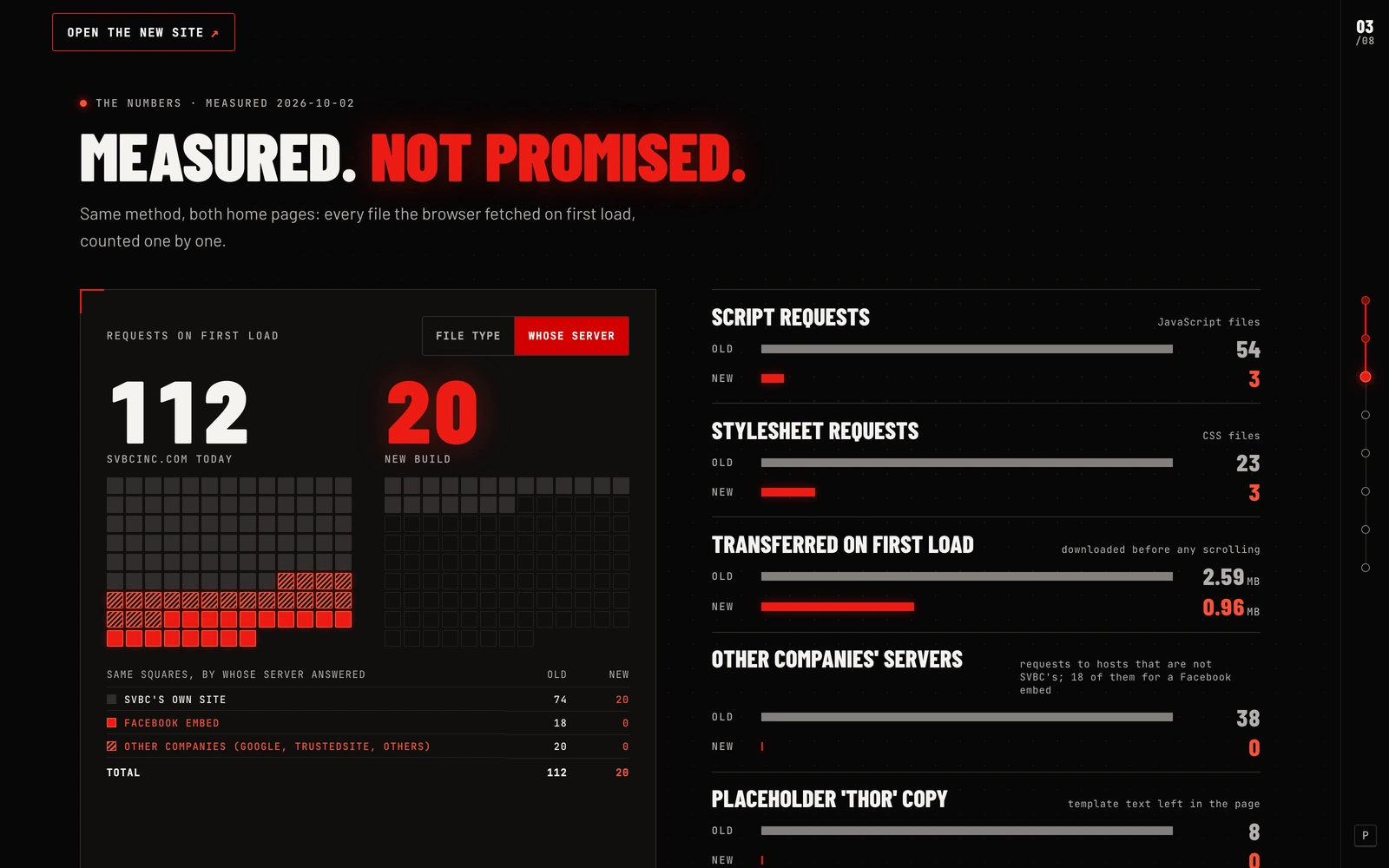
The proof scene: requests on first load shown as waffle grids, 112 against 20, with bars for scripts, stylesheets, bytes, third-party requests and the Thor placeholder
One caveat is stated on screen in the demo. The new build was measured locally, so it proves request counts, byte counts and script counts. It does not claim a speed in seconds.
A drag line instead of a slide deck
The first scene is a before and after you control. Drag a red line across and the captured old page gives way to the rebuilt page, on desktop or phone. Eight numbered markers sit on the surface, and each pairs a specific problem with the thing that replaced it.
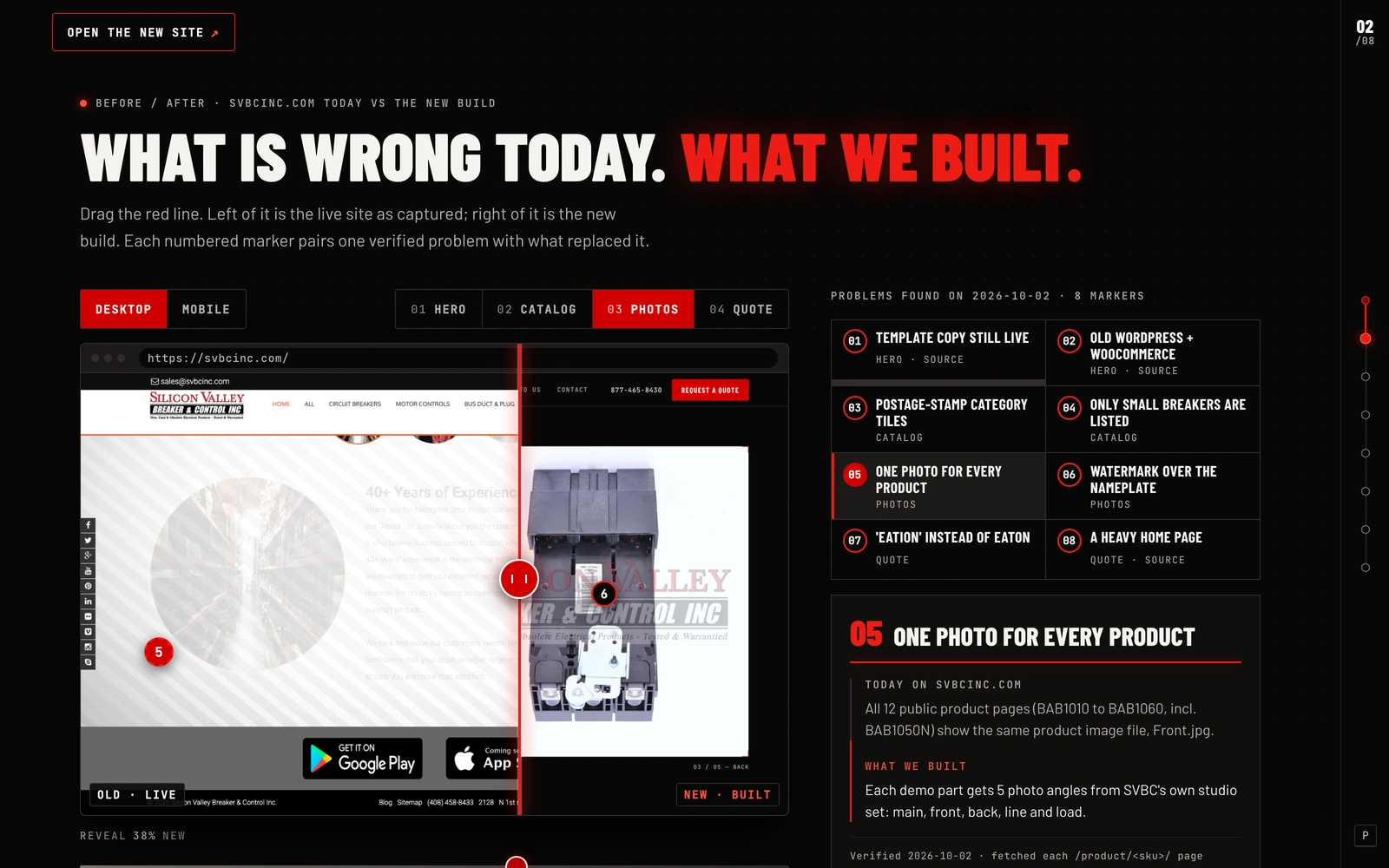
The compare scene with the drag line moved across, the old site fading out on the left and the new build on the right, and a marker open showing one photo for every product
The clearest example is the photographs. All twelve public product pages on the old site loaded the same image file, so a buyer could not tell one breaker from another. The new build photographs each part from main, front, back, line and load, and the demo shows the label being read off the part.
Every spec earns its row
Specifications are where a parts site usually stops. Each spec on screen carries one of three states. Read is text we could read off the label. Inferred is marked as needing verification. Not legible is left empty. A completion meter counts how much of a part's data is actually read, so nothing is quietly padded.
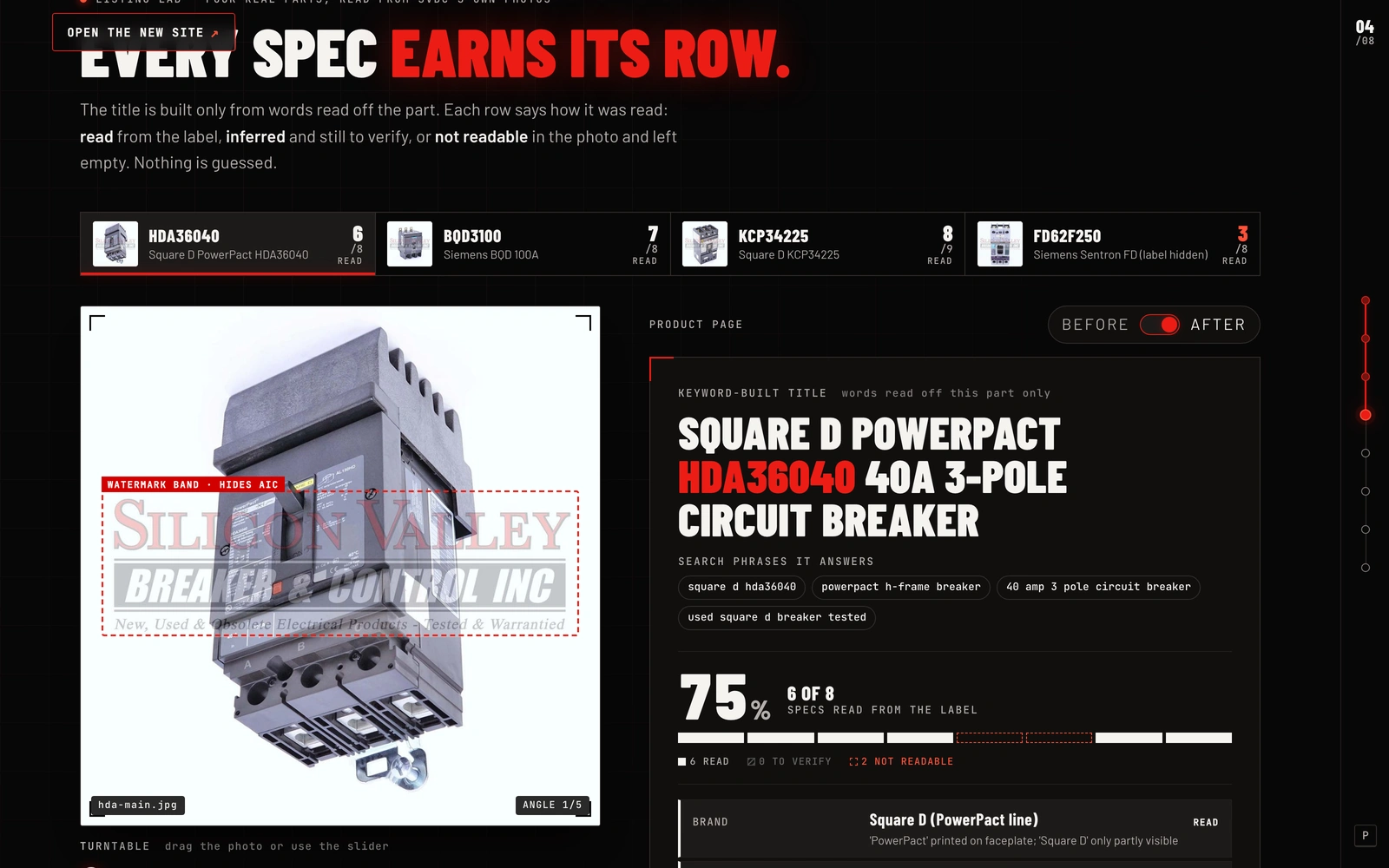
The listing scene: a breaker photograph with the nameplate region highlighted, a spec table beside it, and the completeness meter showing 75 percent read from the label
Quote intake is rules, not magic
The intake scene takes a customer's own words, like asking whether you have a 100 amp three pole Cutler-Hammer breaker. Plain pattern matching pulls out the part type, the manufacturer, the amps, the poles and the quantity. Anything it cannot find is marked missing, and the scene proposes the one question to ask next.
This is deterministic JavaScript and nothing else. The same sentence gives the same result every time, the demo says so on screen, and a person still writes the quote.
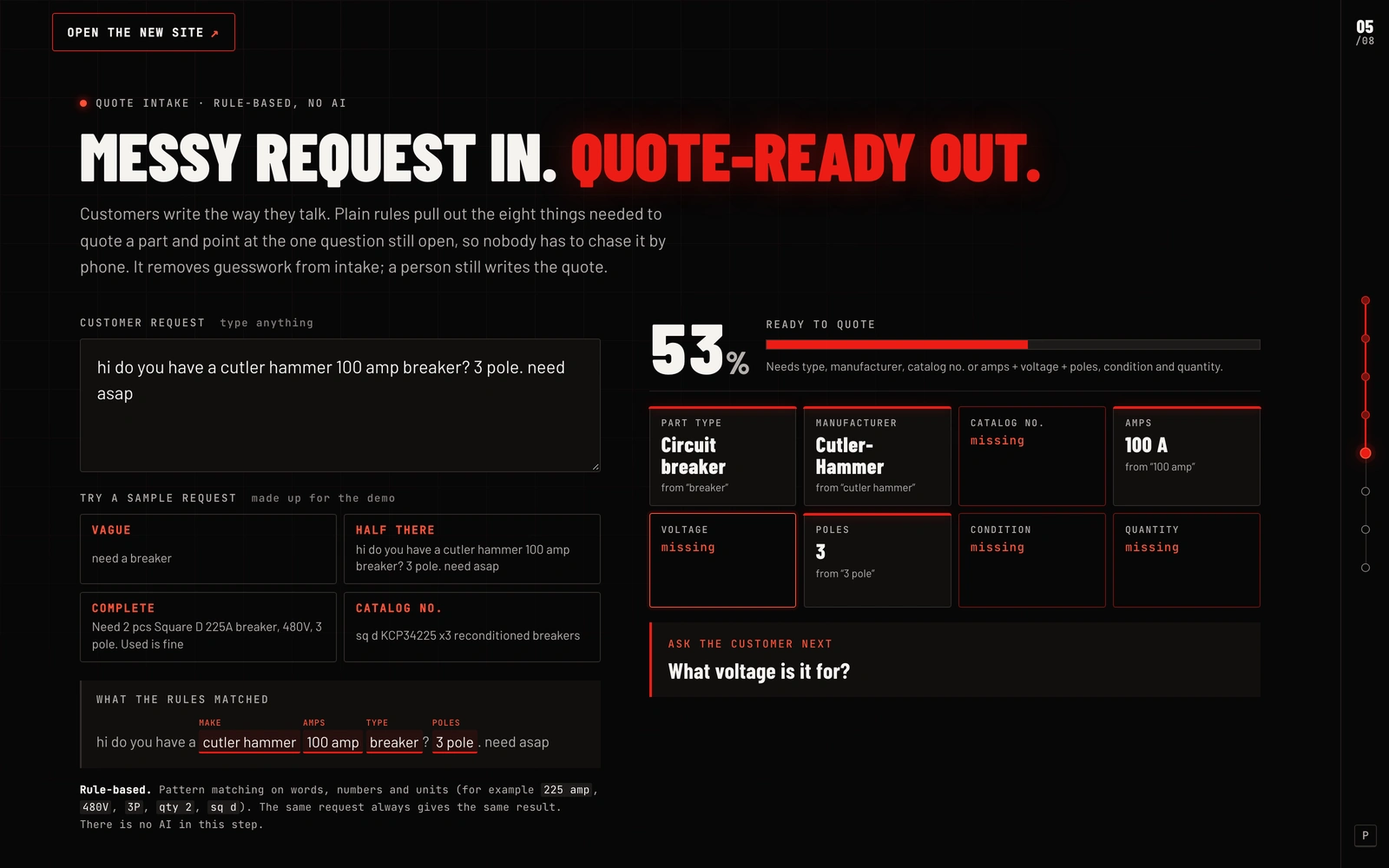
The intake scene with a customer's typed request on the left, the extracted quote fields on the right, four marked missing, and the follow-up question asking about voltage
The search carries over
Earlier work on this client was the catalog, a searchable index built by crawling the site because there was no usable API, with the specs decoded out of hidden taxonomies. That search is why this rebuild can show product pages instead of a contact form. The final scene hands the decision back: price, margin and extra sales are editable examples, the client types what they would invest, and the demo shows profit per sale, the annual total and how many extra sales cover it.
The site is static HTML, CSS and JavaScript with GSAP for the demo transitions. It was checked from 320 to 1920 pixels with no horizontal overflow, keyboard operable, and a calm static version under reduced motion.

The rebuilt home page at phone width, with the headline, both buttons and the business facts all intact
See it live: the rebuilt site and the interactive demo
If you run a catalogue business and your site is quietly costing you quotes, tell us what is broken and we will rebuild the part buyers actually use.
More work: givemeprompts.com/work
Like this project
Posted Oct 4, 2026
A rebuilt website demo for a San Jose electrical supplier, plus an interactive demo that measures the old site and shows the new build working.