
Stellar Anomaly Detection — Python
Independent Research | Python | Data Analysis | Machine Learning
Project overview
Developed an exploratory machine learning workflow to investigate unusual brightness variations in astronomical observations from NASA's Kepler space telescope.
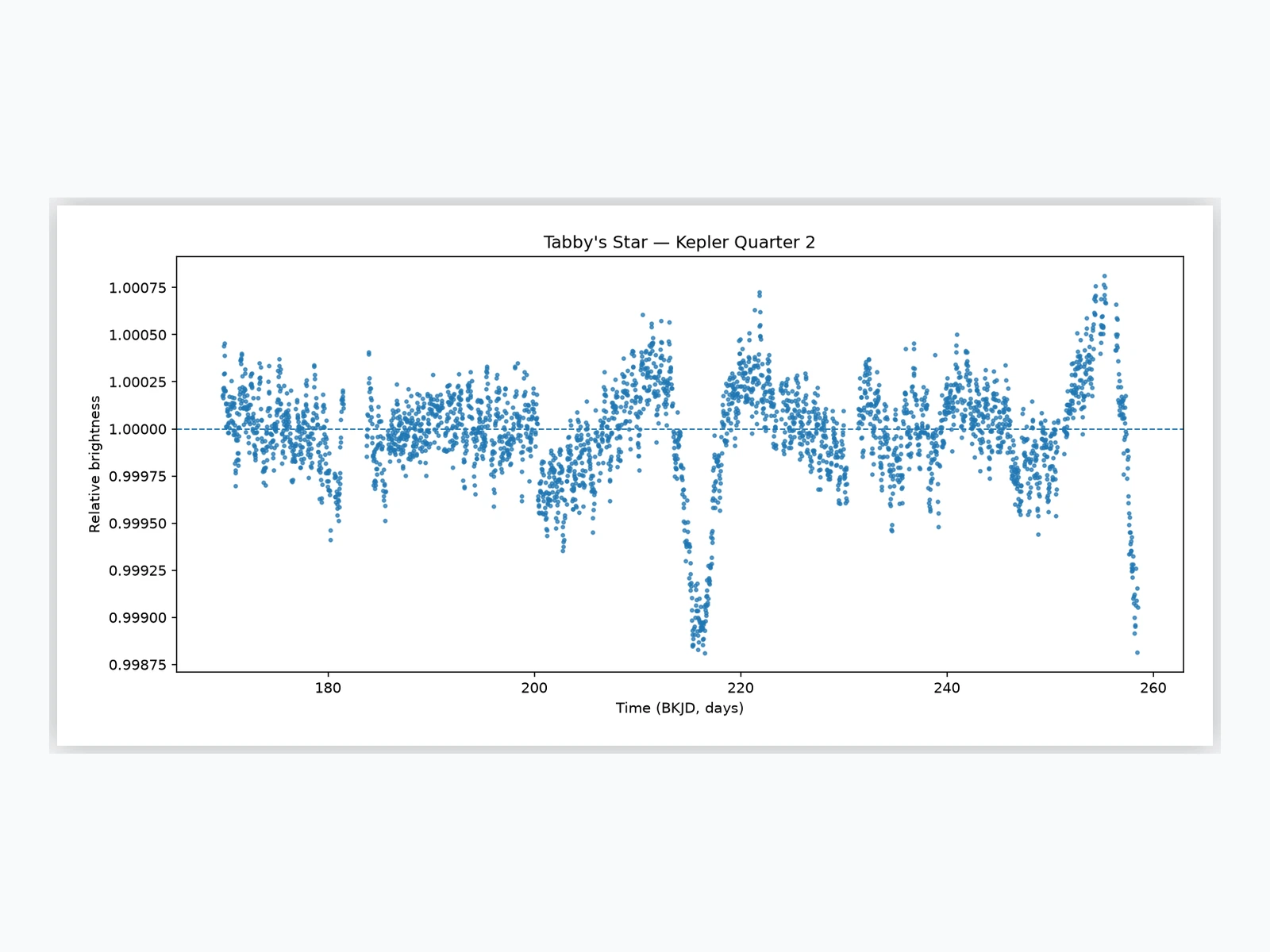
The project examined KIC 8462852 (Tabby's Star), using real observational data rather than synthetic examples.
What I built
Processed Kepler Quarter 2 light-curve data using Python and scientific computing libraries.
Filtered observations using data-quality flags, retaining 3,217 usable measurements.
Implemented a statistical anomaly-detection baseline using the median and median absolute deviation (MAD).
Applied an Isolation Forest model to identify unusual observations.
Compared both approaches and visualized the resulting light curve.
Results
The statistical baseline identified 89 candidate anomalies, while Isolation Forest identified 97. Both approaches agreed on 77 observations.
The comparison produced a Jaccard similarity of approximately 0.706.
These results describe agreement between detection methods, not confirmed astrophysical discoveries. The analysis is limited to one Kepler quarter and lacks independently labeled anomalies.
Technical strengths demonstrated
Python programming, scientific data processing, anomaly detection, machine learning, statistical comparison, and data visualization.
0 likes · 0 views · Oct 30, 2026
Built Python anomaly detectors for Kepler observations and evaluated MAD against Isolation Forest using 48 injected brightness reductions in held-out data.

