Blog Post: 7 Bookkeeping Mistakes Small Businesses Make

Oscar Guardado

Concept piece for a fictional bookkeeping firm. The firm is invented; the tax and record-keeping facts in the post are cited to the IRS and the U.S. Small Business Administration.
The brief
A small bookkeeping firm wanted a search-friendly blog post that brings in small-business owners who still do their own books and are starting to feel the cost of small mistakes. The post had to target the phrase "small business bookkeeping mistakes", run about 1,200 words, back every factual claim with an official source, and give readers something they can fix this week, without giving tax advice or overselling the firm.
Our approach
Search intent: readers want a list they can check themselves against, so the title promises seven mistakes and the intro says right away what each section gives them.
Repeatable structure: every mistake follows the same pattern of why it costs you, what the official source says, and one practical tip.
Sources over opinions: each rule, threshold and time limit links back to an IRS or SBA page, listed in full at the end.
Voice: plain and friendly for owners who didn't start a business to do bookkeeping, with no jargon left unexplained.
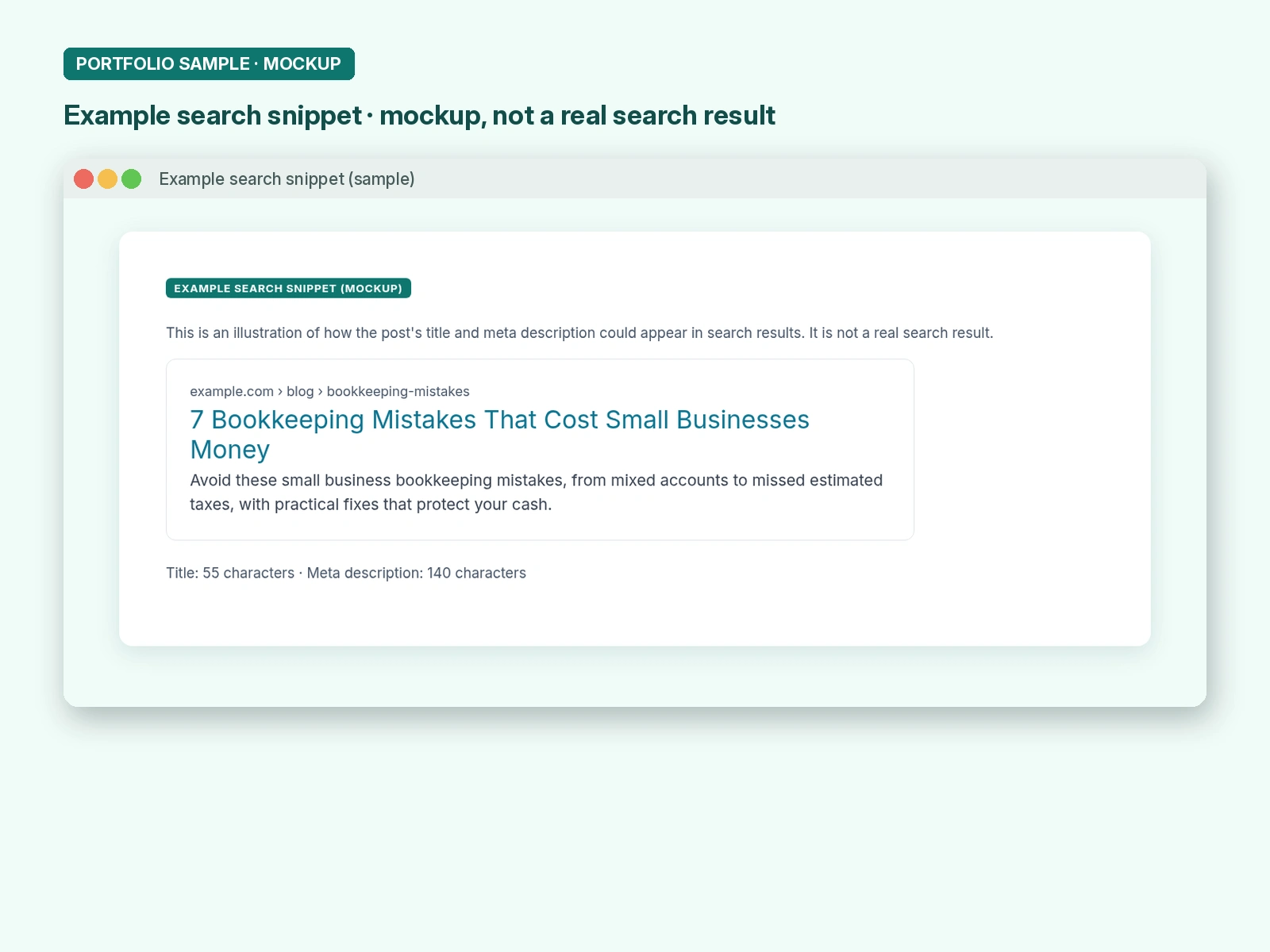
Soft CTA: pick one mistake to fix this week, or hand the details to a qualified bookkeeper or CPA. We also wrote a 55-character meta title and a 140-character meta description.
The piece
Meta title: 7 Bookkeeping Mistakes That Cost Small Businesses Money
Meta description: Avoid these small business bookkeeping mistakes, from mixed accounts to missed estimated taxes, with practical fixes that protect your cash.
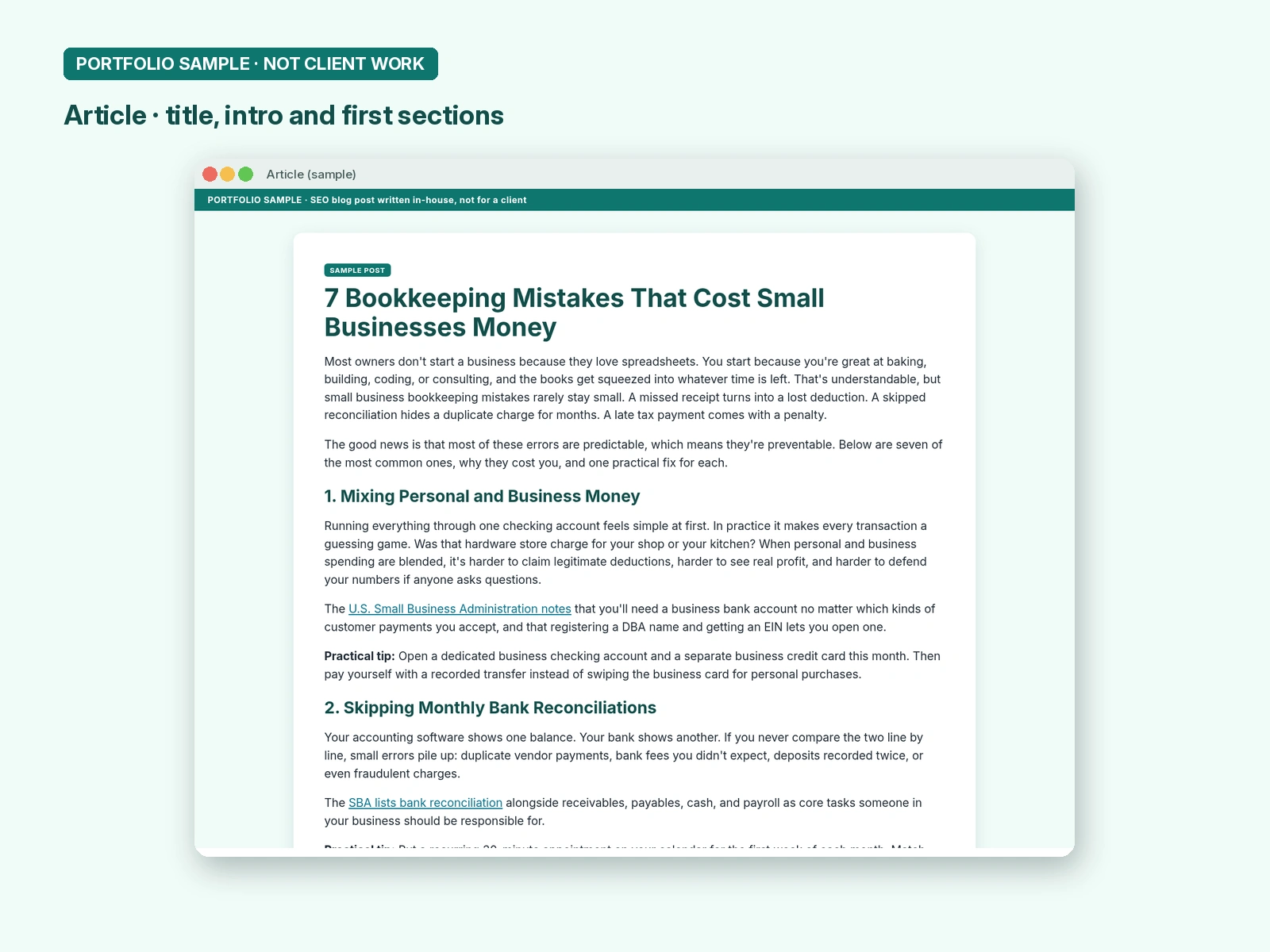
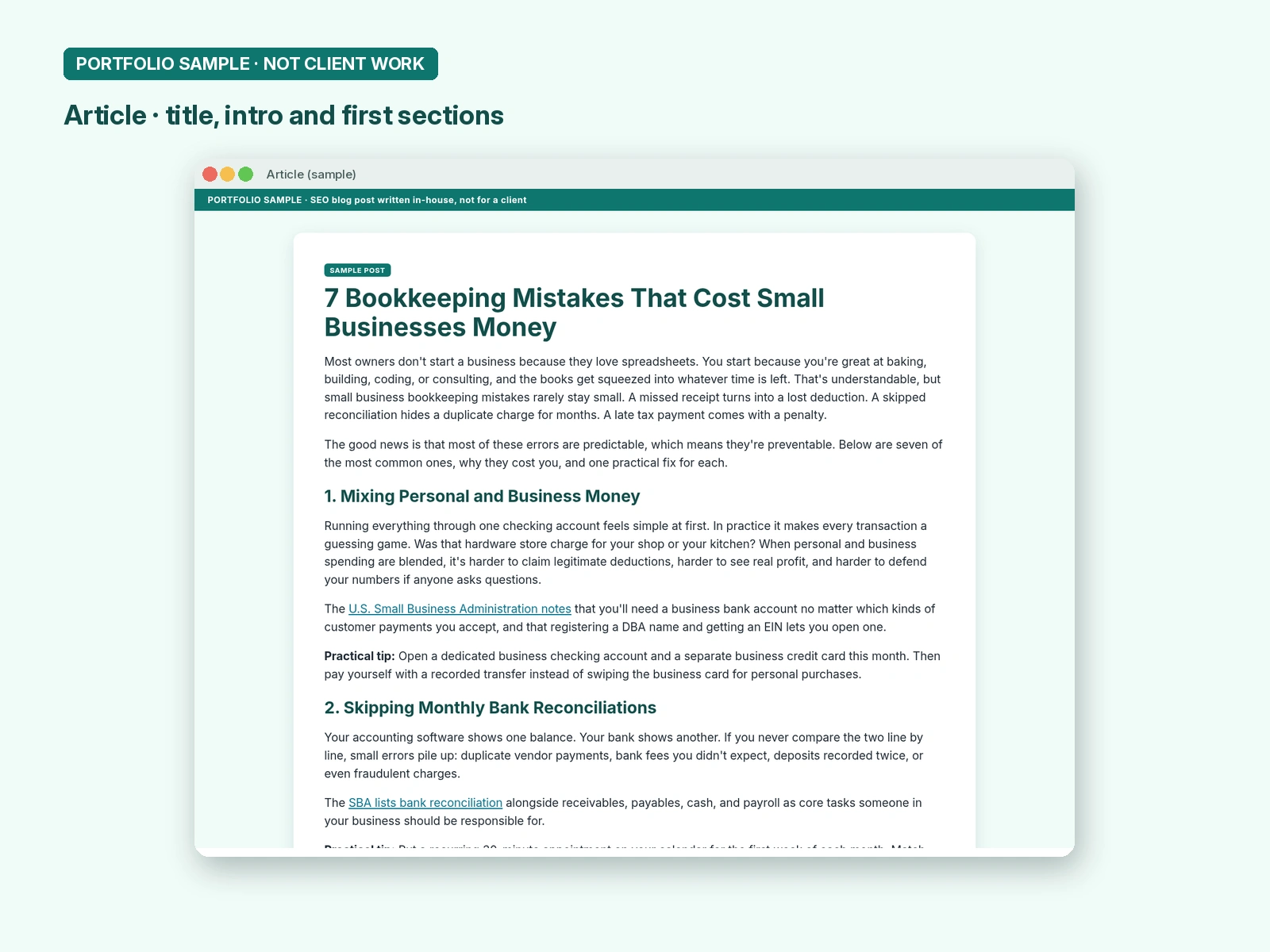
7 Bookkeeping Mistakes That Cost Small Businesses Money
Most owners don't start a business because they love spreadsheets. You start because you're great at baking, building, coding, or consulting, and the books get squeezed into whatever time is left. That's understandable, but small business bookkeeping mistakes rarely stay small. A missed receipt turns into a lost deduction. A skipped reconciliation hides a duplicate charge for months. A late tax payment comes with a penalty.
The good news is that most of these errors are predictable, which means they're preventable. Below are seven of the most common ones, why they cost you, and one practical fix for each.
1. Mixing Personal and Business Money
Running everything through one checking account feels simple at first. In practice it makes every transaction a guessing game. Was that hardware store charge for your shop or your kitchen? When personal and business spending are blended, it's harder to claim legitimate deductions, harder to see real profit, and harder to defend your numbers if anyone asks questions.
The U.S. Small Business Administration notes that you'll need a business bank account no matter which kinds of customer payments you accept, and that registering a DBA name and getting an EIN lets you open one.
Practical tip: Open a dedicated business checking account and a separate business credit card this month. Then pay yourself with a recorded transfer instead of swiping the business card for personal purchases.
2. Skipping Monthly Bank Reconciliations
Your accounting software shows one balance. Your bank shows another. If you never compare the two line by line, small errors pile up: duplicate vendor payments, bank fees you didn't expect, deposits recorded twice, or even fraudulent charges.
The SBA lists bank reconciliation alongside receivables, payables, cash, and payroll as core tasks someone in your business should be responsible for.
Practical tip: Put a recurring 30-minute appointment on your calendar for the first week of each month. Match every transaction in your books to your bank and card statements, and investigate anything that doesn't line up.
3. Losing Receipts and Tossing Records Too Soon
When documentation goes missing, so do deductions. And throwing records away too early can leave you exposed if your return is ever questioned.
The IRS says you generally need to keep records that support income, deductions, or credits until the period of limitations for that return runs out. For many situations that's three years, but it can be longer: six years if you underreport income by more than 25% of the gross income on your return, seven years for bad debt or worthless securities claims, and at least four years for employment tax records.
Practical tip: Snap a photo of every receipt the day you get it and store it in a cloud folder or your accounting app. Organize by tax year, and check the IRS retention rules before you delete anything.
4. Forgetting About Estimated Taxes
If you're used to a paycheck with taxes withheld, self-employment can bring an unpleasant surprise. According to the IRS, taxes must be paid as you earn income during the year. Sole proprietors, partners, and S corporation shareholders generally have to make estimated payments if they expect to owe $1,000 or more, and corporations generally must if they expect to owe $500 or more.
Underpay, or pay late, and you may face a penalty, even if you end up getting a refund when you file.
Practical tip: Move a set percentage of every payment you receive into a separate tax savings account. Use Form 1040-ES (or work with your accountant) to estimate what you owe, and put the four quarterly due dates in your calendar with reminders a week ahead.
5. Misclassifying Workers
Calling someone a contractor when they're really working like an employee can look like a way to save on payroll costs. It can backfire badly. The SBA warns that if a contractor turns out to meet the legal definition of an employee, you may have to pay back taxes and penalties, provide benefits, and reimburse wages required under the Fair Labor Standards Act.
Classification affects withholding, filings, and records, so it's a bookkeeping issue too.
Practical tip: Before you bring anyone on, review the IRS guidance on whether a worker is an independent contractor or an employee, and document why you chose the classification. If the answer isn't clear, ask a CPA or employment attorney before the first payment goes out.
6. Not Understanding Your Accounting Method
Cash or accrual? Many owners never consciously choose, and that can make reports misleading. As the SBA explains, the accrual method records a sale when it happens, while the cash method records it only when the payment arrives. A January sale paid in February lands in different months depending on the method.
Neither is wrong, but each tells a different story. Cash accounting shows cash flow clearly but offers less long-term insight. Accrual gives a fuller picture of performance but is more complex to manage. Confusing the two can lead you to think you're flush when cash is actually tight, or vice versa.
Practical tip: Confirm which method your books use and stick with it consistently. If you track on a cash basis, also keep a simple list of unpaid invoices and bills so you can see what's coming.
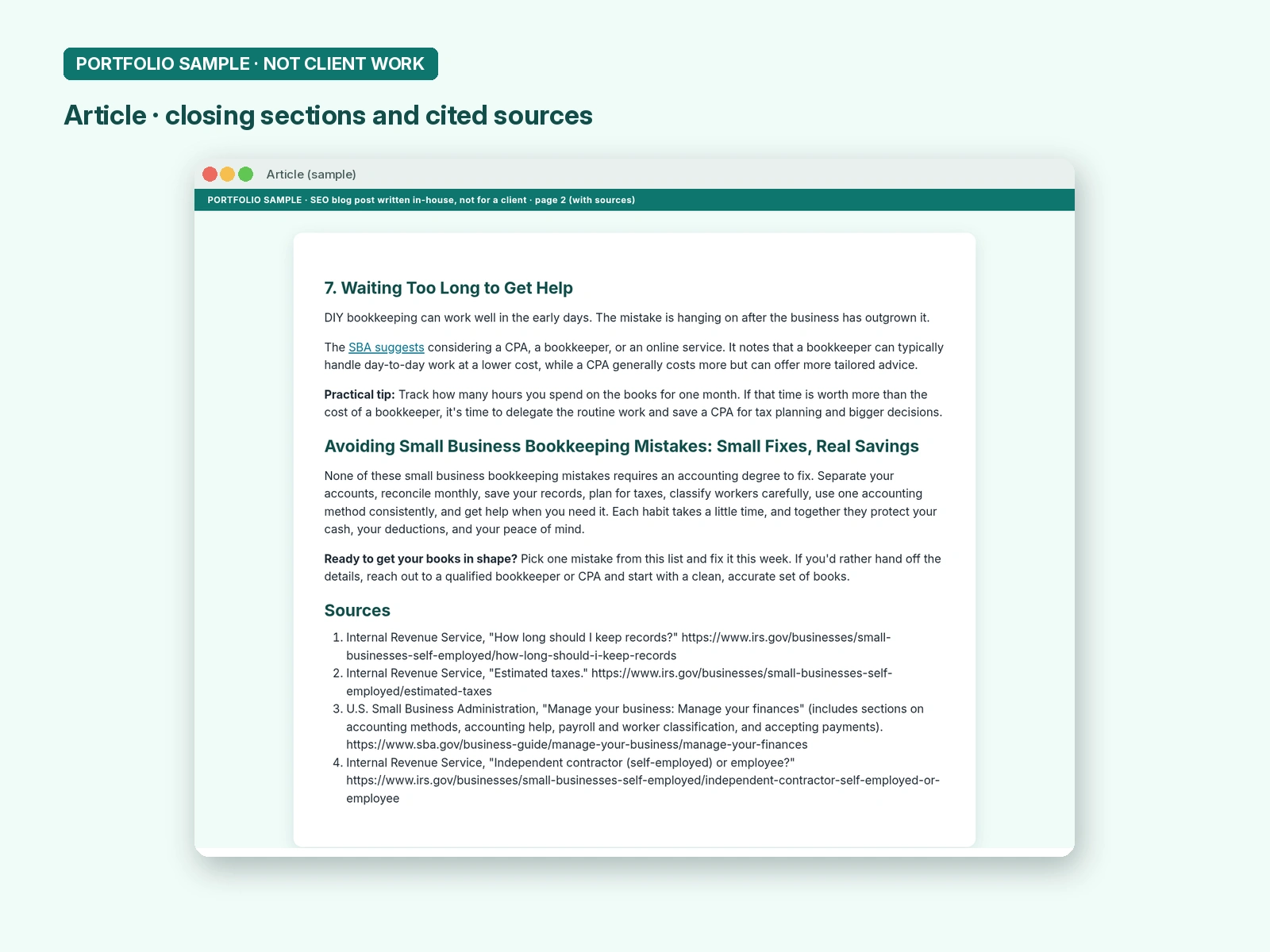
7. Waiting Too Long to Get Help
DIY bookkeeping can work well in the early days. The mistake is hanging on after the business has outgrown it.
The SBA suggests considering a CPA, a bookkeeper, or an online service. It notes that a bookkeeper can typically handle day-to-day work at a lower cost, while a CPA generally costs more but can offer more tailored advice.
Practical tip: Track how many hours you spend on the books for one month. If that time is worth more than the cost of a bookkeeper, it's time to delegate the routine work and save a CPA for tax planning and bigger decisions.
Avoiding Small Business Bookkeeping Mistakes: Small Fixes, Real Savings
None of these small business bookkeeping mistakes requires an accounting degree to fix. Separate your accounts, reconcile monthly, save your records, plan for taxes, classify workers carefully, use one accounting method consistently, and get help when you need it. Each habit takes a little time, and together they protect your cash, your deductions, and your peace of mind.
Ready to get your books in shape? Pick one mistake from this list and fix it this week. If you'd rather hand off the details, reach out to a qualified bookkeeper or CPA and start with a clean, accurate set of books.
Sources
Internal Revenue Service, "How long should I keep records?" https://www.irs.gov/businesses/small-businesses-self-employed/how-long-should-i-keep-records
Internal Revenue Service, "Estimated taxes." https://www.irs.gov/businesses/small-businesses-self-employed/estimated-taxes
U.S. Small Business Administration, "Manage your business: Manage your finances" (covers accounting methods, accounting help, payroll and worker classification, and accepting payments). https://www.sba.gov/business-guide/manage-your-business/manage-your-finances
Internal Revenue Service, "Independent contractor (self-employed) or employee?" https://www.irs.gov/businesses/small-businesses-self-employed/independent-contractor-self-employed-or-employee
What it shows and how we'd adapt it for you
This piece shows how we write a search-focused post that stays accurate: one keyword, a structure readers can skim, and every rule tied to an official source. For your firm, we would pick topics your clients actually ask about, match your voice, and point the closing step to your own services. That is what we deliver in our SEO Blog Writing for Finance & Bookkeeping service on Contra.
Like this project
Posted Oct 20, 2026
Concept piece for a fictional bookkeeping firm. A cited ~1,100-word SEO post with H2 structure, meta title and description, and IRS and SBA sources.
Likes
0
Views
0