
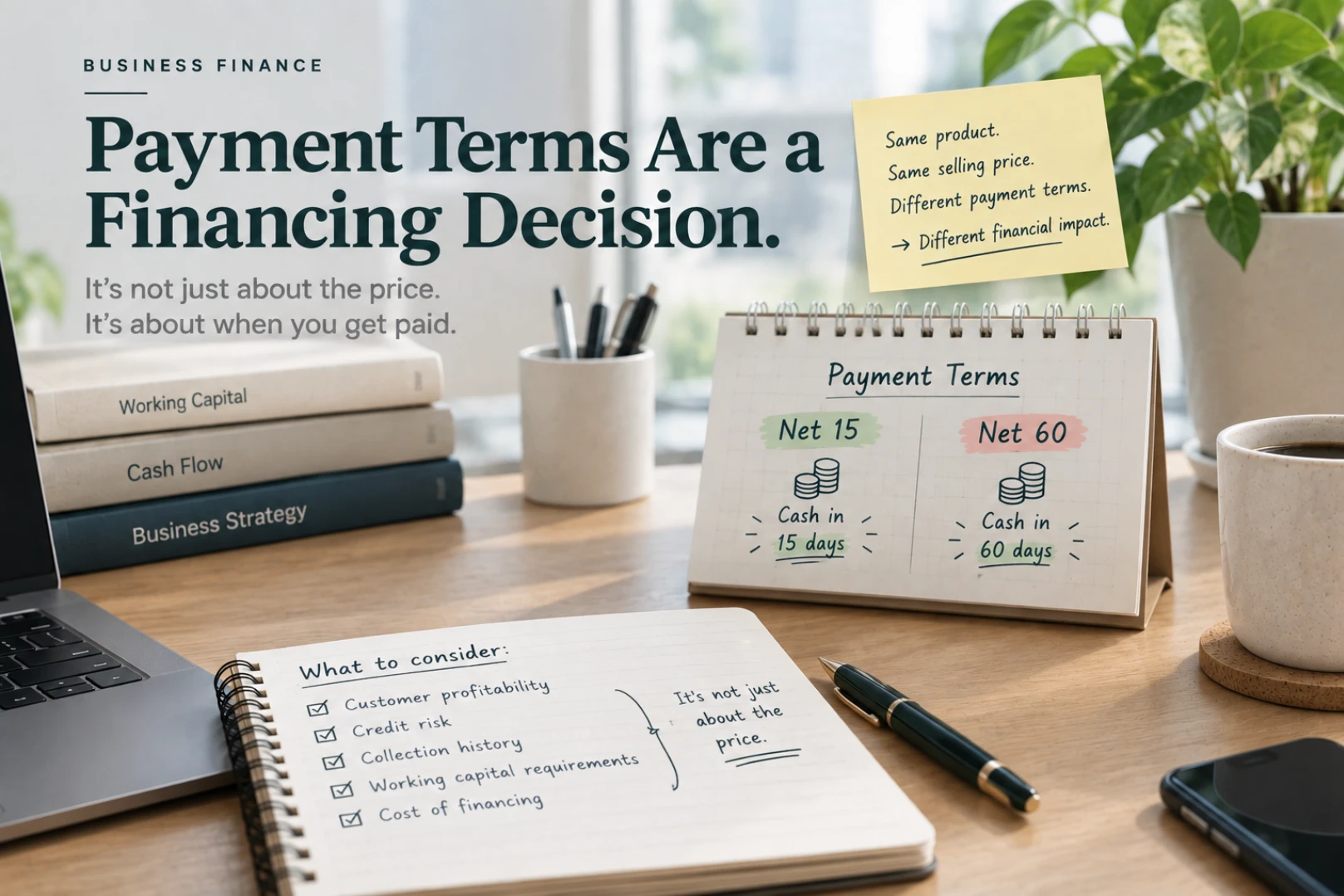
“Net 60” sounds like a payment term.
But financially, it can also be a financing decision.
Imagine you sell $100,000 of products to a customer.
They don't pay today.
They pay in 60 days.
That means your business may need to fund:
→ Inventory
→ Staff costs
→ Shipping
→ Supplier payments
→ Other operating expenses
for up to two months before receiving the cash from that sale.
Now imagine another customer offers to pay within 15 days.
Same product.
Same selling price.
But financially, the two customers aren't exactly the same.
The difference is how long your cash is tied up.
This is why payment terms should be considered alongside:
→ Customer profitability
→ Credit risk
→ Collection history
→ Working capital requirements
→ Cost of financing
For example:
Customer A generates $20,000 of gross profit but pays in 90 days.
Customer B generates $18,000 of gross profit but pays in 15 days.
The $2,000 difference in gross profit doesn't tell the whole story.
If serving Customer A requires the business to borrow money or carry significantly more working capital, the financing cost may change the economics.
So when negotiating a contract, the question shouldn't only be:
“What price can we get?”
It can also be:
“When do we actually get paid?”
Because revenue has a timing dimension.
And sometimes, the timing of the cash matters almost as much as the amount.
Do you think businesses pay enough attention to payment terms when evaluating a customer or contract?
#BusinessFinance #WorkingCapital #CashFlow #FinancialAnalysis #FPandA #BusinessStrategy #B2B #SmallBusiness
0 likes · 0 views · Sep 25, 2026
“Net 60” sounds like a payment term. But financially, it can also be a financing decision. Imagine you sell $100,000 of products to a customer. They don't pa...
