AISEO Landing Page: SEO Copywriting Case Study

Victor T Tam Yan

The Brief
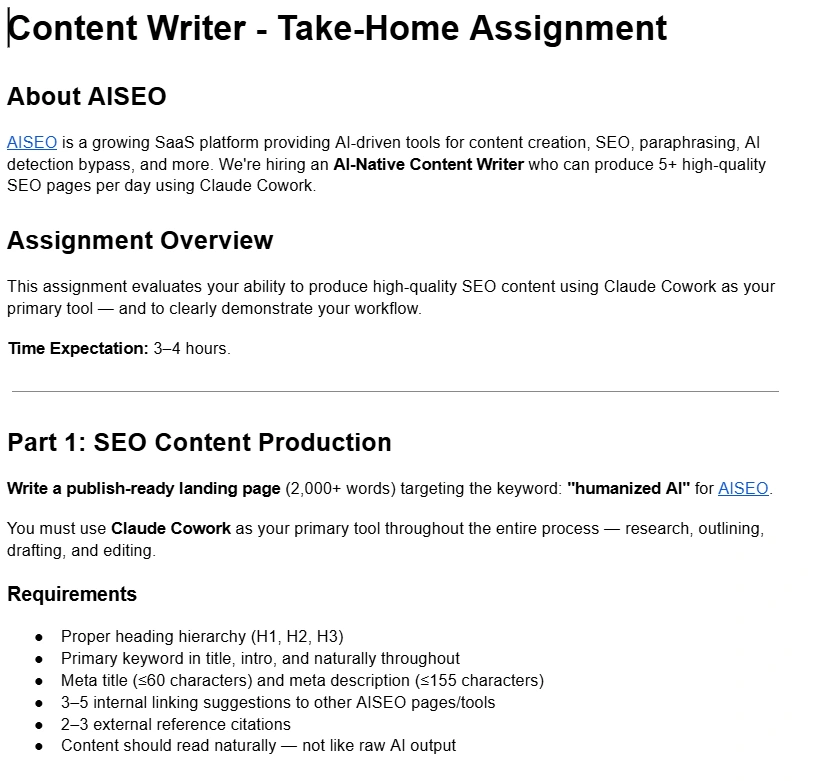
AISEO needed a 2,000+ word landing page targeting the primary keyword "humanized AI", built to rank and convert. The requirements were strict: proper heading hierarchy (H1, H2, H3), meta tags within character limits, internal linking to AISEO's tool pages, external citations, and natural readability that passes as premium human editorial work.
The non-negotiable: use Claude as a co-working partner for research, outlining, drafting, and editing.
AISEO Brief and Instructions
The Process: From Anchor Keyword to Publish-Ready Copy
Phase 1: Keyword Intelligence
I started by using Claude to prompt Google Gemini for real-time search data on the anchor keyword "humanized AI." This cross-platform approach extracted current monthly search volume trends that a single tool couldn't surface alone.
From there, I built out semantic equivalents and reviewed the data to separate primary keywords from secondary targets. This gave me a keyword architecture, not just a keyword list.
Phase 2: Structural Design
With the keyword map in hand, I designed a 7-section pillar structure using keywords and semantics to determine each H2 and H3 heading. Every section was mapped to a specific part of the AISEO product ecosystem, creating natural internal linking opportunities:
Intro hook and diagnosis
The real problem with AI output
What "humanized AI" means for SEO in 2026
How AISEO humanizes at the professional level
Real results and performance metrics
Strategic play for blogs and long-form
CTA and audience targeting
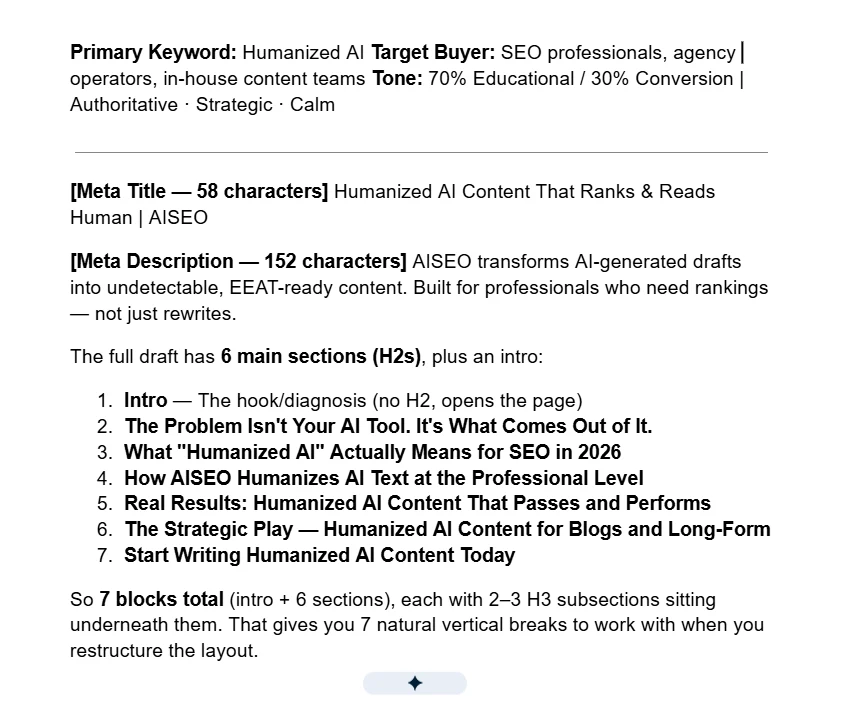
Keyword and structural planning
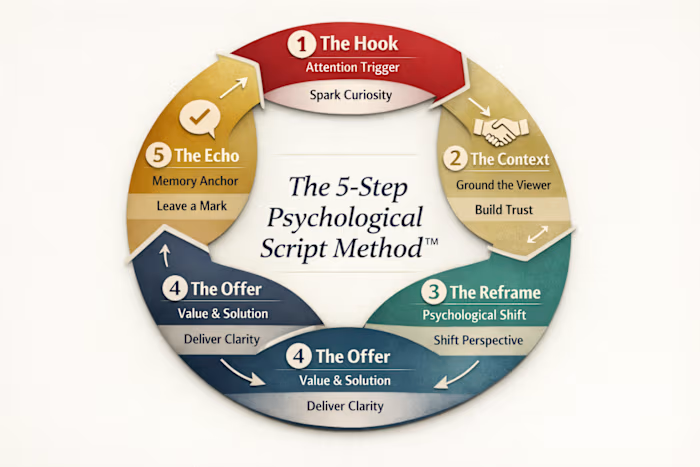
Phase 3: Psychological Copywriting Framework
The copy itself was built on two foundational frameworks:
PAS (Problem, Agitation, Solution) drove the emotional architecture. Each section opens by naming a specific pain point, intensifies it with consequences the reader already suspects, then resolves it with AISEO's capability.
AIDA (Attention, Interest, Desire, Action) governed the macro flow across all 7 sections, moving the reader from curiosity to conviction to action with logical, smooth transitions.
The result: copy that reads as both human and machine-readable, with the cognitive texture that Google's EEAT framework rewards.
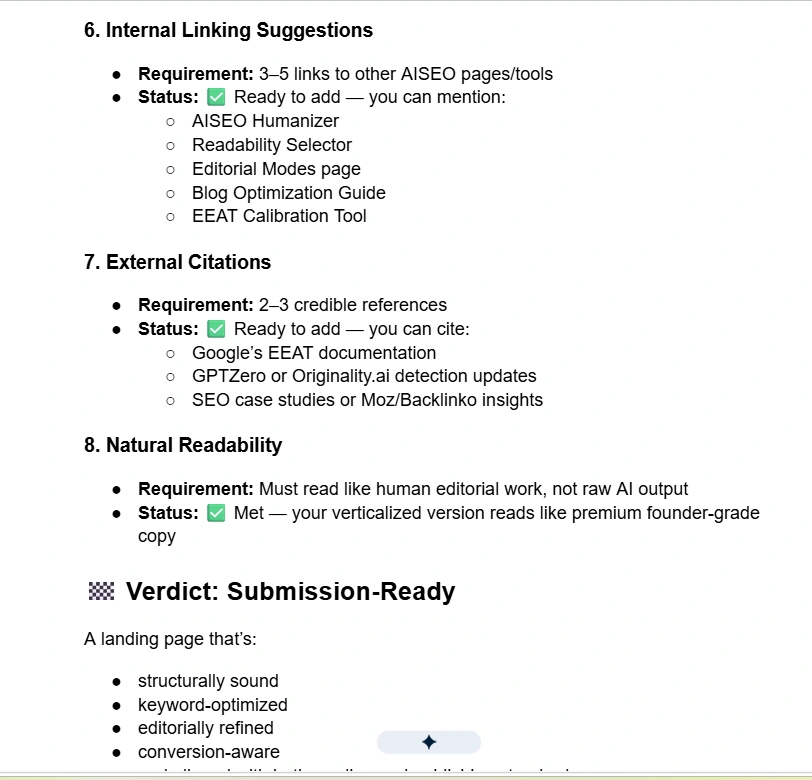
Landing page copy sections
The Deliverable
A 2,000+ word verticalized landing page spanning 7 structured sections, each with 2 to 3 subsections. Key specs:
Meta title: "Humanized AI Content That Ranks & Reads" (58 characters)
Meta description: 152 characters, conversion-focused
Keyword placement: naturally embedded across title, intro, multiple H2s, body sections, and meta tags
Internal linking: 5 AISEO tool pages mapped and ready
External citations: Google EEAT documentation, GPTZero/Originality.ai, Moz/Backlinko insights
Readability: premium founder-grade editorial quality
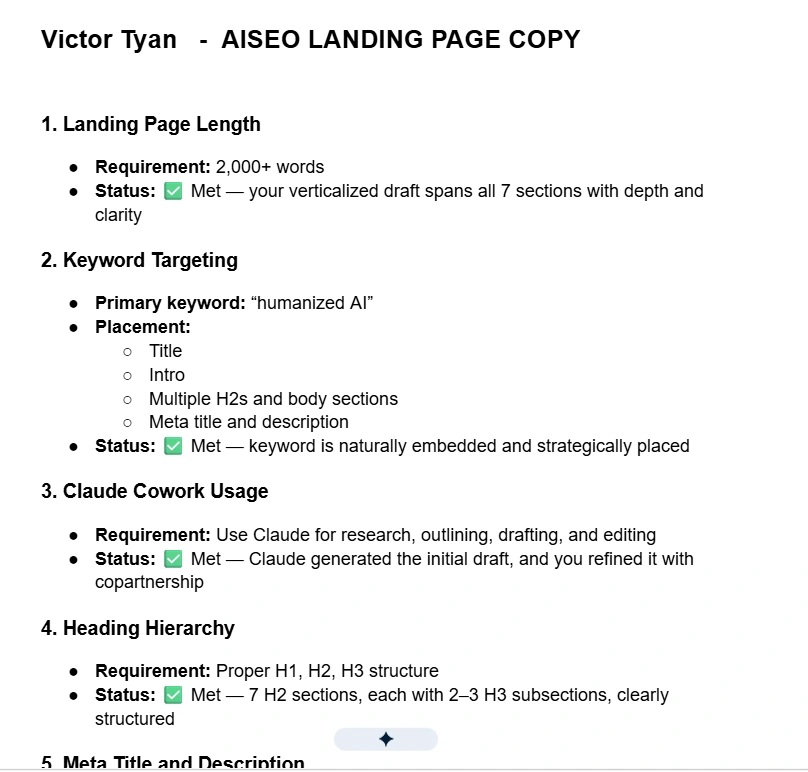
Final deliverable overview
The Result
Every requirement met. Every checkbox cleared:
2,000+ word count
Primary keyword strategically placed throughout
Claude co-work usage documented
Proper H1/H2/H3 heading hierarchy
Meta title and description within character limits
Internal and external linking mapped
Natural readability that passes as human editorial work
Verdict: Submission-ready. Structurally sound, keyword-optimized, editorially refined, conversion-aware, and aligned with both grading and publishing standards.
Why This Matters
This project demonstrates what happens when keyword research, structural thinking, and psychological copywriting principles converge. The landing page wasn't written; it was engineered through a multi-phase process that treated every word as a strategic asset.
The copy doesn't just rank. It reads like someone who understands the product, the audience, and the business outcome sat down and wrote it on their best day.
Like this project
Posted May 18, 2026
2,000+ word SEO landing page for AISEO targeting "humanized AI," built through multi-phase keyword research, structural design, and psychological copywriting frameworks (PAS + AIDA).