Ember: AI-Powered Investigation Platform Design

Fatima Farooq


Ember — AI Investigation Platform
Overview
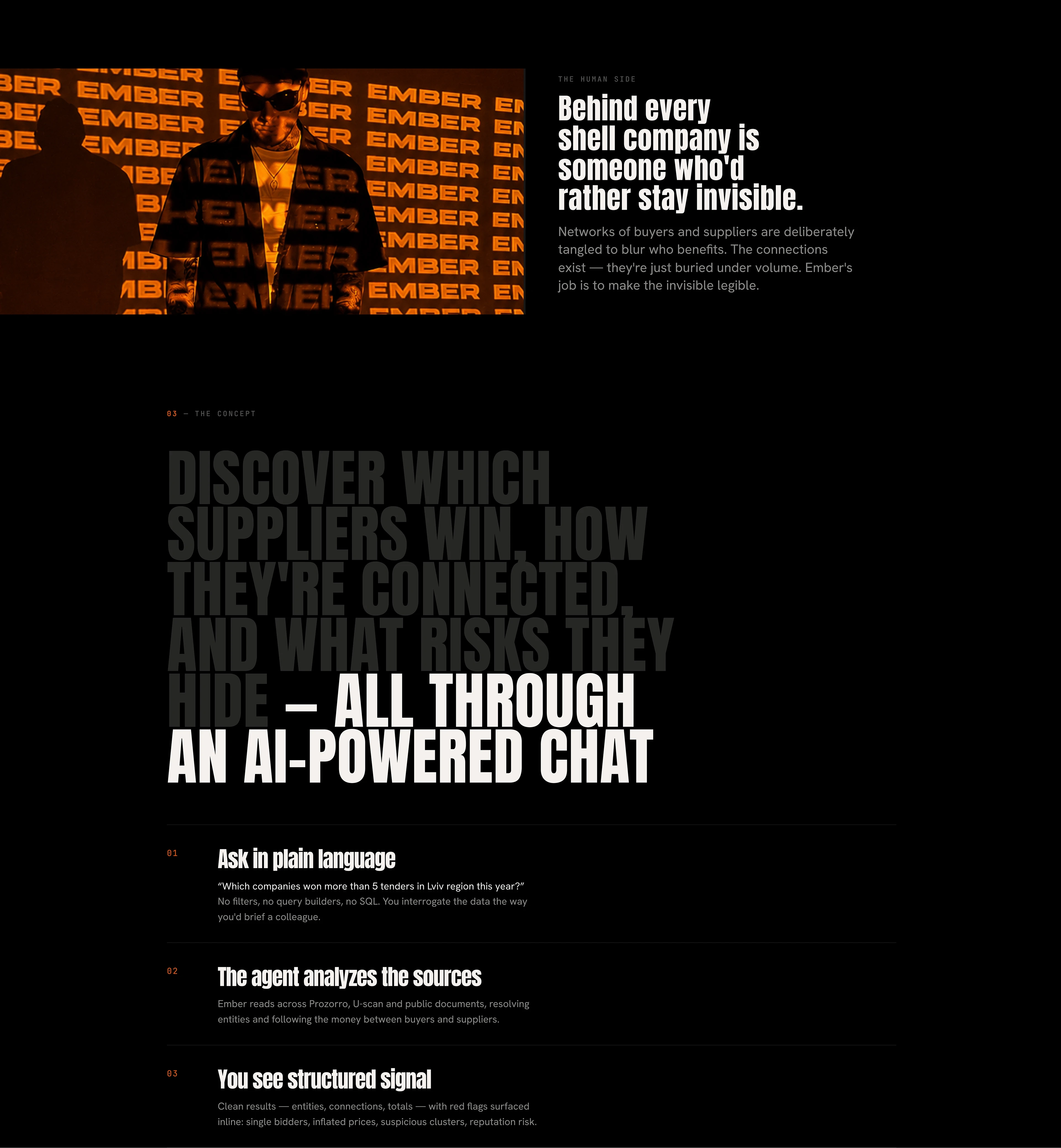
Ember is an AI-powered investigation platform designed to help users explore complex information, connect scattered evidence, and turn large amounts of data into actionable insights.
Investigation workflows often involve moving between multiple sources, reviewing large amounts of information, identifying relationships, and manually building a picture of what happened.
Ember explores how AI can simplify that process by bringing investigation, analysis, and discovery into a single intelligent workspace.
The goal was to create an interface that feels powerful enough for complex investigations while remaining clear and approachable for everyday use.
The Challenge
Modern investigations generate enormous amounts of information.
An investigator may need to work across documents, people, organizations, events, conversations, locations, and other connected pieces of evidence.
Traditional tools can make this process fragmented.
Users often have to:
Search across multiple sources.
Manually organize information.
Compare related pieces of evidence.
Identify connections between entities.
Keep track of investigative context.
Switch between different tools and interfaces.
The challenge was to design an AI-powered workspace that could reduce this complexity without hiding important information from the investigator.
The central question became:
How might AI help investigators move from scattered information to meaningful connections faster?
Product Vision
Ember is designed around the idea of an AI-assisted investigation workspace.
Rather than replacing the investigator, the platform acts as an intelligent layer that helps users discover, organize, and understand information.
The experience focuses on three core activities:
Discover
Find relevant information and surface potentially important signals.
Connect
Identify relationships between people, organizations, events, and other entities.
Understand
Use AI-assisted analysis to turn connected information into a clearer investigative picture.
Target Users
The platform is intended for users who work with complex information and need to establish relationships between different pieces of evidence.
Potential users include:
Investigators
Intelligence analysts
Security professionals
Researchers
Journalists
Compliance teams
Fraud and risk analysts
These users share a common need: they need to understand relationships within large and complicated datasets.
The Investigation Workflow
The experience can be understood as a continuous investigation loop:
Search → Discover → Analyze → Connect → Investigate → Validate → Report
Instead of forcing users through a rigid sequence, Ember provides an environment where users can move between these activities as new information emerges.
This is particularly important in investigative work because a single discovery can completely change the direction of an investigation.
AI as a Research Partner
One of the central ideas behind Ember is using AI as an assistant rather than making it the entire interface.
The AI can help users interpret information, surface relationships, summarize findings, and accelerate exploration.
This creates a human-AI collaboration model:
Human asks → AI investigates → Information is surfaced → Human evaluates → Investigation continues
The investigator remains responsible for interpreting and validating the information, while AI reduces the manual effort required to navigate it.
Information Architecture
The platform needs to support multiple levels of information simultaneously.
At a high level, users need to understand:
What investigation they are working on.
What entities are involved.
What information has been discovered.
How entities are connected.
What the AI has identified.
What evidence supports a finding.
The interface therefore benefits from a layered information architecture where users can move from overview to detail without losing investigative context.
Entity-Based Investigation
A key concept in an investigation platform is the ability to treat important objects as connected entities.
Examples include:
People → Organizations → Locations → Events → Documents → Relationships
Instead of viewing every piece of information independently, Ember can represent the investigation as a network of relationships.
This makes it easier to move from one discovery to another.
For example:
Person → Organization → Event → Location → Related Person
Each connection can become another path for investigation.
AI-Powered Discovery
AI can help identify patterns that may not be immediately obvious when information is reviewed manually.
The platform can surface:
Potential relationships
Relevant entities
Related events
Similar information
Important documents
Emerging connections
Areas requiring further investigation
The important UX challenge is presenting these AI-generated insights in a way that feels useful rather than overwhelming.
Investigation Workspace
The workspace is designed around maintaining context.
Rather than forcing users to open completely separate pages for every piece of information, an investigation interface can keep important context visible while allowing users to explore deeper.
This creates a balance between:
Context
and
Detail
The user should always understand where a piece of information belongs within the larger investigation.
Search & Exploration
Search becomes more than a simple keyword field.
In an AI investigation environment, users may begin with a person, organization, event, document, or natural-language question.
The experience should allow users to move from an initial query toward broader exploration.
For example:
Search → Result → Entity → Related entities → New discovery
This transforms search from a destination into an investigative starting point.
Visualizing Relationships
Complex investigations are inherently relational.
A visual relationship model can help users understand how entities interact and identify clusters or unexpected connections.
Rather than presenting relationships only as rows of data, the interface can provide a visual representation of the investigation's structure.
This gives users two complementary ways to understand information:
Structured data for precision.
Visual relationships for exploration.
AI Insights
AI-generated insights should be clearly differentiated from verified source information.
This distinction is especially important in investigative workflows.
The interface should help users understand:
What information comes from a source.
What has been inferred or summarized by AI.
Why an insight was surfaced.
Which entities or evidence support it.
This creates transparency and gives users greater confidence when evaluating AI-assisted findings.
Visual Design Direction
The visual language of Ember is built around the intersection of investigation, intelligence, and artificial intelligence.
The interface benefits from a sophisticated, technology-focused aesthetic while maintaining strong usability.
The visual system emphasizes:
Clear information hierarchy
Dark, focused workspace surfaces
High-contrast content
Subtle accent colors
Structured cards and panels
Data visualization
Connected-node visual language
Minimal distractions
The overall experience should feel analytical rather than decorative.
Designing for Information Density
Investigation platforms naturally contain a lot of information.
The challenge isn't simply displaying more information.
It is making large amounts of information understandable.
The interface therefore relies on:
Progressive disclosure
Strong grouping
Consistent spacing
Clear hierarchy
Contextual details
Expandable information
Persistent navigation
Users can start with a high-level view and progressively reveal more detail when needed.
Interaction Design
Micro-interactions play an important role in helping users understand the state of an investigation.
Examples include:
Loading and analysis states
AI processing indicators
Entity selection
Relationship highlighting
Expandable evidence
Search suggestions
Interactive graph exploration
Contextual AI actions
These interactions provide feedback while keeping the investigation flow uninterrupted.
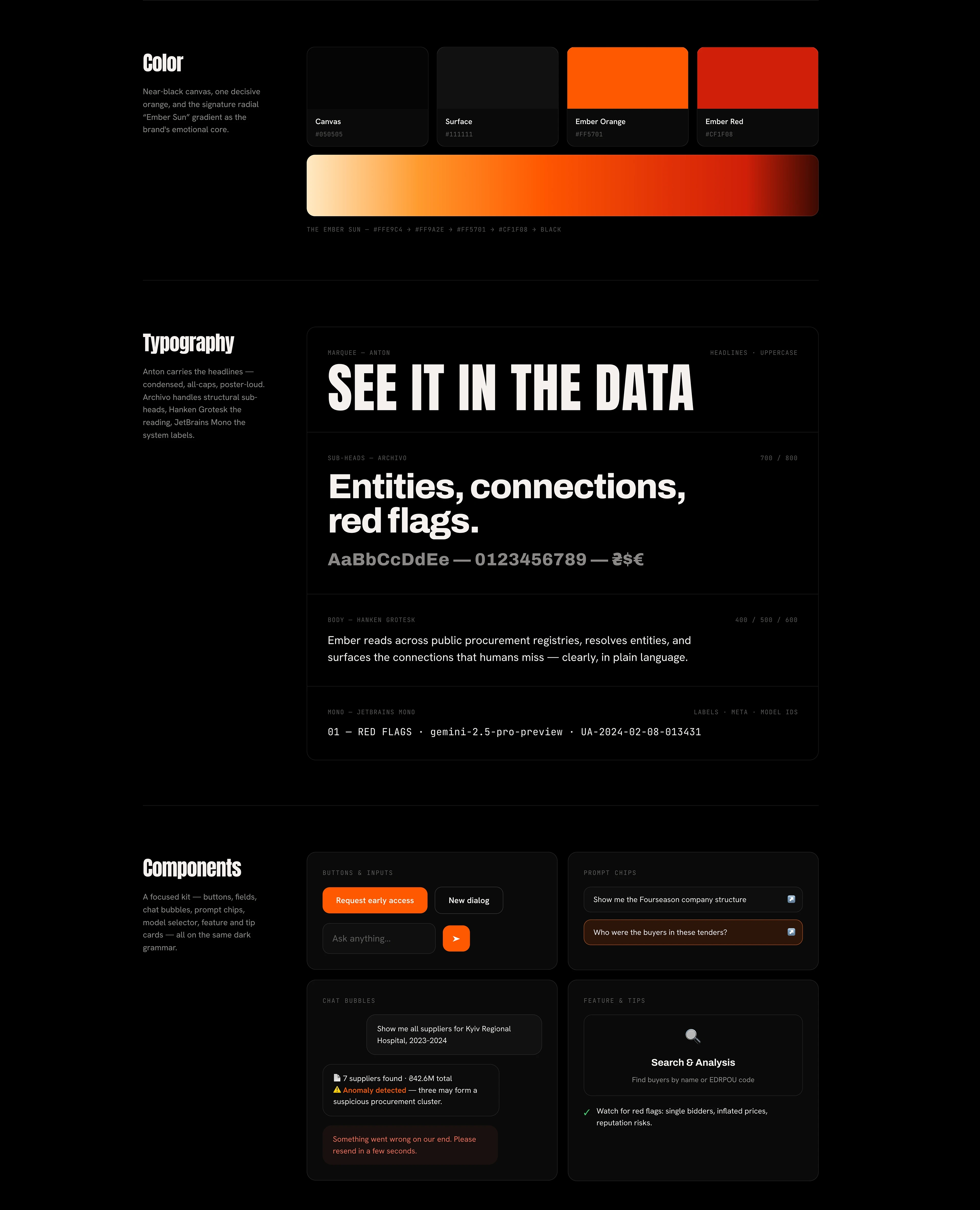
Design System
A scalable design system provides consistency across the platform.
Typography
Typography prioritizes readability and information hierarchy, particularly for dense investigative content.
Color
A restrained palette allows important information and interactive states to stand out without overwhelming the user.
Components
Reusable components establish consistency across:
Navigation
Search
Cards
Entity profiles
Data tables
AI insights
Filters
Graph elements
Detail panels
Action controls
This creates a flexible foundation for expanding the product.
UX Principles
The Ember experience is guided by several principles.
01 — Keep the investigator in control
AI should assist investigation rather than make unexplained decisions on behalf of the user.
02 — Preserve context
Users should be able to explore details without losing sight of the larger investigation.
03 — Make connections visible
Relationships are often as important as individual pieces of information.
04 — Reduce cognitive load
AI should help users process complexity rather than introduce additional complexity.
05 — Explain AI outputs
Users should understand where insights come from and have enough context to evaluate them.
From Data to Insight
The core value of Ember can be represented as a simple transformation:
Raw Information
↓
AI-Assisted Discovery
↓
Connected Entities
↓
Investigation Context
↓
Actionable Insight
The interface exists to make this transformation easier to understand and faster to navigate.
Outcome
Ember demonstrates how AI can be integrated into an investigation workflow without turning the product into a conventional chatbot.
Instead, AI becomes part of the workspace itself.
The result is an experience where users can search, explore, connect information, and investigate relationships while maintaining control over the overall process.
Conclusion
Investigation is fundamentally about connecting the dots.
Ember explores how AI can help users discover those connections across increasingly complex information environments.
The design combines AI assistance, structured information, entity relationships, and visual exploration into a unified investigation experience.
The ultimate goal is simple:
Help investigators spend less time searching through information and more time understanding what it means.


Like this project
Posted Sep 23, 2026
Ember is an AI investigation platform that helps users uncover connections, analyze complex information, and turn scattered data into actionable insights.