Finding $498K in Hidden Labor Costs for an Executive Search Firm

Vanessa Jambois


EXECUTIVE SEARCH & PLACEMENT / WORKFLOW AUDIT
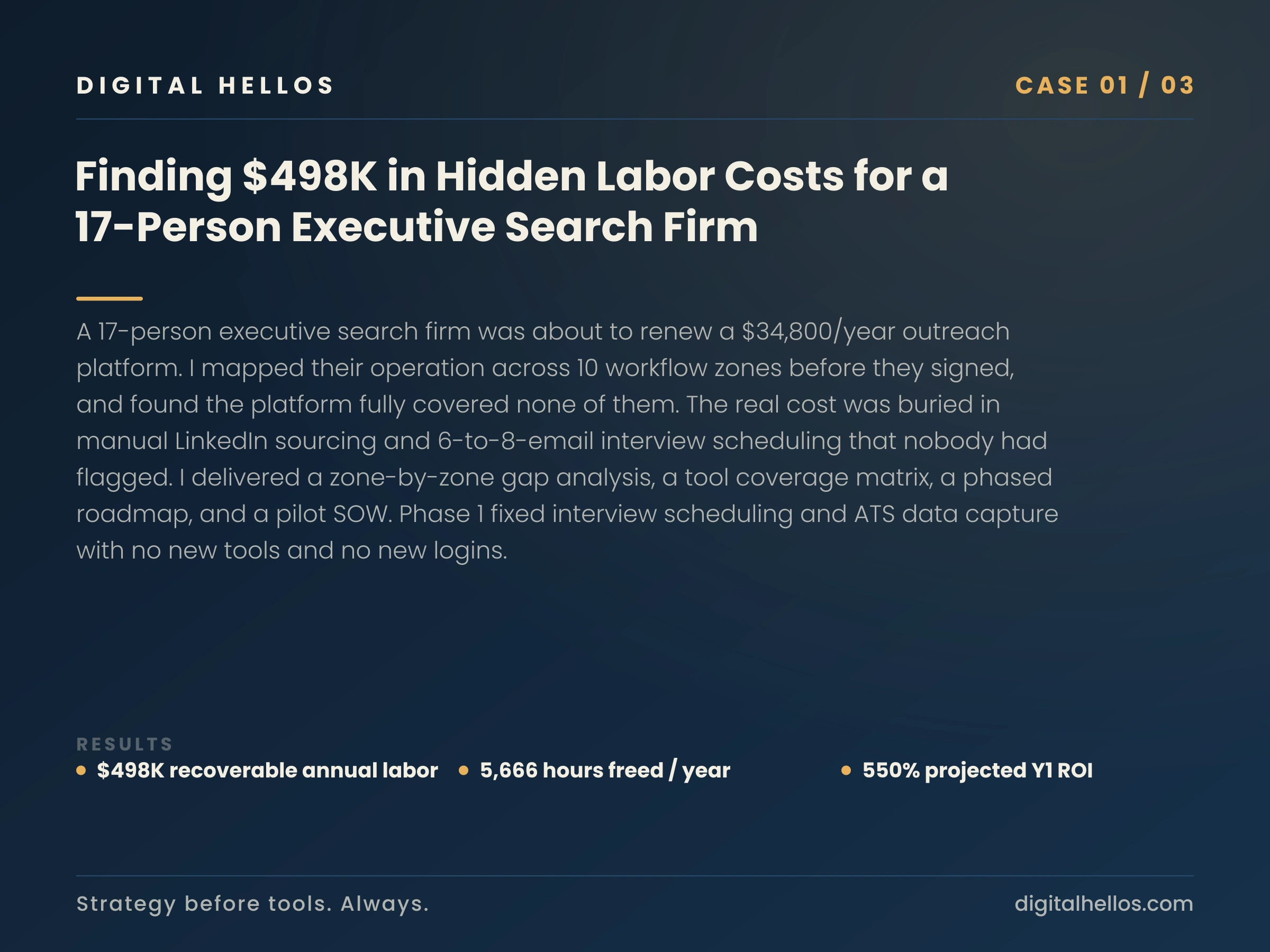
Finding $498K in Hidden Labor Costs for a 17-Person Executive Search Firm
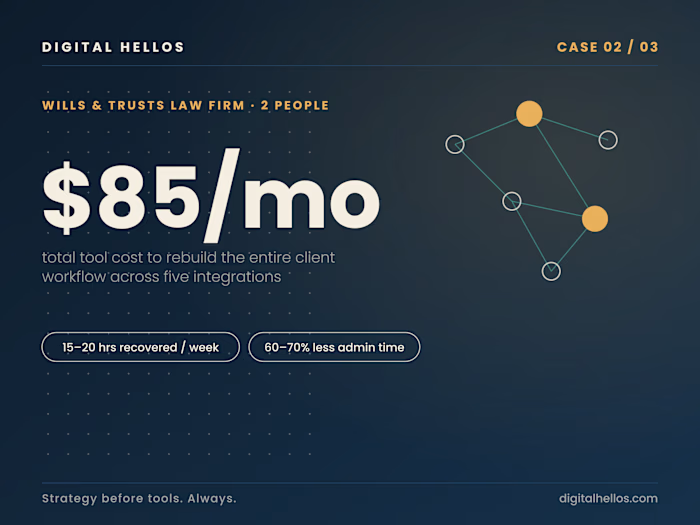
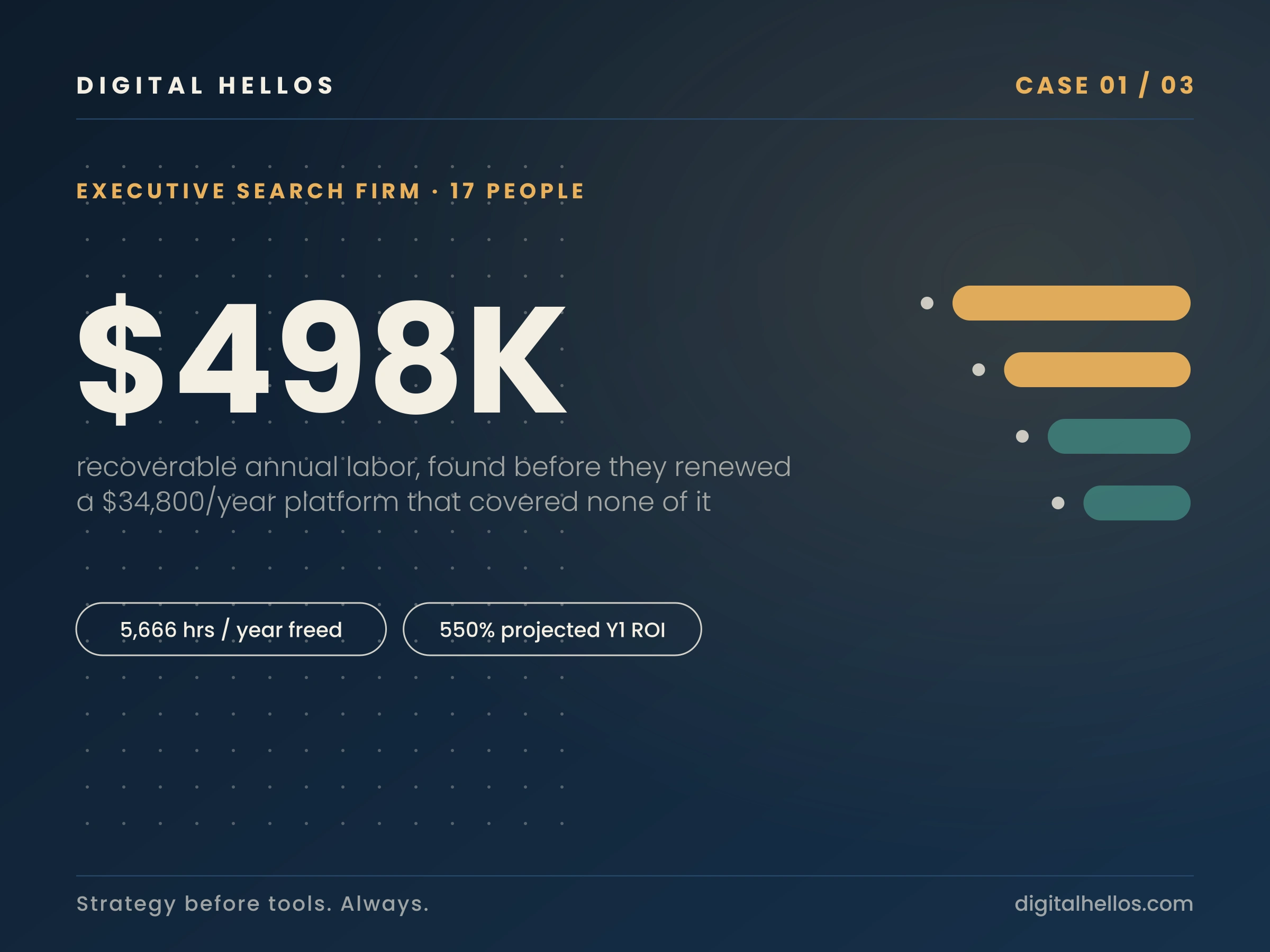
A 17-person executive search and placement firm was about to renew a $34,800/year outreach platform. They had a feeling they weren't getting full value. They were right. They just didn't know by how much.
They brought in Digital Hellos to map their workflows before signing anything.
What I found
I mapped their work across 10 zones: sourcing, candidate documentation, interview scheduling, interview prep, BD reconnects, business development, client management, reporting, onboarding, and database management.
The $34,800 platform they were about to renew? It substantially covered 2 of those 10 zones. Fully covered none.
That wasn't the biggest problem.
The biggest problem was sourcing. Recruiters were doing manual LinkedIn searches for every new role, from scratch, every time. Their outreach platform handled data enrichment. It didn't do semantic search. So all that muscle memory, all that pattern recognition those recruiters had built up over years of placements, was getting manually re-applied on every single req. That's 200 to 250 hours per week across a 17-person team.
Interview scheduling wasn't much better. No scheduling tool. Every interview was 6 to 8 emails over 2 to 3 days. Nobody had flagged it as a solvable problem. It just was what it was.
The managing partner was spending 15 hours a week manually managing BD follow-up. No sequencing. No automation. Just calendar reminders and too many open tabs.
Total recoverable time across the business: $498,000 per year.
How I ran it
I built a persistent workspace in Claude and loaded everything relevant: their tech stack, team structure, role descriptions, tool documentation, workflow observations from interviews. Every zone got a gap analysis. Every tool got mapped to the zones it actually covered versus the zones it claimed to cover.
What would have taken weeks of manual research and spreadsheet work compressed into focused working sessions. The output was specific enough to walk into a partner meeting with: zone-by-zone findings, a tool coverage matrix, a phased roadmap, a pilot SOW, and a one-pager for leadership.
What we fixed first
Phase 1 was the two highest-impact, lowest-disruption fixes. The constraint: no new tools, no new logins, no training burden.
Interview scheduling: the coordinator CCs one address. Coordination handles itself. The 6-to-8-email thread disappears.
ATS data capture: meeting summaries and intake emails were living outside the ATS. Recruiters were re-entering them manually or skipping it entirely. Now they forward one email to a designated address and it routes to the right fields automatically.
Neither fix required anyone to change how they work. That's intentional. Automation that requires new habits usually doesn't stick.
Phase 2 is the sourcing problem. 200 to 250 hours a week. That one's a different scope, but the audit identified exactly what needs to happen.
The actual point
This firm wasn't behind on software. They had real tools. The problem was that the tools covered different parts of the workflow without connecting, and the gaps between them were where all the manual work lived.
That's almost always where it is.
Like this project
Posted Jun 12, 2026
Audited a 17-person executive search firm before a $34.8K tool renewal. Found $498K in recoverable annual labor and a no-new-tools Phase 1 fix.