Churchlify

Deborah Adeoye


Churchlify: Enhancing Community and Engagement Through Digital Worship
Overview
Churchlify is a digital platform designed to help churches manage their congregations, host online services, and foster stronger member engagement. The goal of the redesign was to simplify the digital experience for both church administrators and members by creating a seamless platform for giving, event management, and community connection.
My Role
Lead UI/UX Designer Duration: 3 months Responsibilities: User research, wireframing, prototyping, usability testing, and visual design. Tools: Figma, Miro, Notion, Google Forms
Problem Statement
Many churches struggled with outdated, fragmented digital systems for managing members, donations, and events. Users found it difficult to navigate existing church platforms, and church administrators faced challenges tracking attendance, managing donations, and keeping members engaged outside of Sunday services.
Key challenges included:
Complicated onboarding and registration process.
Poor event visibility and participation.
Limited tools for digital giving and sermon access.
Weak sense of online community connection.
Goal
To create a user-friendly platform that simplifies church operations, enhances digital giving, and strengthens member connection through intuitive design and consistent communication features.
Research Process
User Interviews
I conducted interviews with:
5 church administrators
7 active church members
3 new church visitors
Key insights:
Members wanted a simple way to view events, give offerings, and rewatch sermons.
Administrators needed a dashboard for attendance tracking and announcement posting.
Users preferred an app-like feel with minimal text and clear visual hierarchy.
Competitive Analysis
I reviewed existing platforms like Planning Center, Faithlife, and ChurchSuite. Findings showed that most tools were functionally rich but visually complex, with poor mobile optimization and a lack of personalized user experiences.
Design Process
Information Architecture
I restructured the platform around three main user flows:
Join and Connect – Easy onboarding and personalized dashboard.
Engage and Give – Simple donation system with saved payment options.
Participate and Grow – Event discovery, live streams, and sermon libraries.
Wireframes
Low-fidelity wireframes were sketched to test navigation simplicity. Feedback from early testing guided the placement of key features like the “Give” button and Upcoming Events widget on the homepage.
Prototyping
Using Figma, I developed an interactive prototype with:
A clean visual hierarchy.
Soft, faith-inspired color palette (navy, white, and gold tones).
Clear CTAs (“Join Service,” “Give Now,” “View Events”).
Usability Testing
12 users tested the prototype. The success rate for completing core tasks (donating, registering for an event, viewing sermons) improved by 82% compared to the original platform.
Final Design Highlights
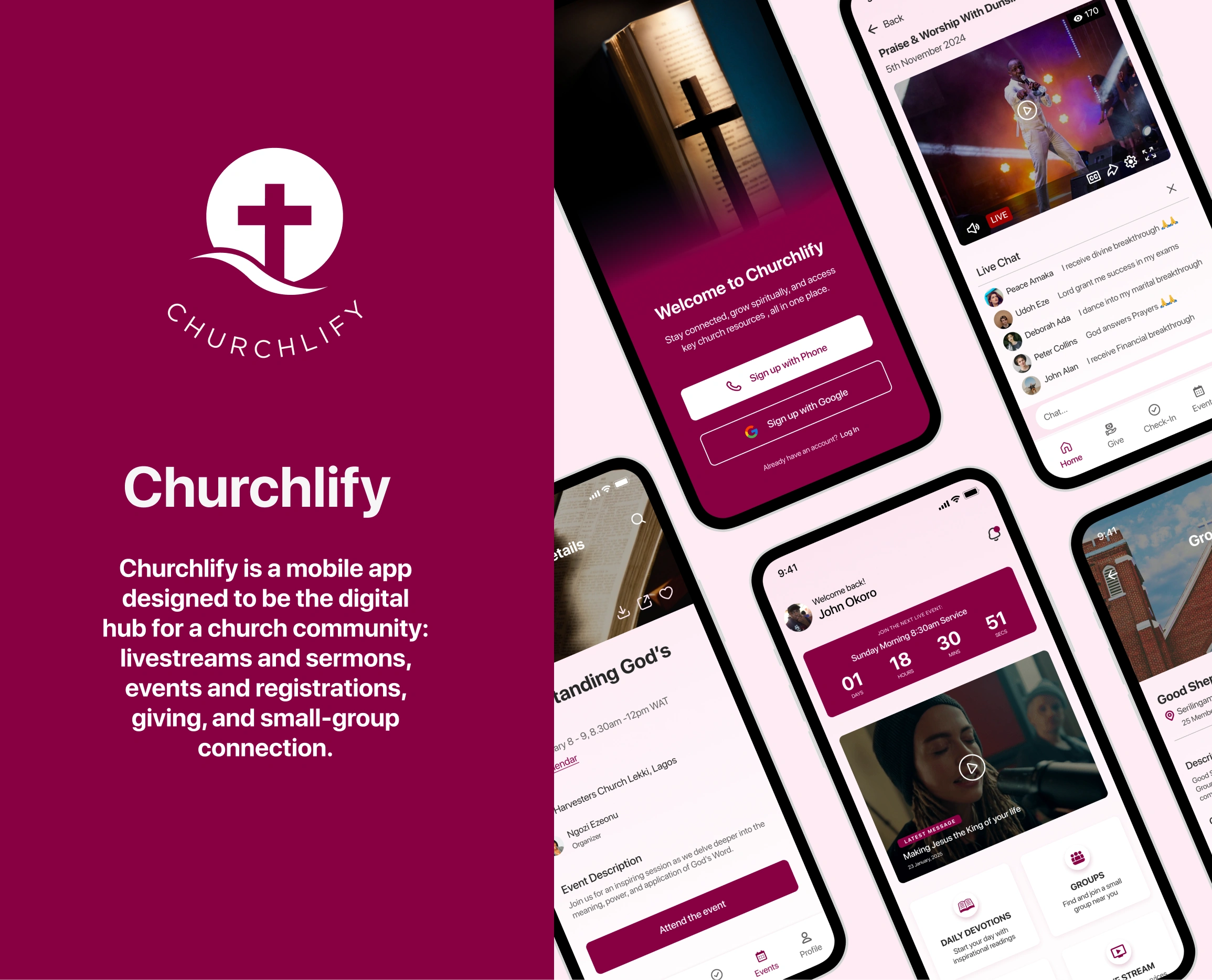
Personalized dashboard: Displays upcoming events, daily devotionals, and giving summary.
One-tap giving: Streamlined donation process with instant confirmation.
Community feed: A modern “church wall” for announcements and member engagement.
Mobile-first design: Optimized for smartphones to support members on the go.
Impact
User satisfaction: +90% positive feedback in post-launch surveys.
Donation process time reduced: From 2 minutes to under 40 seconds.
Event participation: Increased by 60% within the first two months.
Reflection
This project deepened my understanding of designing for emotion and connection. Beyond usability, Churchlify needed to foster trust and belonging. Balancing spiritual tone with modern usability challenged me to design with empathy and cultural sensitivity.
If I were to revisit this project, I’d integrate AI-driven insights for pastors (like attendance patterns and engagement analytics) and expand accessibility options for elderly users.
Conclusion
The Churchlify redesign successfully merged faith, community, and technology into one cohesive experience. Through user-centered design, the platform now serves as a digital bridge that empowers churches and connects congregations beyond the physical walls.
Like this project
Posted Nov 11, 2025
Churchlify is a mobile app designed to be the digital hub for a church community, livestreams and sermons, events and registrations, giving etc
Likes
0
Views
6
Timeline
Feb 10, 2025 - Apr 20, 2025