Semantic Recall Engine

Harshit Chordiya


Semantic Recall Engine (SRE)
Problem statement
Nowadays, practically all knowledge work is done on Browser. Every day, people read News, discussion threads, research papers, blogs and documentation. Although people consume information digitally, human memory is limited for recall. Existing Browsers don't actually keep track of what a particular user has read. Instead of remembering what a user has read in the past, search engines re-query the entire internet.
Core problem
The main challenge is to create an AI memory system that is continuous, time-aware, and relevance-preserving. This system should be able to recall what a user read, where they read it, and when they read it on the web, and retrieve it later with semantic precision and source links when the user queries about it.

Relation to AI Native News Experience
This problem is directly aligned with an AI-native news experience because modern news consumption is high-volume, fast-changing, and fragmented across sources. An AI memory layer would enable users to:
Continuously track and organize news they have already consumed
Retrieve past news contextually (e.g., “What did I read about this topic last week?”)
Maintain temporal awareness of evolving stories
Avoid redundancy and information overload
Build a personalized, evolving knowledge graph of news consumption
Who it impacts
It will impact every browser user. Reliable recall is beneficial for anyone who reads, learns, investigates, compares products, examines documentation, or bases decisions on information found online. In particular, it helps knowledge workers, engineers, product managers, analysts, researchers, students, and lawyers who need precise, source-supported recollection of previously read web content.
PPT & Action Demo
System Architecture
The overarching design is inspired by logical reasoning steps: Observation → Comprehension → Storage → Planning → Execution. Each interconnected layer leans heavily on modern Gemini LLMs combined with high-speed vector retrieval.
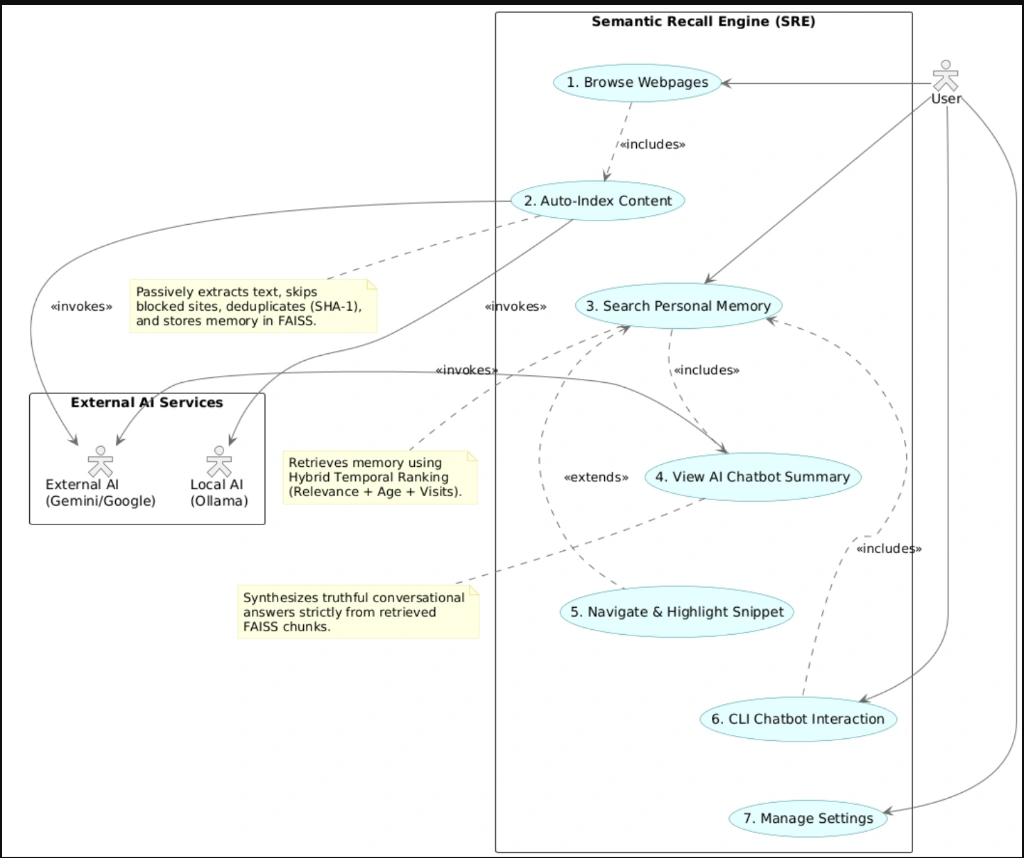
Use Case Diagram
Architecture components
Perception (LLM): extract intents, classify page region to index, normalize titles.
MCP Tools: index_page, search_documents, process_documents
Action: function execution + write-back to working memory.
Memory: short-term session stored in RAM for context; long-term FAISS for persistent recall.
Primary Capabilities
Intelligent Reasoning via Gemini: The engine exclusively uses advanced models like Gemini 3.1 Flash-Lite to orchestrate searches and summarize answers naturally.
Flexible Vector Generation: Toggle easily between cloud-hosted Google embeddings for maximum accuracy, or local Nomic embeddings for complete offline privacy.
Time-Decay Algorithms: Employs temporal scoring techniques to ensure the most recently consumed information surfaces first.
Storage Optimization: Prevents bloated databases by utilizing SHA-1 hash deduplication.
Dual-Tier Memory System: Pairs short-term session tracking with permanent FAISS storage to maintain an ongoing dialogue seamlessly.
Conversational Summaries: Beyond returning URLs, the internal chatbot synthesizes a direct answer strictly derived from your personal web history.
Popularity Scoring: Incorporates a dedicated
/visit route to monitor how often you access certain pages, passively enhancing their relevance.Multi-Platform Access: Exposes capabilities simultaneously over standard HTTP REST and standardized MCP protocols.
Universal Ingestion: Can rip and embed markdown from standard HTML, PDFs, and Word documents via MarkItDown.
Browser-Native Client: A fully functional Chrome Manifest V3 extension serves as the primary visual interface and automated web scraper.
Technology Stack Overview
Category Selected Tooling Primary Function Logic & Reasoning Gemini 3.1 Flash-Lite / 2.0 Flash Powers cognitive planning and response synthesis Vectorization Google
text-embedding-004 / Ollama Transforms plain text into mathematical vectors Database FAISS Enables high-speed semantic similarity lookups Routing FastAPI & Uvicorn Acts as the robust API gateway for browser interaction Integration Model Context Protocol (MCP) Allows native hooking into external AI agent systems Text Parsing MarkItDown Strips noise from complex web documents Environment uv Package Manager Ensures lightning-fast virtual environment setupData Processing Pipelines
1. Ingestion
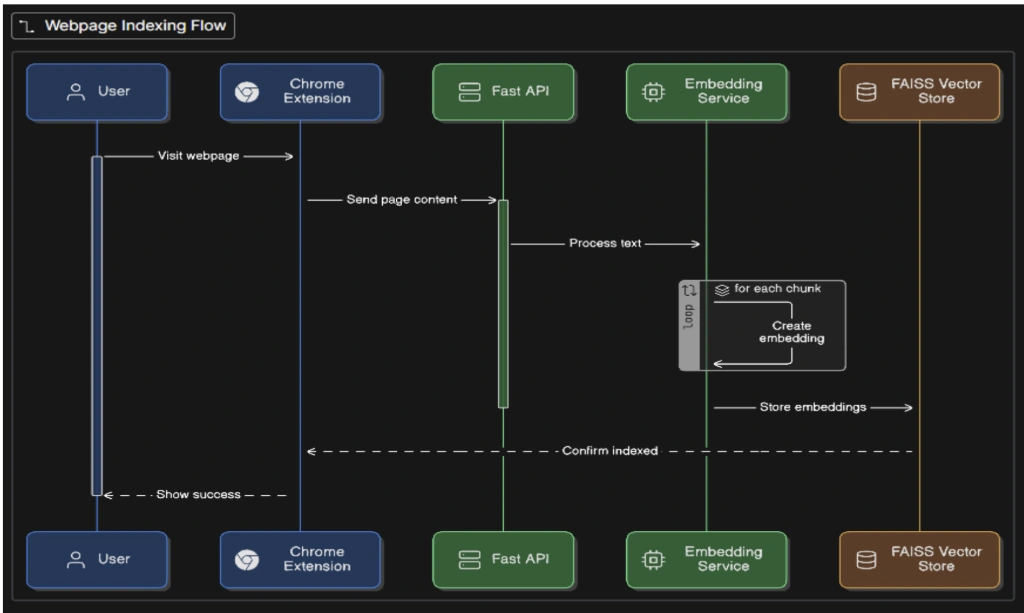
Extract: Extract textual content from the webpage.
Chunking: Split text into overlapping semantic chunks (~1000 chars, ~150 overlap) to preserve context.
Embedding: Convert each chunk into a vector and attach metadata
{url, title, chunk_id, timestamp, visit_count}.Indexing: Store vectors in FAISS for similarity search and prevent duplicates using SHA-1 hashing.
2. Retrieval
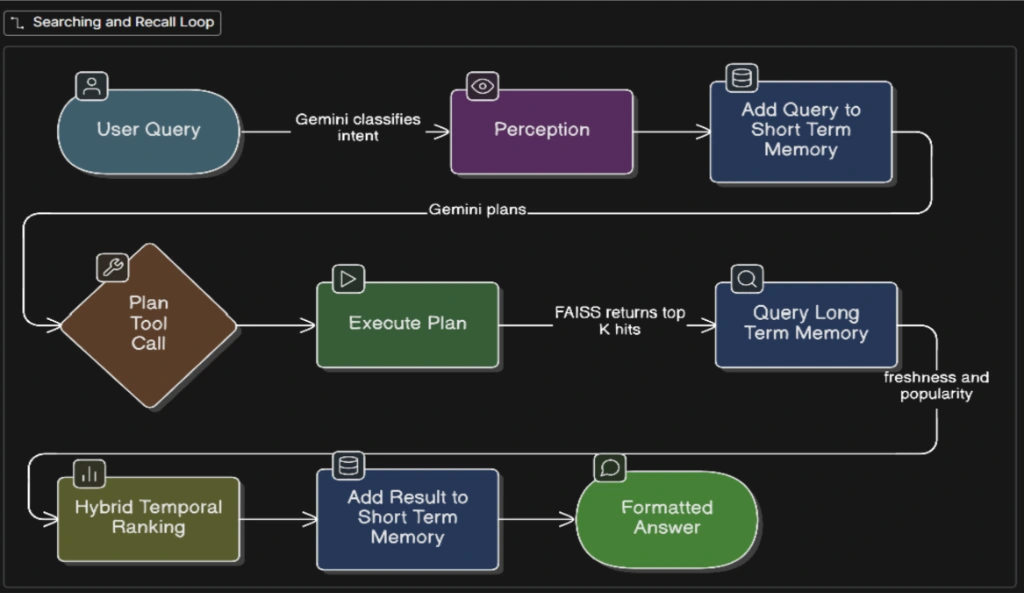
Convert: Convert the user query into the same vector space.
Semantic Search: Retrieve top-k similar chunks using cosine similarity.
Hybrid Re-ranking: Adjust ranking using temporal and behavioral signals. It ranks results based on how closely the content matches the user’s query. The most crucial element is that match (semantic similarity), and the system modifies the ranking a little bit depending on how frequently and recently the page has been viewed. Pages that the user has visited frequently and recent pages receive a slight priority boost, but this increase levels off so they don't take over the ranking.
Like this project
Posted Aug 23, 2026
Developed an AI memory system to recall based on users browsing history.