Practice Manager — Medical Billing & Autopay (Flutter, Firebase)

Viktor Zahurskyi



Overview
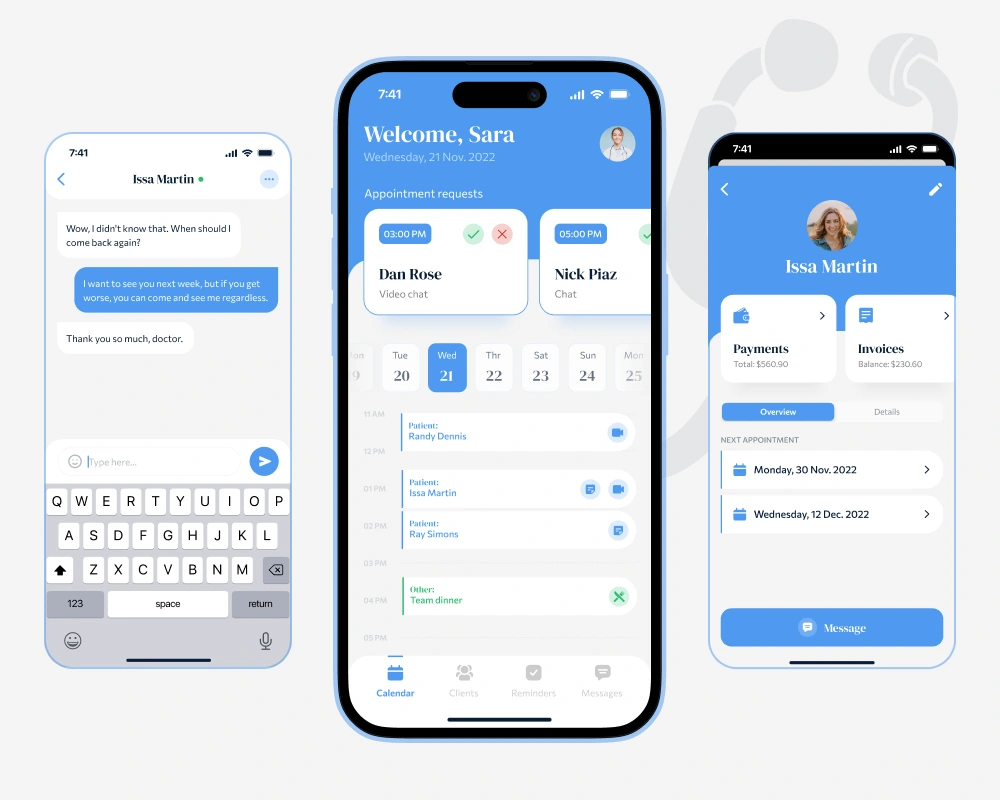
Practice Manager is a secure, multirole mobile app that streamlines medical billing, debt management, and payment tracking for patients, families, and healthcare providers. Built with Flutter and Firebase, it delivers a fast, intuitive experience, integrates multiple payers, and reduces administrative overhead through automation and real‑time transparency.
Key Features
Autopay & Scheduling: Recurring payments with configurable rules, due‑date reminders, and grace periods.
Multi‑Payer Support: Split bills across patients, family members, guardians, or third‑party payers.
Invoices & Statements: Real‑time viewing, PDF downloads, filters by status/date, and shareable links.
Secure Payments: Card processing, Apple Pay/Google Pay, stored payment methods, and refunds/voids.
Debt Management: Outstanding balance views, payment plans, settlements, and hardship options.
Transaction Tracking: Itemized history, receipt emails, export to CSV, and dispute workflows.
Roles & Permissions: Patient, Family, Provider, and Admin roles with scoped access and audit logs.
Notifications: Push and in‑app alerts for new invoices, upcoming charges, failed payments, and plan changes.
Forms & Compliance: Upload/attach forms, e‑sign support, and retention policies.
Analytics: Revenue dashboards, collection rates, plan adherence, and cohort reports for providers.
Tech Stack
Frontend: Flutter (Dart) for iOS/Android; Material/Cupertino UI, responsive layouts, and motion.
State Management: GetX for reactive controllers, DI, navigation, and route guards.
Backend & Data: Firebase Authentication, Firestore (invoices, payments, plans), Cloud Storage (statements/forms).
Cloud Functions:
Autopay scheduler, payment retries, and dunning logic.
Webhooks for payment gateways; reconciliation and ledger updates.
Role provisioning, audit trail writes, and statement generation.
Payments: Stripe (PaymentIntents, SetupIntents), Apple Pay/Google Pay; tokenized cards and PCI‑aware flows.
Security & Compliance: Firestore Security Rules (RBAC), MFA, encrypted fields, PII minimization, and audit logs; HIPAA‑aligned practices.
Observability: Crashlytics, Performance Monitoring, Analytics events; alerting on payment failures and latency.
CI/CD: GitHub Actions/Codemagic, automated testing, store deployment, and staged rollouts.
Workflows
Onboarding: User verifies identity, selects role, and links payer profiles and payment methods.
Billing: Provider issues invoice; user gets push/email; balance updates in real time.
Autopay: Rules apply on due date; Functions attempt charge, handle 3DS, and retry on failure.
Payment Plan: Configure installments, schedule, and notifications; plan status reflects in balances.
Reconciliation: Webhooks confirm settlement; receipts generated; ledgers and reports update.
Reporting: Providers view revenue, aging, write‑offs; export data for accounting.
Challenges & Solutions
Payment Failures → Dunning strategy with retries, alternative method prompts, and partial payments.
Data Security → Strict Security Rules, server‑side verification, and granular audit trails.
Multi‑Payer Splits → Canonical ledger entries per payer with proration and reconciliation checks.
Compliance Needs → Data retention, access logs, and least‑privilege RBAC across roles.
Results
Automated Autopay reduced manual reminders and admin workload.
80% of healthcare specialists rated debt‑management convenience as excellent during trials.
25% indicated readiness to replace paper invoices.
90% of patient transactions completed within 2 minutes, demonstrating high adoption and efficiency.
Like this project
Posted Jan 15, 2026
Secure medical billing, Autopay, multi‑payer splits, real‑time invoices, and transaction tracking with Flutter + Firebase and Stripe/Apple Pay/Google Pay.