Legacy LAMP Server Migration: Ubuntu 14.04 to 24.04

Joseph Joseph


The problem
Many small businesses still run sites on Ubuntu 14.04 with PHP 5. Hosts are now shutting down vulnerable servers, and an in-place upgrade across five Ubuntu releases and three PHP major versions is slow and hard to undo.
The approach
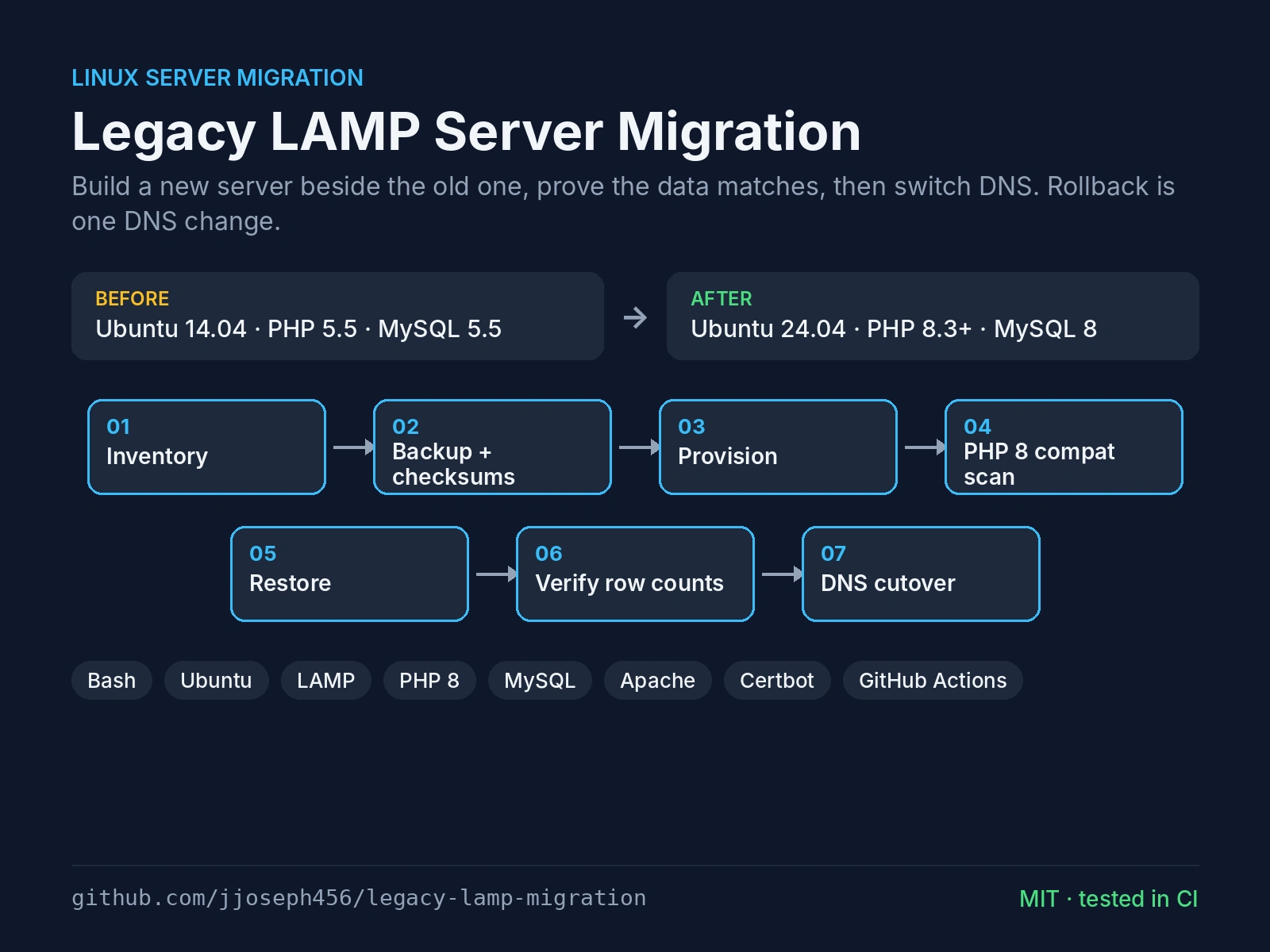
Build a fresh server beside the old one, move the data, prove it matches, then switch DNS. The old server stays untouched until the new one is verified, so rollback is a single DNS change.
Inventory the old server (read-only): PHP modules, vhosts, databases, cron jobs, certificates, ports
Back up each database with exact per-table row counts, plus files, config and SHA-256 checksums
Provision Ubuntu 24.04 with PHP 8, MySQL 8, Certbot, a firewall and automatic security updates
Scan the code for features removed between PHP 5 and 8, then lint every file with PHP 8
Restore, checking every checksum first; old vhosts are staged for review, not enabled blindly
Verify every table's row count against the old server and test real URLs before DNS moves
Cut over DNS, with a documented rollback
The compatibility scanner
Reports each problem with file, line and fix: the mysql_* extension, ereg and split, each(), create_function, mcrypt, magic quotes, curly-brace string offsets, the /e regex modifier and more. It avoids lookalikes such as str_split and mysqli_*, and exits non-zero so it can gate CI.
Testing
GitHub Actions runs Bash and ShellCheck on every script, and tests the scanner against a PHP 5 app (must fail, every issue reported) and a PHP 8 app (must pass, no false positives) on PHP 8.3 and 8.4.
This is a personal portfolio project, not client work.
Like this project
Posted Nov 3, 2026
Personal project: a tested runbook and scripts to move an end-of-life Ubuntu 14.04 + PHP 5 server to Ubuntu 24.04 + PHP 8, with rollback built in.
Likes
0
Views
1