
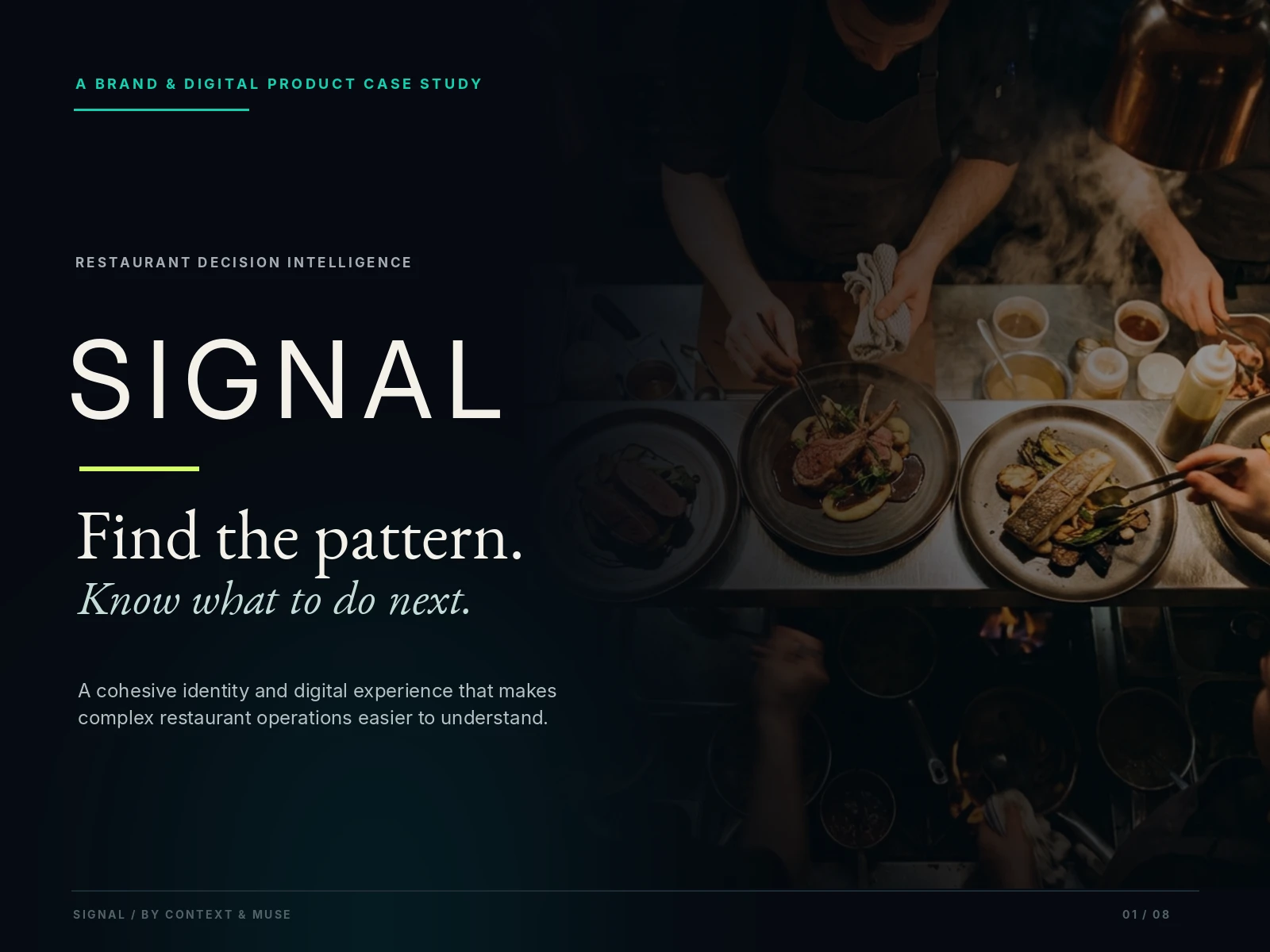
Signal Operations Intelligence
An independent product by Context & Muse, currently pilot-ready.
Signal Operations Intelligence is a decision-support concept for high-velocity operating teams. It turns fragmented inputs into prioritized, evidence-backed action paths while keeping operational impact separate from AI confidence.
The Challenge
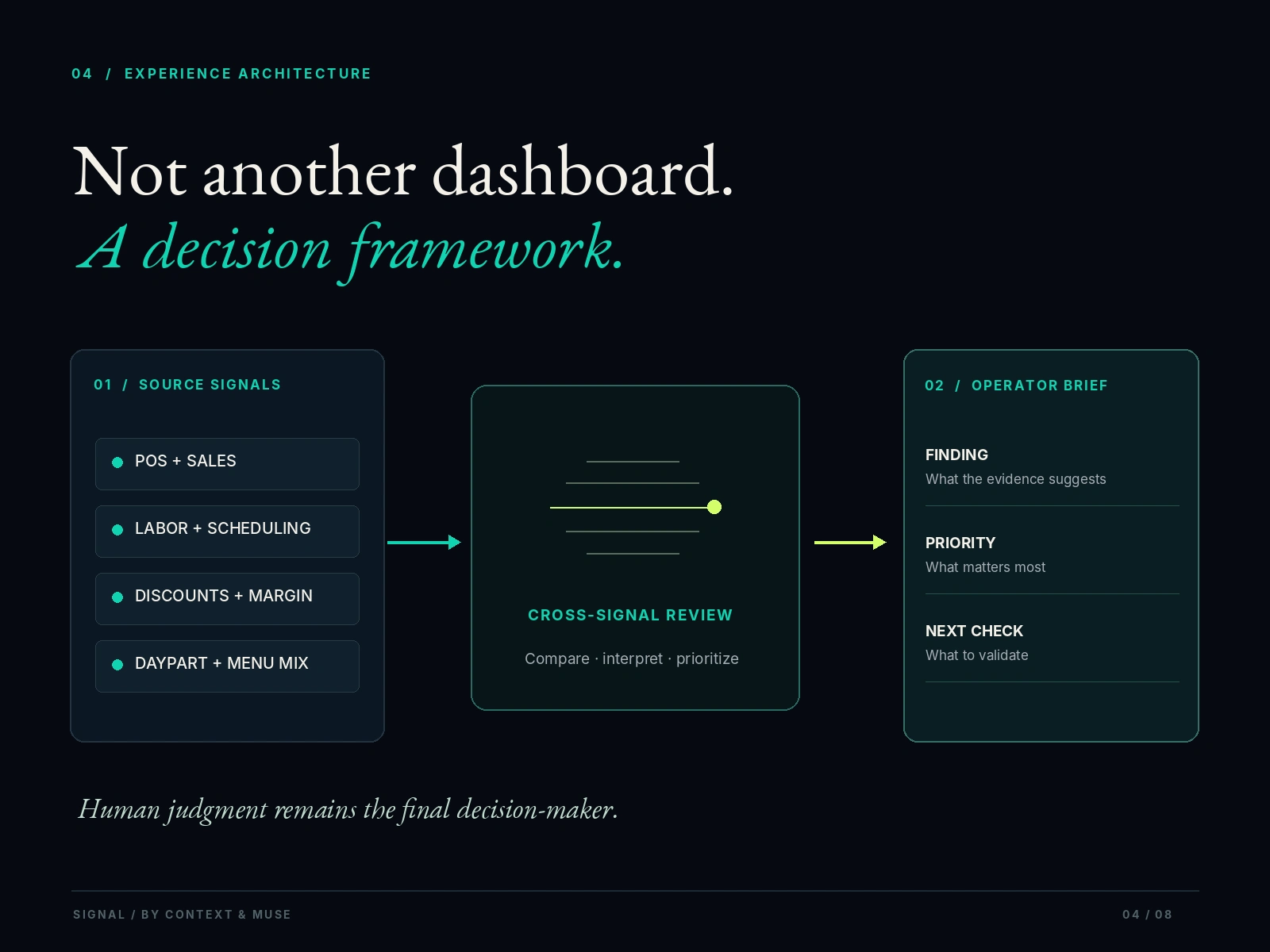
In high-pressure operational environments (such as restaurant hospitality, customer support, or logistics center floors), operators are flooded with data but starved of structured decision support. Data comes from isolated endpoints (POS reports, payroll systems, compliance logs) in fragmented formats, often containing duplicates, missing data points, or outliers.
The core challenge: How do we convert inconsistent operational metrics into standardized, high-confidence, explainable recommendations that accelerate human action?
Constraints
Client-Side & Offline First: Zero server dependencies. Ingestion, cleansing, scoring, diagnostics, and test runner execution must run entirely in a local browser sandbox to guarantee operational privacy.
Dynamic Ingest Variations: Source logs differ across endpoints. The ingestion pipeline must handle column drift (e.g. mapping
net_sales vs NET SALES vs Gross Sales) without breaking.Auditability: Operators will ignore black-box anomaly alerts. Every decision support card must display the exact mathematical formulas, observations, baseline thresholds, and rules triggered.
IP Protection: Core evaluation rules must remain simplified in public shells to protect proprietary grading algorithms, yet demonstrate production architecture patterns
Operational teams often work from incomplete context, shifting priorities, and inconsistent source material. When a recommendation affects a real decision, a plausible AI summary is not enough. Teams need to see what informed the recommendation, where uncertainty remains, and when human judgment should take over.
Restaurant Decision Intelligence.
Design Decisions
Fuzzy Schema Normalizer + Mapping UI: Implemented a parser that checks incoming columns against a dictionary of aliases. If it encounters a key it cannot map, it throws a
MappingError and pops up a mapping modal. This combines automated mapping speed with human-in-the-loop accuracy.Deterministic Calculations: Used strict, well-documented operational formulas (Z-Scores, Smith-Kasavana popularity cutoffs, labor spend percentages) instead of opaque machine learning models. This guarantees predictability and repeatability.
Granular Confidence Grading: Rather than displaying flat alert levels, recommendations are graded on:
Severity Scale (15pt): Combines financial size, frequency, and operational risk.
Confidence Scale (5pt): Rates completeness, pattern stability, and timestamp alignment.
Decision Readiness Score: Created a dynamic system readiness score based on data quality validation and evaluator confidence averages, alerting operators whether they have sufficient evidence to act.
Trade-offs
Choice Made | Advantage | Disadvantage / Mitigation
Vanilla JS & Client-Side Execution | Zero setup barrier, zero deployment cost, 100% data privacy. | Limit on data processing capacity (100MB+ logs could lag main thread). Mitigation: Ingested chunks are parsed line-by-line and scoped to shift-level aggregates.
Strict Rule-Based Thresholds | Auditable, deterministic, explainable, and zero warm-up period. | Lacks self-learning capabilities for novel anomalies. Mitigation: Implemented configuration parameters to modify baselines manually.
Custom Column Mapping Wizard | Prevents system crashes on schema drift by prompting user action. | Introduces human intervention friction during log upload. Mitigation: Remembers previous mappings locally.
Architecture
Signal is structured as a pipeline with clear separation of concerns:
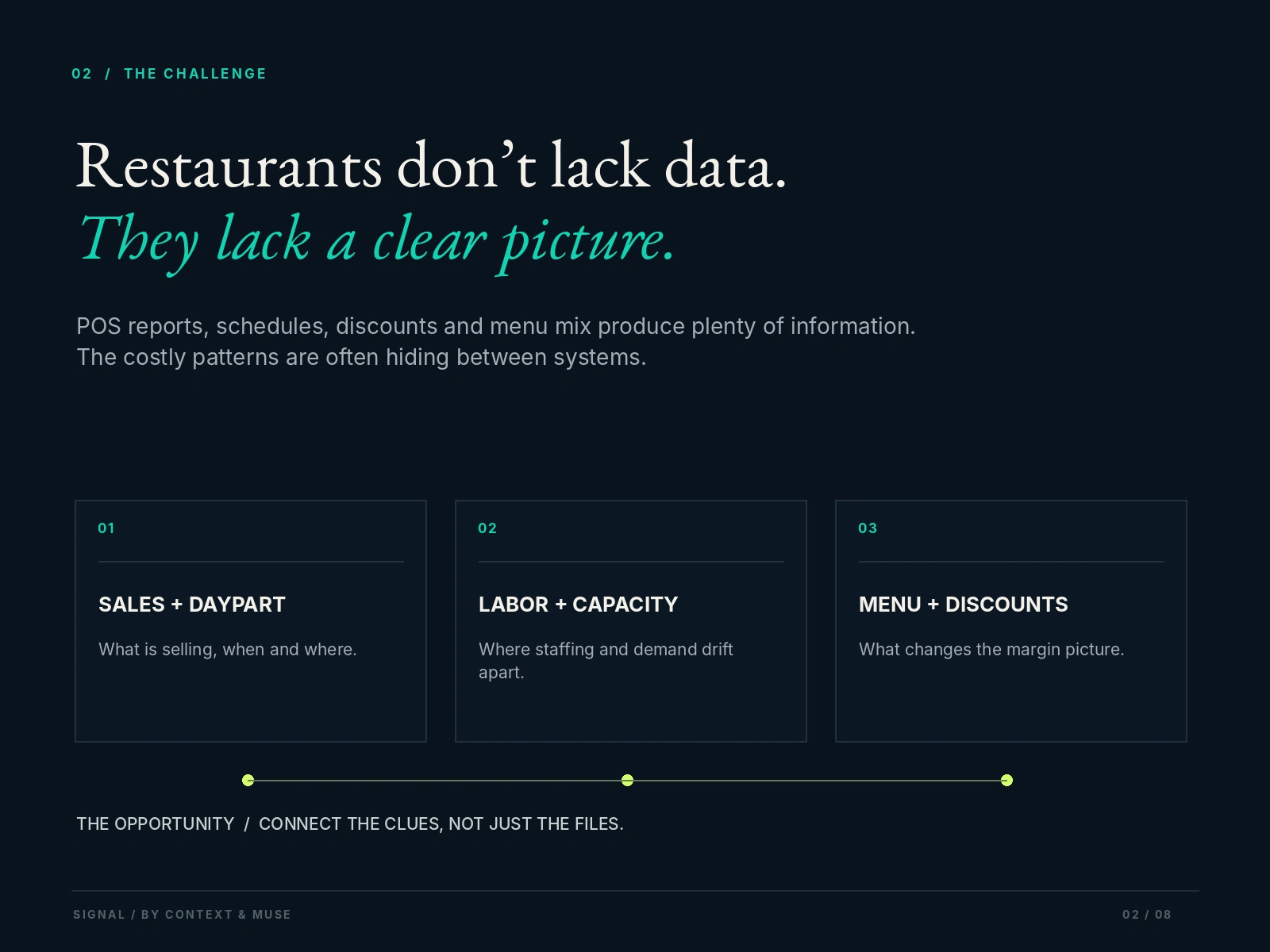
Prioritized Decision Intelligence grounded in real data that you already generate.
The approach
I shaped the product around a clear distinction: operational impact answers how consequential an issue may be, while AI confidence communicates how reliable the supporting signal is. Keeping those measures visible side by side gives operators a more honest basis for deciding what to do next.
The system brings together:
Structured intake to normalize inconsistent operational inputs
Impact and confidence separation so severity is not mistaken for certainty
Evidence-linked causal chains connecting inputs, conditions, and recommended actions
Human review paths for incomplete, conflicting, or high-stakes cases
The interface is designed to help an operator move from signal to action without losing the thread. Information is organized around priority, supporting evidence, and the decision that still needs to be made.
Rather than treating AI as the authority, the product uses it as an instrument for surfacing, organizing, and explaining signal. Recommendations stay connected to their evidence, confidence remains explicit, and consequential decisions retain a human review path.
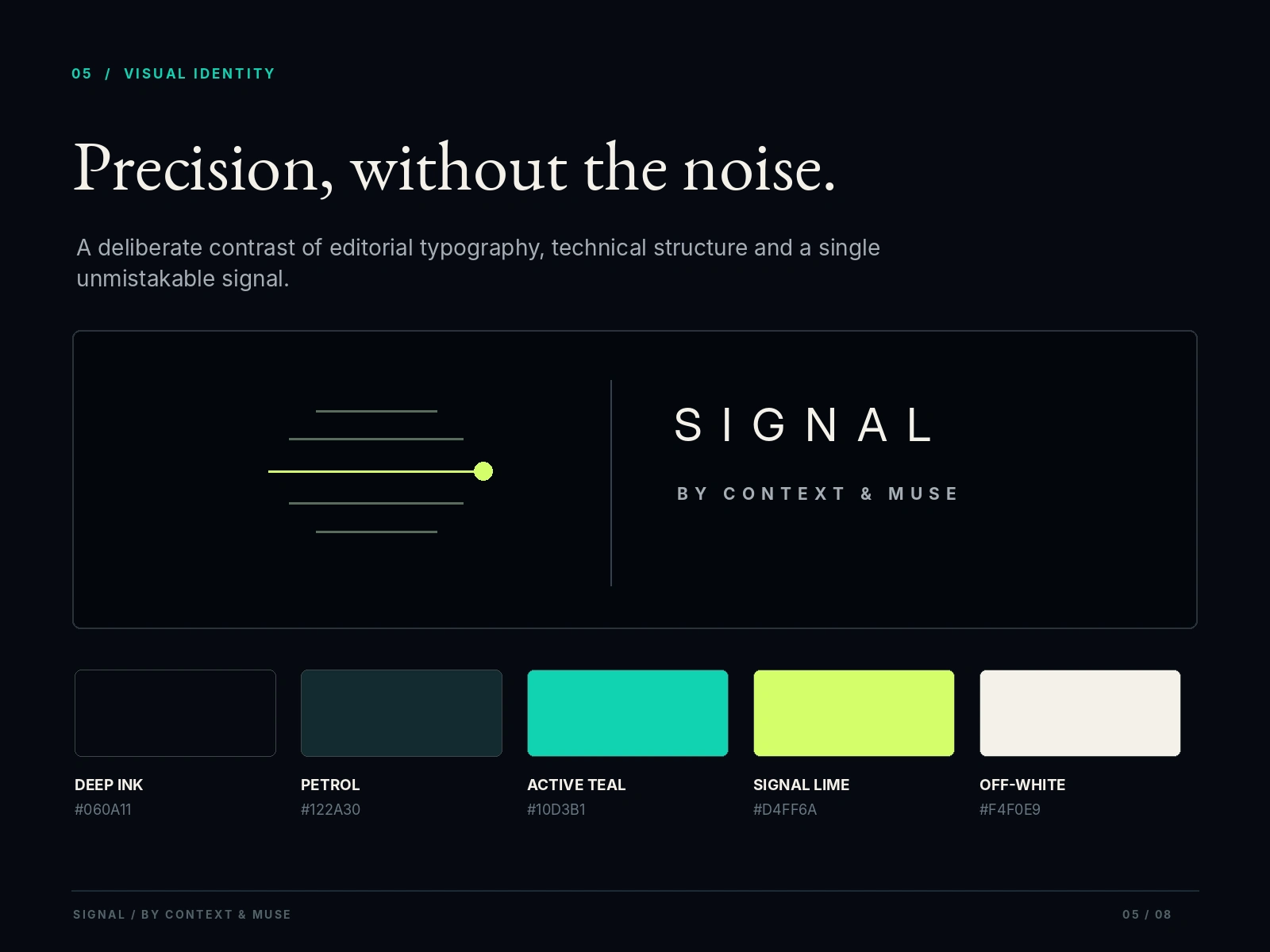
Signal Color Palette.
My Role
I designed the product architecture, information model, decision logic, and operator-facing interface. I also implemented the system with agentic development workflows, defining the constraints, acceptance criteria, and validation boundaries that governed what could ship.
Outcome
The result is a pilot-ready decision-intelligence concept that converts noisy operational inputs into clear, reviewable action paths without collapsing evidence quality and confidence into one score.
Built with
Next.js, TypeScript, and Google Antigravity.
0 likes · 2 views · Oct 20, 2026
A pilot-ready decision-support concept that makes operational signals reviewable, evidence-linked, and clear about AI confidence.


