Linux Fleet Readiness: Risk Audit & Decommission Planning

Joseph Joseph


The problem
Two questions come up constantly in infrastructure work: which Linux hosts need attention before they become an outage or a security finding, and can this host be retired without breaking something?
Audit checks
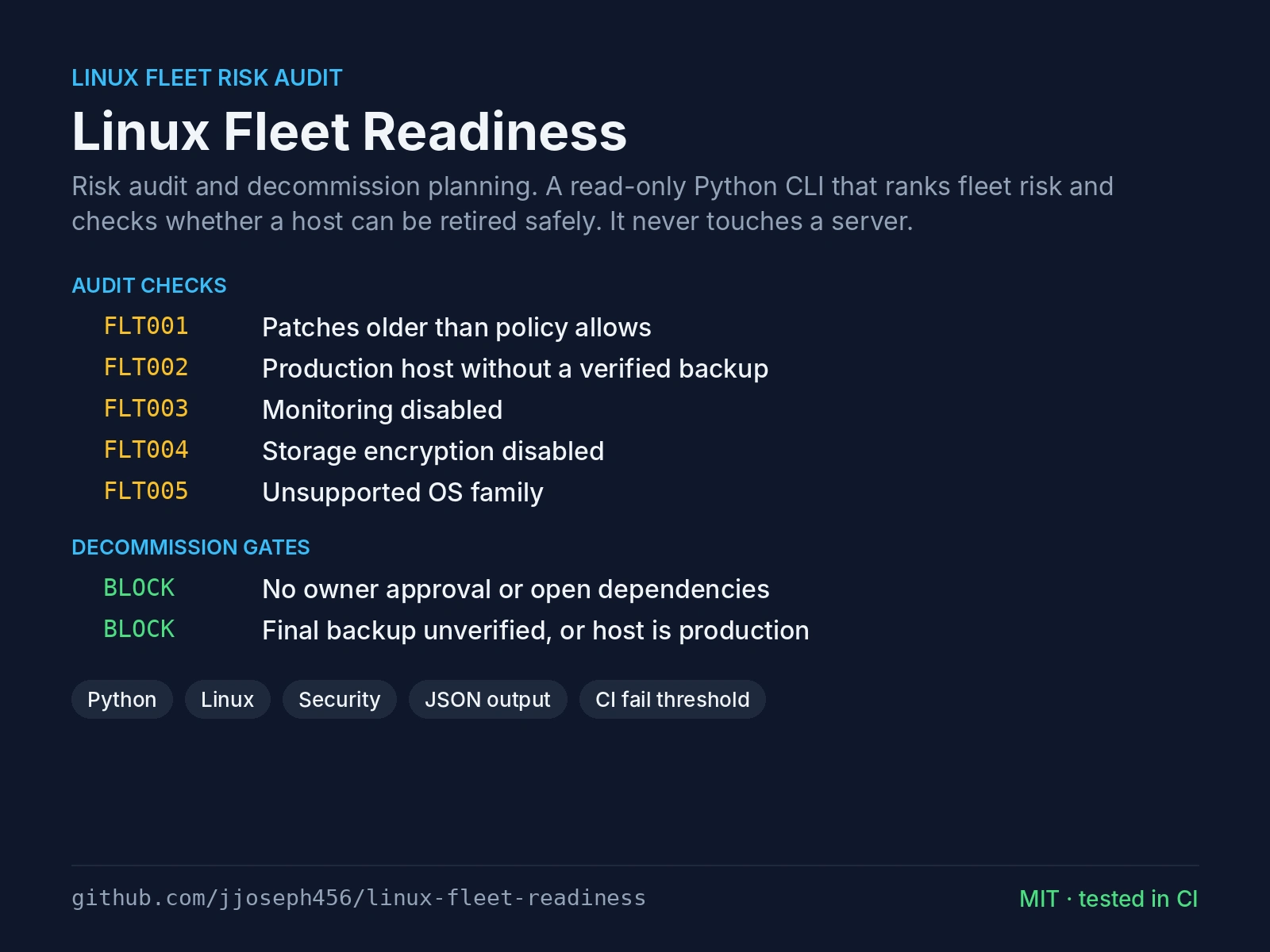
The CLI reads a JSON inventory and policy file and flags:
FLT001 Patches older than policy allows (High)
FLT002 Production host without a verified backup (High)
FLT003 Monitoring disabled (Medium)
FLT004 Storage encryption disabled (High)
FLT005 OS family outside the supported policy (Medium)
Findings are sorted by severity, and a threshold such as --fail-on high lets it fail a CI pipeline.
Decommission planning
A host is blocked if owner approval is missing, service dependencies remain, the final backup is unverified, or it is classified as production. For hosts that pass, it generates a step-by-step plan: evidence capture, traffic removal, monitoring, credential revocation, shutdown observation, resource deletion and inventory closure. It produces a plan only and never acts on it.
Safety design
Read-only: never connects to or changes a server
Strict schema validation, so bad input fails visibly
Audit findings kept separate from decommission plans
Production decommissioning intentionally blocked
Text or JSON output, clear exit codes, no runtime dependencies, Python 3.10+, tested in GitHub Actions.
All examples use synthetic data. This is a personal portfolio project, not client work.
Like this project
Posted Nov 3, 2026
Personal project: a read-only Python CLI that ranks Linux fleet risk and checks whether a host can be safely decommissioned.
Likes
0
Views
1