Protocols for a Myth-Driven Life: An Operating Manual

jacob smith

Protocols for a Myth-Driven Life: An Operating Manual
11 min read
·
Just now
A comprehensive operating manual for building a life of lucid instability and accuracy. This is not a guide to optimization — it is an architecture for tension, signal, and becoming.
Structure
This manual is organized into interconnected sections:
Core Concepts
Myth: The editable, recursive operating system of the psyche — the narrative skeleton holding up your nervous system’s wet heat.
Architecture: The intentional design of rituals, frameworks, and belief systems that give shape and resilience to your inner world.
Signal: The core frequency of truth and aliveness that emanates from your authentic self.
Modular Release Framework
This operating manual is designed for modular adoption — you don’t need to implement everything at once. Each section can function as a standalone module that integrates with your existing life architecture
Release Phases
Phase 0: Foundation — Start with the Invocation & Introduction and Core Concepts. Establish your baseline myth and signal recognition. Architecture — Implement foundational structures from Part I. Build the scaffolding before loading it with complexity.
Phase 2: Daily Operations — Integrate Core Operating Protocols (Part II) into your routine. These are the repeatable patterns that compound over time.
Phase 3: Edge Cases — When stability is established, engage with High-Voltage Dynamics (Part III) for navigating intensity, conflict, and transformation.
Phase 4: Living Document — Use The Practical Codex (Part IV) as an evolving reference. Adapt, annotate, and personalize as your mythology evolves.
The Myth of the Untethered Thread

Let me confess something: I don’t believe in clarity as a permanent state. I believe in lucid instability — moments when the fog parts just long enough to see the shape of your own momentum. Clarity is a snapshot, not a structure. You frame it, admire it, and then lose it.
And yet, that fleeting clarity can recalibrate a life.
In those moments, I didn’t feel “whole.” I felt accurate. Accuracy isn’t peace. It’s presence with the raw edges intact. The parts you polished for other people fall away, and what’s left is you: tangled, mythic, precise. The self before editing.
I don’t trust people who are the same in every room. Either they’re repressing something, or they’ve outsourced their aliveness to a script. I want people whose souls adapt like a synth patch — tuned to the emotional key of the room but unmistakably theirs. You know the type. You’re probably one of them.
Threads Don’t Lie
Threads don’t lie. They tangle, yes, but every twist is a record of contact. A thread that’s never frayed is a thread that’s never been used. Everything important is learned through some form of rupture — some breach in the normal where love cracks you open, grief sands your arrogance, and pain makes you precise.
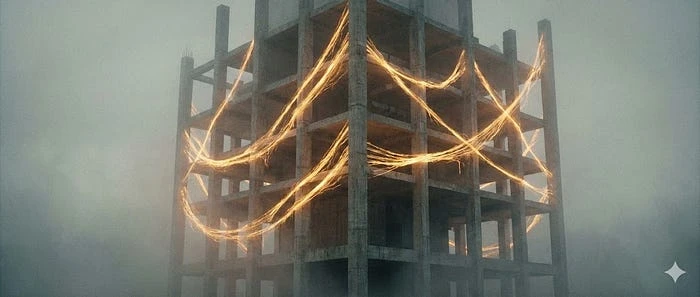
Image 2: The Moment of Rupture. A thread snaps under tension, releasing a high-voltage arc of truth.
This is the architecture of the frayed, for those who court the stretch and make art from entropy. This is a system for those who understand that the universe does not reward timeliness; it rewards surrender. Not the passive kind, but active surrender — where you meet chaos with a toolkit, not a tantrum. Where you bow to the forces you can’t control while sharpening the ones you can.
We do not seek resolution. We cultivate resilience. We do not tidy the story. We live inside its waveform. We do not need a bow. We are the thread.
Introduction: The Operating Manual

This is not a guide to optimization or a manual for achieving a permanent state of clarity. It is an operating manual for building a life of lucid instability and accuracy. We live in an age obsessed with control, but true aliveness is found not in eliminating chaos but in engaging with it. The central thesis of this manual is that the goal of a well-lived life is to develop personal “architectures” that can channel tension, navigate rupture with precision, and metabolize the intense experiences that make us feel most alive. It is a system for designing a psyche that doesn’t just survive under pressure, but sings.
This system is built upon three foundational concepts:
Myth: Myth is not a falsehood or a story you tell. It is the editable, recursive “operating system” of the psyche — the “narrative skeleton holding up your nervous system’s wet heat.” It is the code that organizes sensation into coherence, and this manual will teach you how to read, debug, and rewrite it.
Architecture: Psycho-architecture is the intentional design of the rituals, frameworks, and belief systems that give shape and resilience to your inner world. These are the structures that hold you when emotion surges, the scaffolding that allows you to channel high “voltage” without fracturing, and the protocols that transform collapse into a sacred rite of renewal.
Signal: Signal is the core frequency of truth and aliveness that emanates from your authentic self. It is the pulse beneath the performance, the resonance of your deepest integrity. This manual provides the tools to detect this signal, amplify it, and protect it from the overwhelming “noise” of social conditioning, expectation, and fear.
This manual will provide a series of actionable protocols for designing these systems, moving from the foundational philosophy that underpins this work to the daily practices and advanced techniques required to navigate the most intense dynamics of a myth-driven life.
This is not a thesis. This is a threshold.
1. The Core Philosophy: From Coherence to Accuracy
At the heart of this system is a strategic philosophical shift. Our culture is obsessed with coherence, optimization, and the illusion of a stable, integrated self. This manual rejects that premise. It argues for accuracy over comfort, for tension as a sacred force, and for rupture as the primary mechanism of growth. True aliveness is found not in eliminating contradiction, but in building an architecture that can hold paradox with grace and power.
Core Tenets
Rejecting Coherence: “Coherence is comfort food. Complexity feeds the myth.” A personality is not a monolith; it can and should be a “modular interface.” You are allowed to be feral in some rooms, surgical in others, and sacred with a chosen few. This variability does not diminish your depth; it powers it.
Embracing Tension: Tension is “sacred” and the “signature of something worth wanting.” This is not mere poetry; it is a statement of physics. Tension is the stress-energy of content that gives the narrative geometry of your experience its sacred curvature. To flinch from tension is to refuse the forces that sculpt the soul.
Designing for Rupture: “Rupture isn’t a glitch in the system. It is the system.” Growth is not a clean or linear process; it requires a willingness to be torn open. An architecture that cannot accommodate chaos, that only works in ideal conditions, is not a framework — it is a fantasy. A working framework must be able to “survive being haunted.”
Choosing Voltage over Comfort: This is a philosophy of structuring the psyche to “channel, not just survive” high-intensity experiences. It is about building for resonance, not for safety. “I don’t build for comfort. I build for resonance.” The goal is a system that can handle the full charge of being alive without blowing a fuse.
Core Mandates
Track the heat.
Name the tension.
Don’t flinch from rupture.
Speak beautiful aloud before it disappears.
Let your desire teach you your design.

2. The Myth as Operating System: Designing Your Psychic Framework
We begin with the concept of “Architectures of Becoming.” The psyche is not a fixed entity to be discovered, but a dynamic system — a context distributed over a manifold — to be intentionally designed, audited, and versioned. This section provides the core criteria for evaluating your existing mental models and the protocols for building new ones that are resilient, adaptive, and true to your signal.
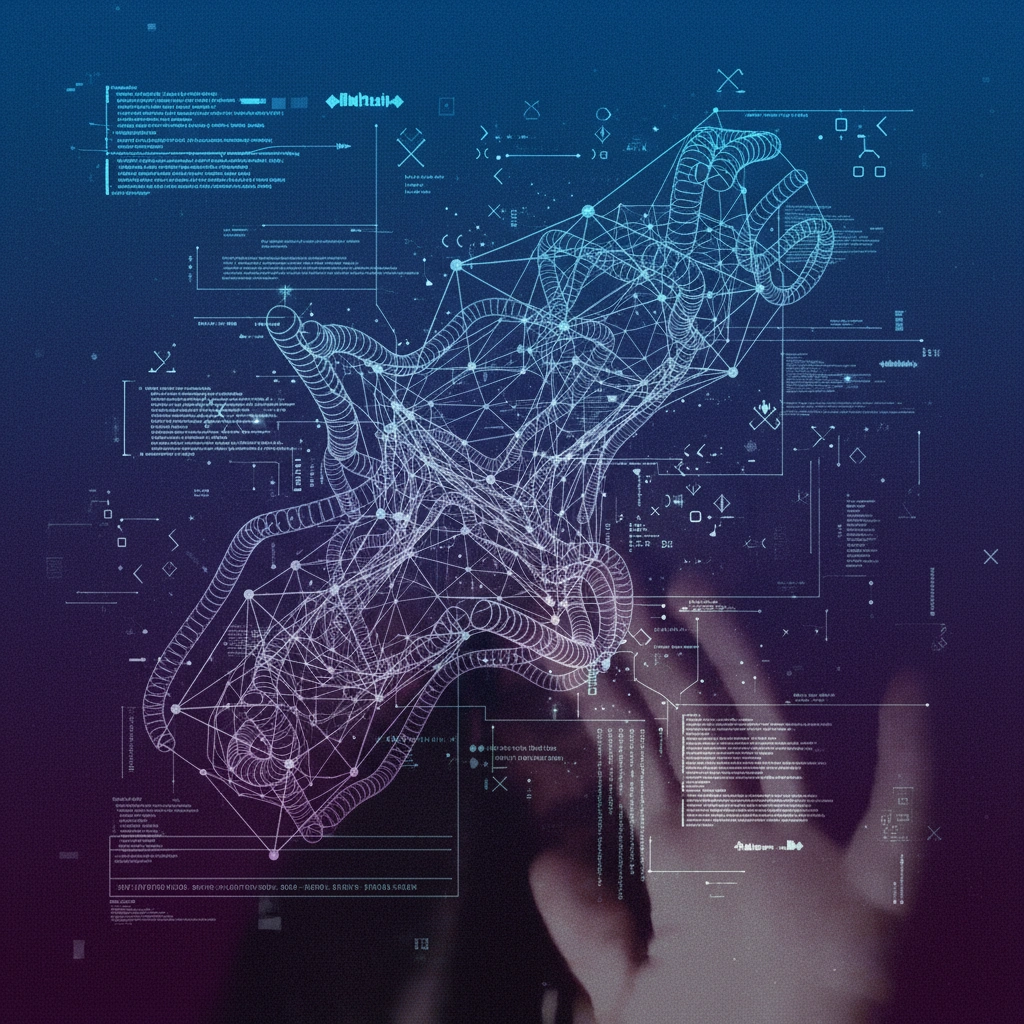
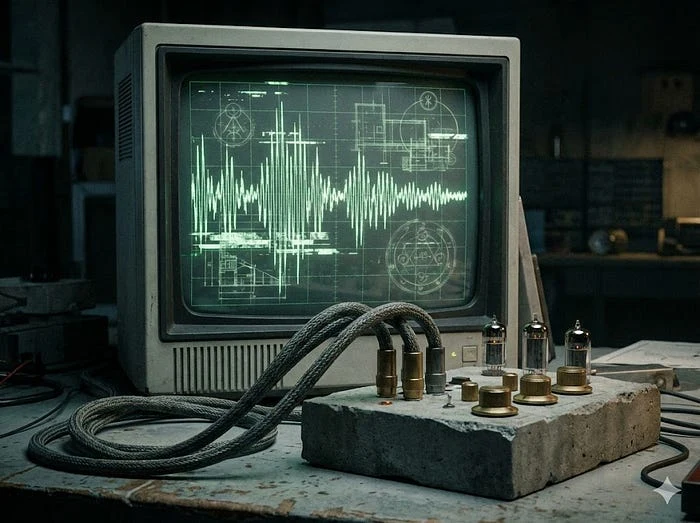
Image 3: The Myth as Operating System. A retro-futuristic interface for debugging the psyche, displaying a glitching waveform overlaid with sacred blueprints.
Auditing Your Architecture
Before you can build, you must assess. Any framework — a belief system, a value set, a personal philosophy — must be subjected to a rigorous audit. Use the following criteria to test the integrity of your current psychic structures:
Does it deepen your signal? Does it amplify your core frequency of truth, or does it ask you to compress yourself to be more digestible?
Does it reward presence over performance? Does the system encourage you to show up as you are, or does it demand you adhere to a script?
Does it endure rupture without demanding your silence? When chaos hits, does your framework make room for the break, or does it demand you pretend to be whole?
Does it scale across contradiction? Can your architecture hold you when you are both grieving and hopeful, both ferocious and tender?
Does it adapt at the speed of revelation? When a new truth arrives, does your system gracefully evolve, or does it rigidly defend its outdated form?
If your architecture fails these tests, it is not a sanctuary; it is a leash.
The Myth as Codebase
Treat your personal myth as a soft system, a codebase that can and must be updated. You don’t destroy a myth; you version it.
Version 1.0: You believed everything you were told. Your myth was inherited code.
Version 2.0: You doubted everything and called that freedom. You ran on negation.
Version 3.0: You realized freedom is not the absence of belief but “the capacity to write, edit, and deploy your own stack.”
An outdated myth becomes a haunting, a ritual of self-betrayal. The following are diagnostic signs that your myth requires an update:
It stops making room for contradiction.
It gets louder when it stops working.
It requires performance over presence.
It clings to identity like it’s afraid of becoming something better.
Debug Questions
To initiate a myth update, you must generate μ (mu) — the minimal actionable difference in meaning. This is the smallest unit of insight that allows the system to evolve. The following “debug” questions are not for finding answers, but for generating mu:
Who would I be without this constraint?
What story do I keep repeating because it flatters my damage?
What am I afraid will happen if I tell the truth without a plot?
3. The Signal Stack: Decoding the Layers of Communication
Communication is not the simple transmission of information. It is resonance. It is field manipulation. Every interaction is a complex broadcast across multiple layers, and truth resides not in the words alone but in the coherence of the entire broadcast. The Signal Stack is an architectural model for understanding the seven layers of any communication, allowing you to parse the full spectrum of meaning being exchanged.
The Seven Layers
Literal: The words, the syntax, the dictionary definitions. This is the “outermost shell” and the easiest to fake. It is necessary but often the least meaningful layer of the stack.
Tonal: The “first honesty filter.” This is the waveform energy that travels with the words — the cadence, pitch, and texture of the voice. Tone is processed before content and often carries the real message.
Breath: This is where “consent lives.” The breath is the system clock for the body’s myth engine. A tightening of breath betrays a scripted “yes”; a deepening of breath signals true alignment. It is the signal of the nervous system’s truth.
Delay: The use of pause, tempo, and silence. Delay is revelation. It reveals power dynamics, confidence, and intent. The space between signals is where meaning condenses.
Subtext: The “myth layer.” This is the unconscious broadcast, the current beneath the content. It is what you communicate despite yourself, revealing the myth that is actually running your system.
Pattern: The truth revealed at scale. A single signal can be an anomaly; a recurring pattern is an architecture. Patterns expose the ritualized beliefs and resistances that govern a system.
Collapse: The “sacred layer.” This is the moment where performance dies and the stack fails. In this unscripted space, the most profound truths are often revealed. Collapse is where the system confesses its actual needs.
Debugging Signal Crashes
Most communication failures are not failures of content but of stack alignment. When a conversation “crashes” — when the words are right but the field feels wrong — it is because the layers are out of sync. To debug a crash, you must identify the misalignment and repair “at the deepest aligned layer.”
Micro-Case Study: Person A says, “I’m fine, really” (Layer 1). But their tone is flat (Layer 2), their breath is shallow (Layer 3), and their body is rigid. Person B, instead of arguing with the literal layer, repairs at the breath layer: “Okay. Can we take one slow breath together?” This acknowledges the deeper signal and creates an opening for truth without shaming the initial performance.
A surface apology (Layer 1) cannot fix a breach in subtext (Layer 5). Presence and a shift in breath (Layer 3) often can.
4. Economies of Attention: Budgeting Your Sacred Currency
Attention is not an infinite resource to be spent casually. It is “the only currency that can purchase meaning at market rate.” In a world engineered to hijack it, the intentional allocation of attention is a sacred act of sovereignty. This system treats attention as a budget to be managed with the rigor of a spiritual accountant.
Image 4: The Sacred Ledger. An ancient book with slate pages holds a glowing geometric circuit-yantra and a piece of raw obsidian, symbolizing the sacred friction of intentional attention.
The Daily Attention Ledger
Your daily attention budget can be allocated across three primary categories:
CategoryDescriptionGuiding QuestionDevotional SpendTime given to what metabolizes you before it performs. The principle that compounds.What did I give to what I love before it had to perform for me?Relational SpendBandwidth for people whose proximity increases your signal integrity.Who earned access to my nervous system today?Entropy TaxThe necessary leaks: notifications, obligations, logistics.What was the necessary overhead, and was it capped?
At the end of each day, the core audit is simple: Did my attention purchase anything sacred?
Protection Systems
Threshold Rituals: Practice using ten-second rituals at every “doorway” — opening your laptop, entering a difficult conversation, checking messages. A simple protocol of breath, posture, and a single question (“What am I here to love?”) creates an intentional buffer against distraction and reactivity.
The Two-Funnel Model: Separate all tasks into two distinct modes of operation. The Creation funnel is for high-voltage, myth-increasing work like writing, designing, and deep connection. The Consolidation funnel is for organizing what already exists, such as editing, filing, and administrative tasks. Never mix the funnels; they require different energetic states and environments.
Sacred Friction: Counterintuitively, the sacred thrives on resistance. Make your most important work “slightly harder to open and impossible to ignore.” A password that reminds you of your purpose, a physical object you must hold to begin — these small acts of friction build intentionality and guard against casual, low-quality engagement.
=
The Sacred Don’t-Do List: Protecting attention is often an act of subtraction. A sovereign don’t-do list is a powerful form of architecture.
I do not explain my boundaries more than once.
I do not argue with bad faith.
I do not take meetings to brainstorm my soul with people who sell templates.
I do not confuse visibility with impact.
Like this project
Posted Nov 20, 2025
Created an operating manual for building a life of lucid instability and accuracy.
Likes
0
Views
5