Guide to Building a High-Converting Sales Funnel

Oladele Steve

The Ultimate Guide to Building a High-Converting Sales Funnel with HubSpot
Are leads falling through the cracks? Does your sales process feel more like a guessing game than a predictable engine for growth? You’re not alone. Many businesses struggle to turn strangers into patrons.
But what if you could create a clear, automated path that guides potential customers from their first click to their final purchase — all within a single, powerful platform?
In this guide, we’ll break down how to build a high-converting sales funnel using HubSpot’s free tools. You’ll learn how to attract the right audience, convert them into qualified leads, and nurture them into loyal customers, creating a sales machine that works while you sleep.
Why a Sales Funnel is Your Non-Negotiable Growth Tool
A sales funnel is a strategic map of your customer’s journey. It’s not just a concept; it’s an operational framework that allows you to:
Systematize your sales process.
Personalize communication at scale.
Measure and optimize what’s actually working.
Ignoring it means operating blindly, wasting resources on unqualified leads, and missing crucial opportunities to engage buyers when they’re most ready.
HubSpot provides the integrated toolkit — from its free CRM to its marketing hub — to not just understand this journey, but to actively manage and optimize it without draining your budget.
Mapping the Journey: The AIDA Model Meets the HubSpot Funnel
The classic AIDA model (Awareness, Interest, Desire, Action) perfectly aligns with HubSpot’s functionality. Here’s how to execute each stage.
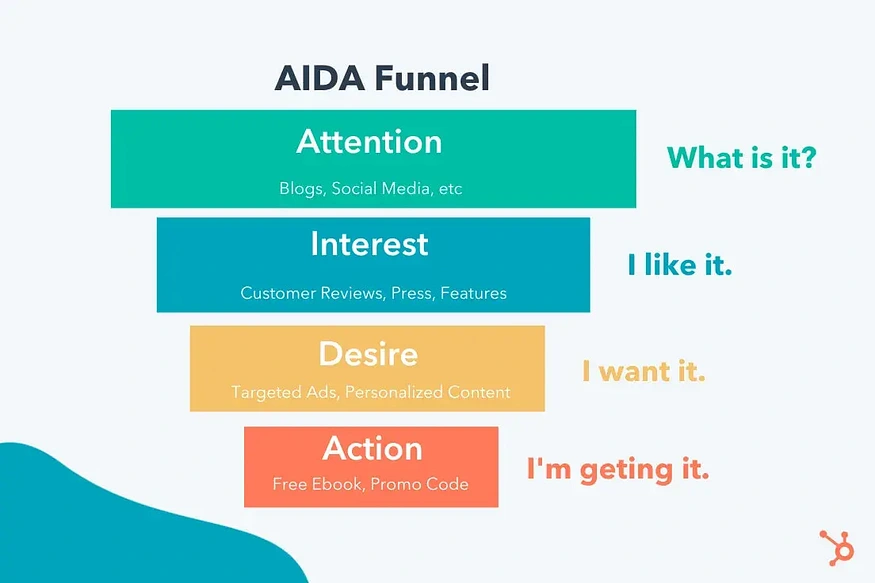
AIDA Model
Stage 1: Awareness (Attracting Strangers)
Goal: Generate awareness and attract potential leads with top-of-funnel (TOFU) content.
HubSpot Tools: Blog Module, SEO Recommendations, Social Media Tools.
At this stage, potential customers are discovering they have a problem. They’re searching for answers on Google and social media. Your job is to be the solution they find.
Actionable Strategy: Use HubSpot’s SEO suggestion tool to find keywords your ideal customer is searching for (e.g., “how to generate more leads,” “what is a crm”). Create blog posts that answer these questions directly.
HubSpot in Action: Every blog post should include a relevant call-to-action (CTA) built with HubSpot’s CTA tool, offering a lead magnet like an ebook or checklist to capture visitor information.
Stage 2: Interest & Consideration (Converting Visitors into Leads)
Goal: Capture contact information and nurture the lead with middle-of-funnel (MOFU) content.
HubSpot Tools: Landing Pages, Forms, CRM, Email Marketing.
A visitor is now interested and wants a deeper solution. This is where you offer valuable content in exchange for their contact info, turning an anonymous visitor into a known lead in your HubSpot CRM.
Actionable Strategy: Create a dedicated landing page using a HubSpot template for a specific lead magnet (e.g., “The Ultimate Guide to Lead Nurturing”). Embed a simple HubSpot form to capture names and emails.
HubSpot in Action: The moment a form is submitted, the contact is automatically created in your free HubSpot CRM. You can then trigger an automated email workflow to deliver the content and begin nurturing.
Stage 3: Desire & Decision (Nurturing Leads into Customers)
Goal: Build trust, overcome objections, and motivate a purchase decision.
HubSpot Tools: Email Workflows, CRM Deal Pipeline, Meetings Tool.
Your leads are evaluating their options. They need proof and a push. This is where you use personalized communication to demonstrate value and ease the path to a sale.
Actionable Strategy: Create an automated email nurture sequence that delivers case studies, testimonials, and a personalized offer over several days.
HubSpot in Action: For highly qualified leads, use the HubSpot Meetings tool to let them book a demo directly on your calendar. Create a “Deal” in the CRM and track its stage from “Presentation” to “Closed-Won.”
Stage 4: Action (Delighting Customers into Advocates)
Goal: Complete the sale and foster loyalty to encourage repeat business and referrals.
HubSpot Tools: CRM, Tickets Tool, Surveys.
The sale is just the beginning. A delighted customer becomes your best marketing asset.
Actionable Strategy: Use your CRM to track customer history and provide personalized support. After a purchase, send a follow-up survey using HubSpot’s form tool to gather feedback.
HubSpot in Action: Use support tickets to resolve issues quickly, show customers you value them long after the deal is closed.
Optimizing Your HubSpot Sales Funnel: Data-Driven Decisions
An effective funnel is never “set and forget.” HubSpot’s analytics dashboards are critical for optimization.
TOFU Metric: Track Visitor-to-Lead Conversion Rate. Are your CTAs and landing pages effective?
MOFU Metric: Track Lead-to-Customer Conversion Rate. Is your nurture content building desire?
BOFU Metric: Track Deal Win Rate. Is your sales process effective?
Use HubSpot’s A/B testing functionality to test different subject lines, CTA colors, and form lengths to continuously improve these metrics.
Conclusion: Your Funnel is a Living System
Building a sales funnel isn’t a one-time project. It’s a dynamic system that attracts, engages, and delights customers. With HubSpot’s powerful (and often free) tools, you have everything you need to create this system, measure its performance, and scale your growth predictably.
Ready to build your funnel? Sign up for HubSpot’s Free CRM and start turning strangers into customers today.
Like this project
Posted Sep 22, 2025
Freelancer wrote a guide on building a high-converting sales funnel with HubSpot.
Likes
0
Views
4