Wealth & Equity

Usama Tariq
1 collaborator


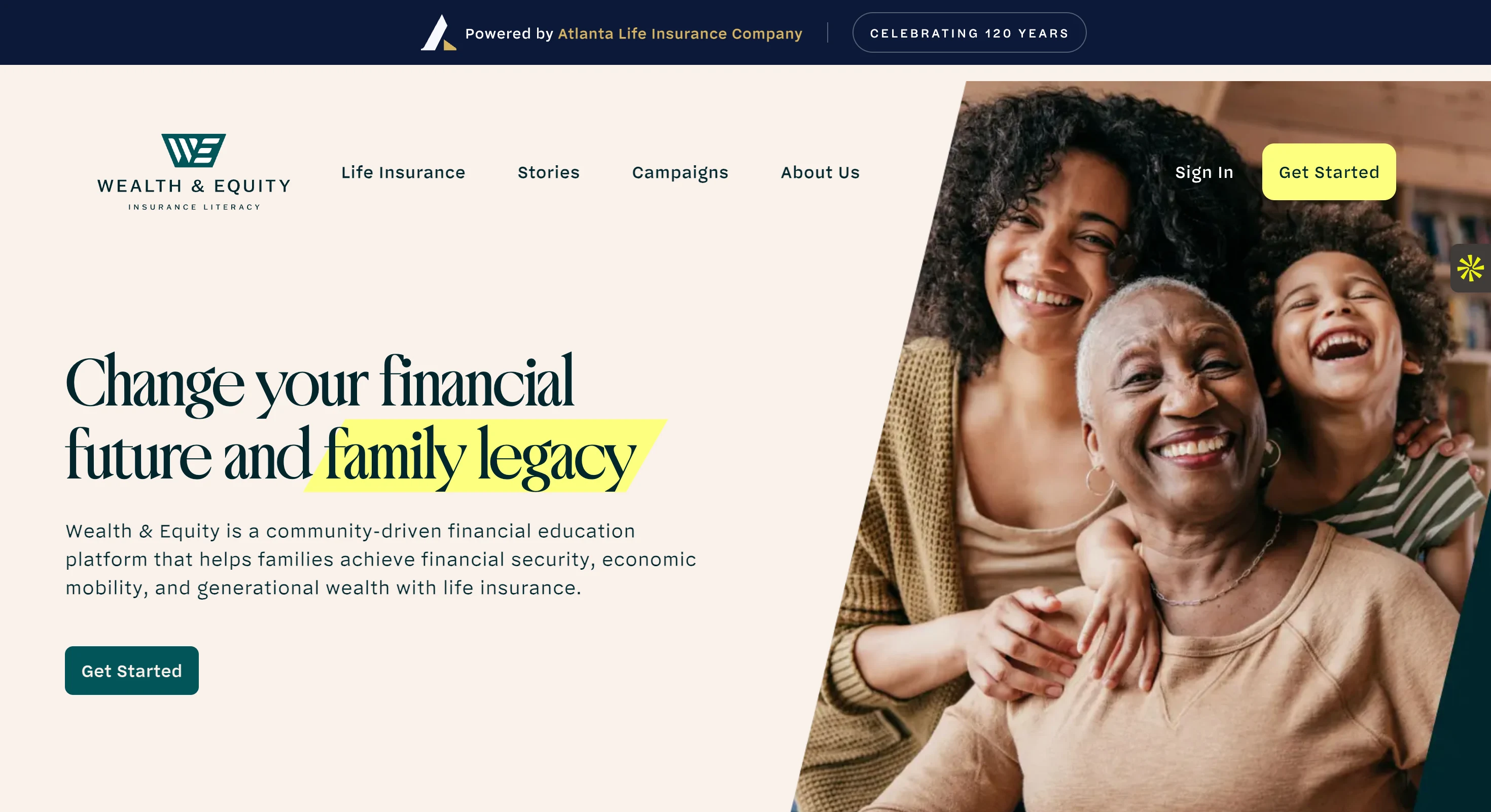
Wealth & Equity platform screenshot
The mission
Atlanta Life Insurance Company is a Black-owned insurer founded in 1905, now in its 120th year. Wealth & Equity (W&E) carries that century-old mission online: help families in diverse and historically underserved communities achieve financial security, economic mobility, and generational wealth using life insurance as the foundation.
The north-star goal is specific: close the life insurance coverage gap in one generation by helping 1 million families each secure $500,000 in coverage. That's $500 billion in financial protection for their communities.
The core idea
The entire experience reframes a person as a "million-dollar asset." The hero math on the homepage says it plainly:
$50K income x 20 years = $1M of earned income worth protecting.
Everything in the app builds from that reframe. You're not "buying a policy." You're protecting and compounding your economic value.
The signature feature: Personal Wealth Potential (PWP)
The centerpiece of the platform is the Personal Wealth Potential calculator. PWP is a computed number representing the total financial contribution a person is expected to make to their family over their working life, derived from inputs like income, years of work, and life factors (childcare, healthcare, and more).
It's the on-ramp: the result becomes the basis for how much coverage a family should carry, and it feeds into their personalized plan. On the backend, a user's PWP inputs and results are persisted in Prisma/Postgres so their plan and account carry it forward.
From a number to a plan: the Roadmap-for-LIFE
Off the PWP result, the app guides users to build a personalized insurance plan called a "Roadmap-for-LIFE," structured around the W&E Personal Wealth Pyramid:
Protect → Plan → Preserve → Pass Along
The pyramid is interactive (click each tier for detail) and educational, walking users through term vs. permanent life insurance, living benefits, and a set of real-life "What ifs...?" scenarios:
What if I die too soon?
What if I get sick and can't work?
What if I want to leave a legacy?
Each scenario maps to a coverage strategy. From there the platform matches users with trusted insurers and advisors, with the option to purchase virtually or meet an advisor over Zoom.
Content, community, and campaigns
Because education is the product, I built out several content-driven surfaces:
Campaigns — Movement pages like "I'm a Million-Dollar Asset" and "The $500 Billion Wealth Gap Bridge," with live stat visualizations that multiply out collective impact.
Family Stories — A rotating library of customer testimonials covering college funding, mortgage protection, small-business coverage, and chronic-illness living benefits.
Blog / Insights & Resources — An authored article system with multiple contributors and categorized posts, backed by a lightweight CMS on Prisma/Postgres so non-engineers can publish.
About — Mission, vision, guiding principles (Education & Awareness, Access to Protection, Community & Partnership), and the company's track record including a prior $50 Billion Empowerment Plan that guided approximately 200,000 clients.
Multiple audiences, one platform
The app isn't just consumer-facing. It serves distinct user journeys for:
Customers — Sign In, Get Started, account login, PWP calculator, plan builder
Agents — Agent Login, W&E for Agents portal
Employers — W&E for Employers portal
Affiliates & Partners — Affiliate Program, partnerships with community organizations, employers, and HBCUs
That multi-role structure is where Prisma models and Postgres relations do the heavy lifting: one platform serving distinct user journeys off a shared data layer.
Why this stack
Next.js — The site is content-heavy and SEO-heavy (marketing pages, campaigns, blog) and interactive (PWP calculator, plan builder, authenticated accounts). Server rendering keeps the public/educational pages fast and indexable while the client-side handles dynamic features.
Node.js — A single-language backend for the API, PWP calculation logic, and integrations.
Prisma + PostgreSQL — A typed, relational data layer for users, PWP inputs/results, multi-role accounts (customer/agent/employer/affiliate), campaigns, testimonials, and blog content, with the referential integrity a financial-services product demands.
The bottom line
I built Wealth & Equity as a Next.js/Node/Prisma/Postgres platform that turns a person's income into a "Personal Wealth Potential" number, then guides them to build a life-insurance plan around it, with a mission to close the racial wealth gap in a single generation.
Like this project
Posted Jul 17, 2026
A full-stack financial empowerment platform built for Atlanta Life Insurance Company to help 1 million families close the life insurance coverage gap.
Likes
1
Views
17
Clients
Atlanta Life Insurance Company
Collaborators