Delivo – Food Delivery Platform & Admin Suite

Delower Hasan


Delivo
Building a food delivery app sounds simple until you realize it's actually three separate products stitched together: a customer-facing ordering app, a restaurant management dashboard, and a backend API that keeps both in sync. Most templates give you one of those. I built all three.
What Delivo Is
Delivo is a complete, production-ready food delivery system designed for restaurants, cloud kitchens, and food delivery startups. It ships as three separate projects that work together:
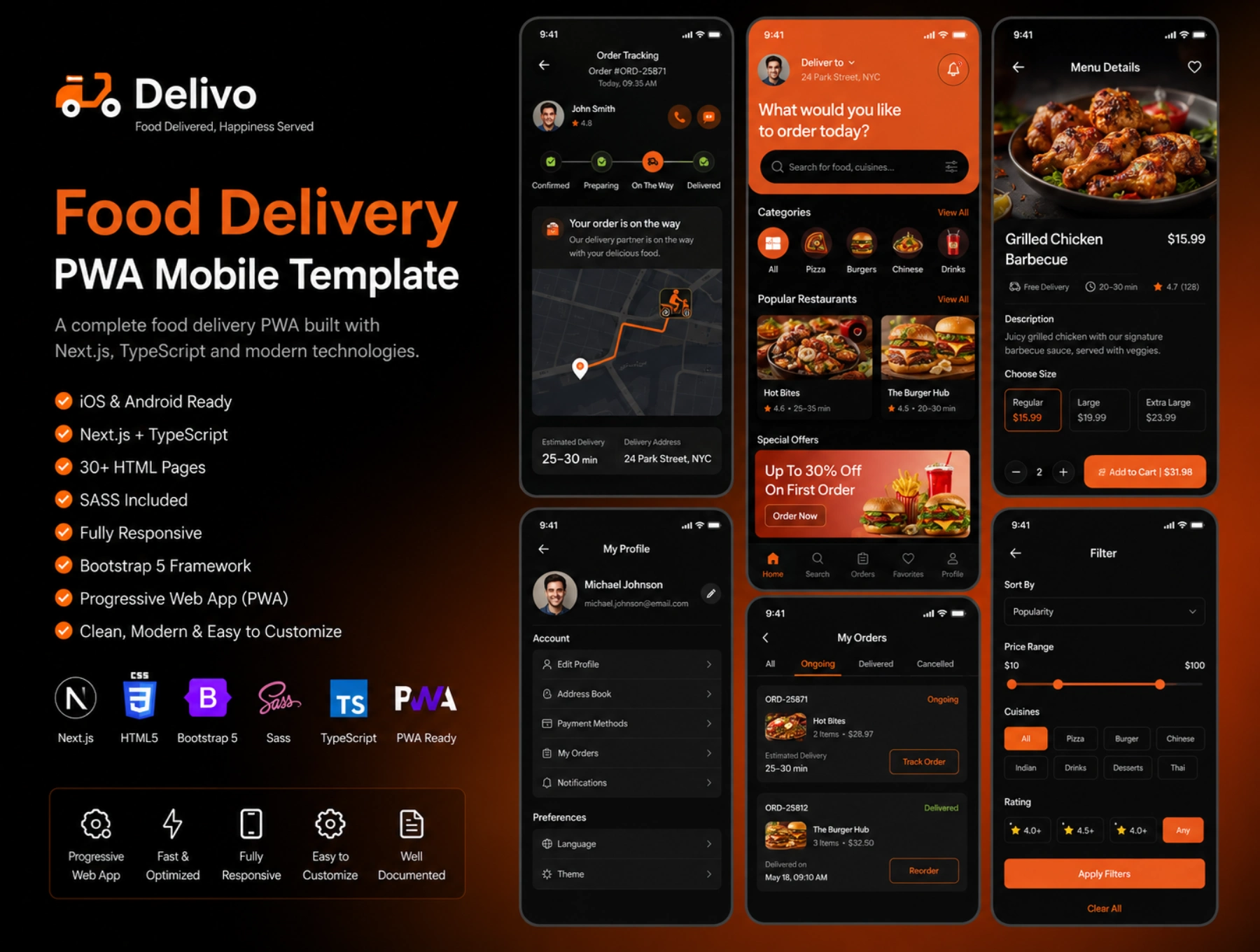
Delivo Client – A PWA mobile app where customers create accounts, browse menus, add items to cart, checkout, and track their orders in real time.
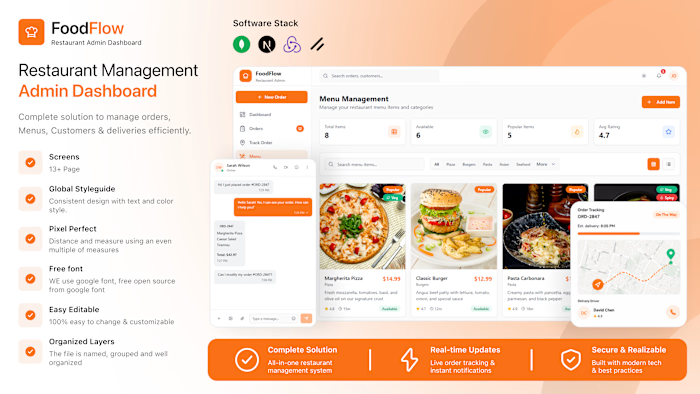
Delivo Dashboard – An admin panel for restaurant operators to manage orders, menu items, products, customers, staff, coupons, reviews, transactions, and events.
Delivo Backend – A NestJS REST API powering authentication, products, cart, orders, users, coupons, reviews, payments, and all admin operations.
The Architecture Challenge
The hardest part wasn't any single feature. It was designing a system where three independent applications share a single source of truth without stepping on each other. A customer placing an order, an admin updating a menu item, and a payment webhook confirming a transaction all hit the same backend simultaneously. The data model and API had to handle that cleanly.
I built the backend as a modular NestJS API with clearly separated concerns: auth, products, cart, orders, users, coupons, reviews, and payments each live in their own module. The frontend apps consume the same API but with role-scoped access, so the admin dashboard sees everything while the customer app only sees what's relevant to them.
Key Features
Customer ordering flow – Browse restaurants and menus, add to cart, checkout with address and payment details, and track order status from placed to delivered.
Order management – Admins see incoming orders in real time, update statuses, and manage the full order lifecycle from confirmation through delivery.
Menu and product management – Full CRUD for menu items, categories, pricing, and availability. Changes reflect instantly on the customer app.
Staff and customer management – Role-based access for restaurant staff, with customer profiles, order history, and communication tools.
Coupon and promotion system – Create, manage, and track discount codes and promotional campaigns with usage limits and expiration dates.
Review and rating system – Customers leave reviews, admins moderate them, and ratings feed back into restaurant and item rankings.
Payment-ready architecture – Transaction management structure ready for any payment gateway integration, with webhook handling and receipt generation.
Real-time chat – Built-in messaging between customers and restaurant staff for order clarifications and support.
Tech Stack
Frontend (Client App): Next.js, React, TypeScript, Redux, TailwindCSS – built as a PWA for mobile-first delivery.
Frontend (Dashboard): Next.js, React, Redux – optimized for desktop restaurant management workflows.
Backend: NestJS, TypeScript, REST API – modular architecture with separate controllers and services per domain.
Database: MongoDB – flexible document structure for orders, menus, users, and transactions.
Who It's For
Delivo is built for developers, agencies, startups, and restaurant owners who want to launch a complete food delivery platform without spending months on infrastructure. Buy it, configure your environment, and start customizing for your market.
Like this project
Posted Jul 29, 2026
A complete food delivery system with a PWA customer app, restaurant admin dashboard, and NestJS backend API, built for restaurants, cloud kitchens, and delivery startups.