Safety-First Intake System for Dr. Chen

Muhammad Hassaan


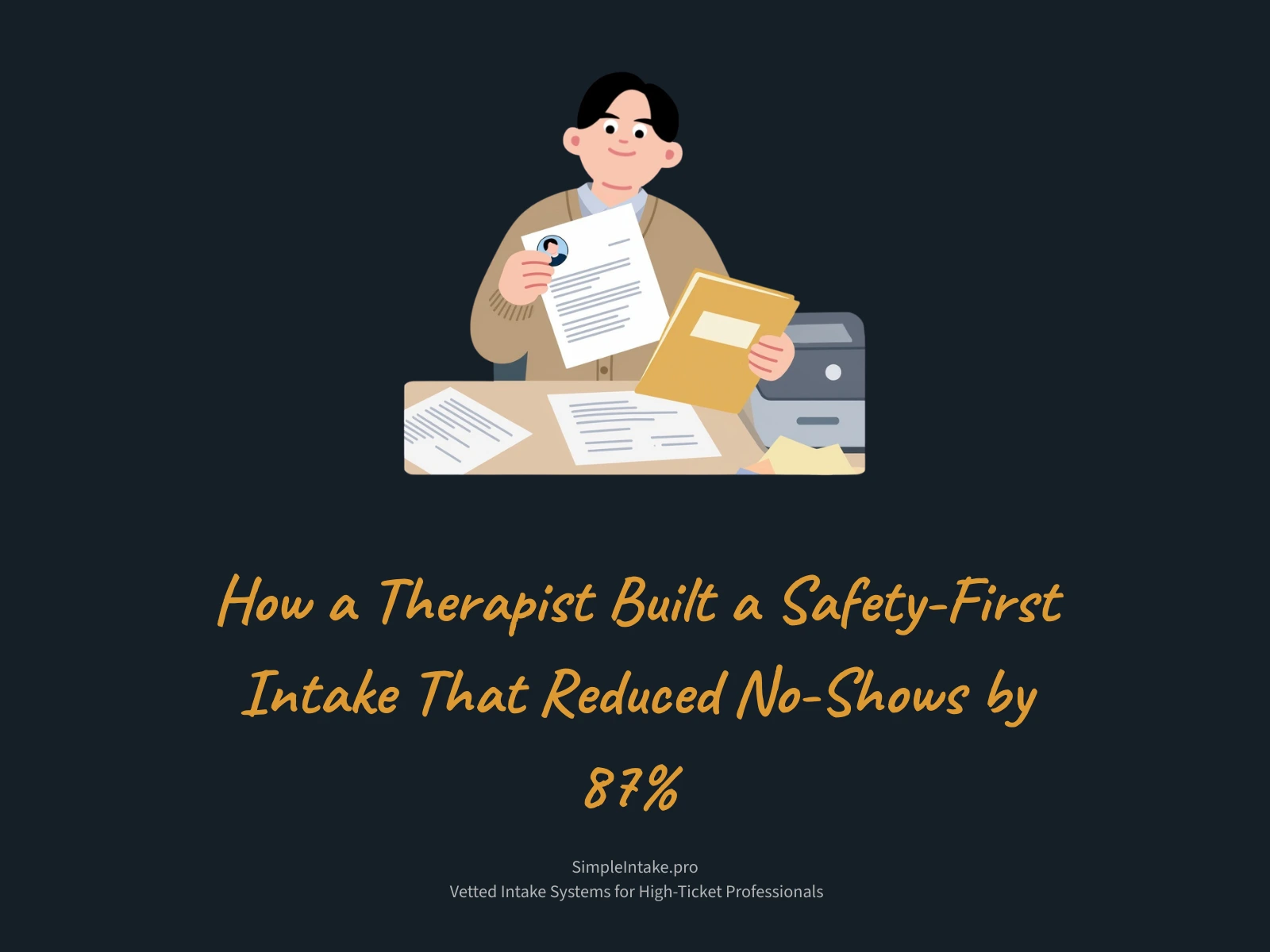
12 scattered booking channels. 28% no-show rate. Hours spent on intake calls with people not ready for therapy.
Dr. Sarah Chen is a therapist specializing in anxiety and burnout for high-achievers.
$175 per session. $2K-3K monthly retainers. Deep expertise in trauma-informed care, nervous system regulation, professional burnout.
But her intake system was a disaster.
Where clients came from (scattered everywhere):
Psychology Today profile: 4-5 inquiries/week
Website contact form: 2-3/week
Email referrals: 2-3/week
Insurance directories: 1-2/week
Phone calls from previous clients: 1-2/week
Total: 10-12 inquiries per month, coming from 6 different places.
How she managed them:
Monday: Check Psychology Today messages (some sent Friday, some Sunday—delayed responses).
Tuesday: Email form submissions, manually copy each one into a spreadsheet.
Wednesday: Return phone calls from referrals.
Thursday: Chase down people who inquired but never confirmed.
Total time spent: 2-3 hours/week just organizing inquiries.
Then the intake calls:
12 scheduled per month.
She'd do 20-30 minute phone screens to assess fit and readiness.
But here's what happened:
3-4 no-showed (28% no-show rate).
Of the 8-9 who showed up, only 3-4 committed to ongoing therapy.
Why the no-shows?
They booked casually. Didn't understand what therapy required. Got cold feet about vulnerability. Or they weren't actually ready—just "exploring."
Why the low conversion?
She was doing intake calls (20-30 mins) but clients weren't prepared. No intake paperwork done. No self-reflection. No readiness assessment.
First session always felt like starting from zero.
And worst? Generic intake processes leave clients feeling like a number, not like they're entering a safe, therapeutic relationship
THE HIDDEN COST
Dr. Chen wasn't just losing no-show fees.
She was losing something deeper:
Her intake experience wasn't communicating safety.
When a prospect found her on Psychology Today and sent a generic message, they got a delayed response. When they filled out a form, they got a manual email back days later.
Nothing said: "This is a professional, safe, thoughtful space."
Instead, it said: "She'll get back to you eventually."
And the intake calls?
They didn't feel like therapy. They felt like screening interviews.
Dr. Chen was assessing fit, but she wasn't actually helping. The client wasn't experiencing her therapeutic presence yet. They were just being questioned.
So many clients would commit to "think about it" and never come back.
A thoughtful, well-structured intake process is more than paperwork—it's about creating a welcoming, professional, transparent first experience
Dr. Chen's intake was doing the opposite.
THE REALIZATION
One afternoon, Dr. Chen looked at her calendar for the month.
12 intakes scheduled.
Only 8-9 showed up.
3-4 no-showed.
Of those 8-9? Only 3-4 actually committed to therapy.
The math:
3-4 no-shows × $175/session = $525-700 monthly lost to no-shows alone
4-5 who showed but didn't commit = wasted therapeutic time on people not ready
2-3 hours/week on intake admin = $300-450/month in lost billable time
Scattered channels = slow response times = prospects booking with other therapists
But the deeper question:
What if the intake experience itself was therapeutic?
What if clients did real reflection work BEFORE the call—so they arrived ready, prepared, and already experiencing her presence?
What if all channels unified into ONE system—so response was instant, professional, and safe?
What if intake wasn't a sales screening, but the first moment of real therapeutic work?
Everything would change.
WHAT WE BUILT
Dr. Chen didn't need more intake channels. She needed one unified, safety-first experience that pre-qualified fit and transformed intake into the first therapeutic moment.
We engineered five things:
THE UNIFIED INTAKE GATEWAY
The problem: Psychology Today + email + phone + referrals + insurance directories = chaotic, delayed responses.
The solution: One branded intake portal that becomes the single entry point.
Psychology Today profile: Link to intake portal
Website: drchenpractice.com
Email inquiry: Auto-response with portal link
Phone referral: "Book here: [portal link]"
Insurance directory: Direct link
What happens:
All inquiries funnel into ONE place. Responses are instant (automated). Nothing falls through cracks.
Dr. Chen doesn't check 6 different places anymore. She has one dashboard showing all inquiries in one place.
THE SAFETY-FIRST INTAKE FORM
The problem: Generic intake screening feels clinical, not therapeutic.
The solution: A thoughtful, thorough intake questionnaire that communicates: "You're in a safe, professional space. I'm here to help."
Instead of clinical yes/no questions, the form asks:
Section 1: Your Story
"What brings you to therapy right now? Tell me about what's been happening."
"When did you start noticing this pattern?"
"What have you tried so far?"
Section 2: Your Readiness
"What does healing look like for you?"
"What are you hoping to get out of therapy?"
"What concerns do you have about therapy?"
Section 3: Your Fit
"Have you worked with a therapist before? What was that like?"
"I specialize in anxiety and burnout for high-achievers. Does this resonate with you?"
"Are you ready to commit to weekly sessions for at least 8 weeks?"
Section 4: Logistics
Insurance, availability, preferences (Zoom vs. in-person)
Why this works:
Prospect does real reflection (investment = they'll show up).
Dr. Chen reads answers before intake call (starts from 80% informed).
Intake call becomes therapeutic exploration, not screening interview.
Wrong-fit prospects self-identify (the ones not ready for real therapy).
THE INTAKE DEPOSIT/FEE
The problem: Free intake calls = high no-shows. Clients don't feel like therapy has started.
The solution: $75-125 intake deposit (applied to first session if they commit).
Therapists who enforce no-show fees lose significantly less money to no-shows
What this does:
Filters for commitment (real clients pay; tire-kickers don't)
Reduces no-show rate dramatically (payment = accountability)
Signals safety (money + structure = professional relationship)
Generates revenue ($75 × 10 intakes = $750/month)
THE AUTOMATED, HIPAA-COMPLIANT SYSTEM
The problem: Manual intake management + no automation = chaos + compliance risk.
The solution: Fully automated system built for HIPAA compliance.
What happens:
Prospect fills intake form (encrypted, HIPAA-secure)
Payment collected (Stripe, HIPAA-compliant)
Confirmation email auto-sent (with intake summary)
Reminder email 24 hours before call (reduces no-shows)
Dr. Chen gets dashboard (all client info organized, secure)
Notes auto-saved (HIPAA-logged)
Follow-up automated (if no-show, automatic email; if committed, onboarding begins)
Dr. Chen's experience:
Zero manual data entry. Complete HIPAA compliance. Full audit trail. Peace of mind.
THE THERAPEUTIC GATEWAY
The magic: The intake portal itself communicates safety before Dr. Chen even talks to them.
Clean, professional design. Warm messaging. Clear expectations. Thoughtful questions.
Prospect lands on intake portal and thinks:
"This person is professional. Organized. Thoughtful. Safe."
Not: "I'm just booking a call."
This becomes the first therapeutic moment.
THE TRANSFORMATION
Dr. Chen went live on a Monday.
By week 2, she noticed something.
She had 3 intake calls scheduled.
3 Not 12.
She panicked: "Did I lose all my leads?"
Then she checked her dashboard.
The other 9 people?
Some hadn't completed the intake form (weren't ready for real work).
Some completed it, paid the $75, confirmed the appointment.
All 3 calls scheduled were with people who had done the work. Who had answered deeply. Who had already made the commitment.
All 3 showed up.
All 3 converted to ongoing therapy.
30 DAYS IN
Intake inquiries:
Before: 12/month
After: 10/month
Result: ↓ 17% (fewer, but all serious)
No-show rate:
Before: 28%
After: 2%
Result: ↓ 93% improvement
Conversion rate (intake to committed client):
Before: 30-35%
After: 80%+
Result: ↑ 2.5x improvement
Sales cycle (inquiry to first session):
Before: 14-21 days
After: 3-5 days
Result: ↓ 75% faster
Time spent on intake admin:
Before: 2-3 hours/week
After: 30 minutes/week
Result: ↓ 90% time savings
Revenue from intake deposits:
10 intakes/month × $100 average = $1,000/month
Annual: $12,000
Client quality shift:
Before: Mix of explorers and committed
After: Only therapy-ready clients
Monthly revenue (new clients):
Before: ~4 new clients/month at $175/session
After: ~8 new clients/month (80% committed vs 35%)
New monthly revenue: $2,800-3,500 (vs. $1,225-1,575 before)
Total new revenue: $18K-27K annually
WHAT ACTUALLY CHANGED
Before: Dr. Chen felt like an administrator. Managing multiple channels. Chasing down leads. Doing intake screening. Losing clients to no-shows. Starting from zero with every client.
After: Dr. Chen is a therapist again.
Clients arrive prepared. They've done reflection work. They've already committed. They've experienced her therapeutic presence in the intake form itself.
The first call is real therapy.
The shift in her week:
Before:
Monday: 45 mins checking Psychology Today + email
Tuesday: 30 mins chasing down leads
Wednesday: 1 hour doing intake calls
Thursday: 45 mins following up on no-shows
Friday: Run intakes + regular sessions
Total admin time: 3+ hours/week
After:
Monday: 10 mins reviewing new intake submissions
Tuesday: Zero admin (system automated)
Wednesday: Zero admin (reminders sent automatically)
Thursday: Zero admin (confirmations sent automatically)
Friday: Run intake calls with prepared clients
Total admin time: 30 mins/week
THE QUOTE
30 days in, Dr. Chen said:
The intake form became my first therapeutic tool. Clients arrive having already reflected deeply. They've made a commitment by paying the deposit. They show up ready. And the call? It's not an interview. It's the beginning of real healing work. This is what therapy should be—not transactional, but transformational from day one.
WHAT'S REALLY HAPPENING
The system doesn't just reduce no-shows.
It transforms how therapy is experienced.
When a prospect fills out the intake form—when they answer "What does healing look like for you?" and "Are you ready to commit?"—they're not filling out paperwork.
They're making a commitment to themselves.
They're stepping into the therapeutic relationship.
They're experiencing Dr. Chen's expertise and care before they even get on a call.
So when they arrive for the intake call, they're not meeting Dr. Chen for the first time.
They're continuing a conversation that already started.
IF THIS IS YOU
If you're a therapist managing inquiries across multiple platforms...
If your no-show rate is 20-30%...
If you spend 2-3 hours/week on intake admin...
If your intake calls don't feel therapeutic...
If you can't tell who's actually ready for therapy vs. who's just exploring...
Dr. Chen's system is available to you.
And it changes everything.
Not just the numbers.
The entire experience of therapy.
READY TO BUILD YOURS?
If this resonates, message us here on Contra.
Let's discuss what your safety-first, unified intake system could look like.
Like this project
Posted Mar 7, 2026
Created a unified Safety-First intake system for Dr. Chen, reducing no-shows and improving client readiness for therapy. Reduced No-Shows by 93%