High-Ticket Consultation Booking System Enhancement

Nnaemeka Anyanwu


PROJECT: CAPACITY PROTECTION
A technical breakdown of the logic, safeguards, and state management behind a fully controlled booking workflow for high-ticket consultations.
The Context: High-Stakes, Low-Volume
The client was a strategic consultant offering high-ticket executive strategy sessions ($2,000+ per session). Their operational drag was invisible but expensive.
Using standard booking links resulted in a "Pending Loop." Clients would book a slot but delay payment. This caused "Calendar Rot"—the calendar was full of tentative blocks that prevented actual paying clients from booking. They spent 3 hours a week manually cross-referencing Stripe payments with Google Calendar events.
They didn't need a scheduler. They needed a gatekeeper.
System Constraints & Goals
To solve this, we couldn't just "zap" data from A to B. We had to enforce strict constraints:
No calendar event is created until funds are secured. Zero exceptions.
Even paid bookings require a final "Approve" click from the consultant before the calendar is touched.
The system must check availability twice: once at request, and again immediately before booking.
The system must filter out "tire kickers" (low-confidence leads) before they ever generate an invoice.
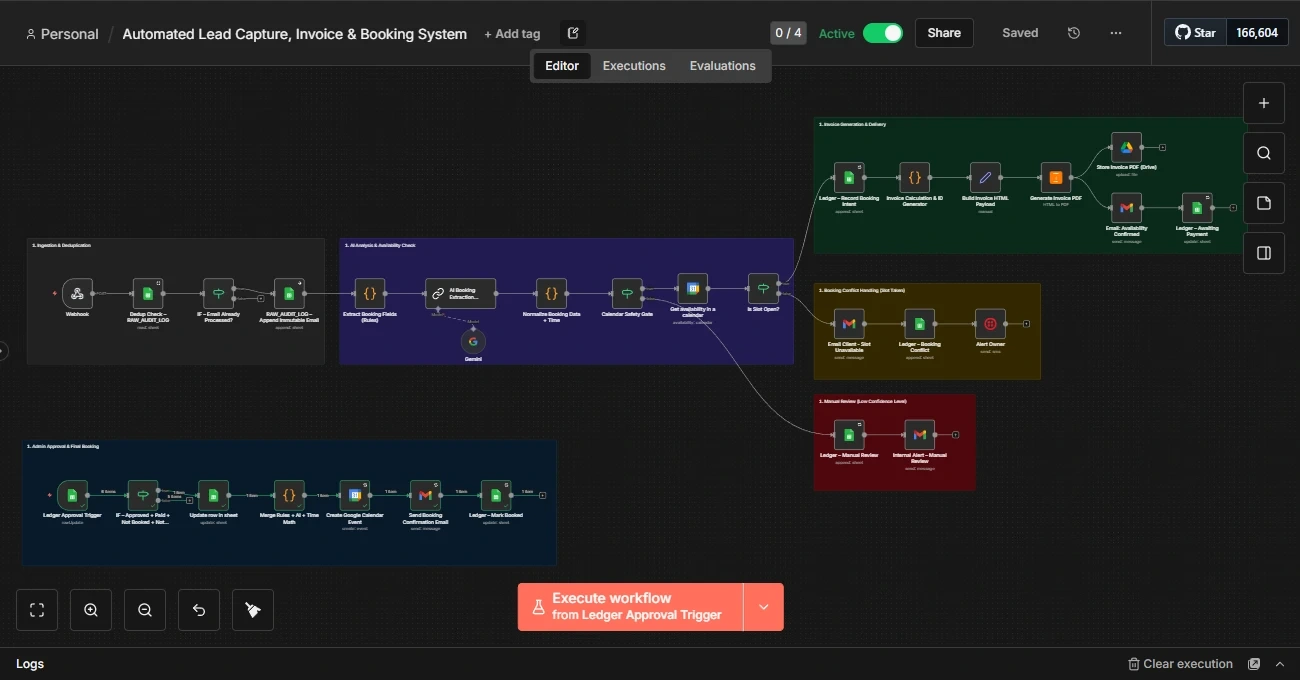
We moved away from linear automation (Trigger → Action) to a layered architecture using n8n.
1. Ingestion Layer: Custom HTML form sending a structured Webhook payload.
2. Validation Layer: Deduplication checks and "Safety Gates" to verify calendar availability in real-time.
3. Intelligence Layer: An LLM (Large Language Model) node to parse the user's message, extracting intent and assigning a confidence score.
4. State Management Layer: A database acting as the "Single Source of Truth" (The Ledger).
5. Execution Layer: The final commit to Google Calendar and Stripe.
Most automations fail because they don't have a memory. If a zap fails, the data is lost. We built a State Machine Ledger using Google Sheets. It doesn't just list leads; it tracks their lifecycle status.
Status Tracking: A lead moves explicitly from
New → Invoiced → Paid → Approved → Booked.Immutability: Once a row is marked
Booked, the system locks that row. It cannot be double-booked.Recovery: If the API fails at step 4, the Ledger remembers we are at step 3. We don't lose the client; we just retry the step.
Trust is built on what happens when things go wrong. Here is how we engineered safety into the system.
We generate a unique hash (
message_id) for every form submission. If a user clicks "Submit" three times, the system checks the Ledger. If the ID exists, it discards the duplicates immediately. No spam invoices.Scenario: A user loads the form at 9:00 AM but doesn't submit until 9:15 AM. In that window, another client books the slot.
Defense: Before processing, the workflow pings the Calendar API. If the slot is taken, the workflow routes to a "Manual Review" path and alerts the owner.
Scenario: A user selects a date but writes: "I'm just testing the form, not ready to buy."
Defense: Standard tools would invoice them. Our AI node detects the intent conflict (Input: "Just looking" → Output:
confidence_level: "low"). The system routes this to a "Lead Nurture" list instead of sending an invoice.The Tooling Stack
We selected tools for reliability and API openness, not just ease of use.
You cannot simply copy-paste this workflow into another business. This is infrastructure, designed to fit the specific contours of your operational risk tolerance.
Business Logic Varies: Your refund policy dictates how we handle cancellations.
Approval Thresholds: Do you want to approve every call, or only ones from new domains?
Payment Timing: Do you invoice immediately, or after a 15-minute manual review?
Is This Architecture Right For You?
Like this project
Posted Jan 28, 2026
This is a "Pay-first" automated workflow that streamlines the transition from client inquiry to paid invoice, preventing "ghost" calendar holds.