Exploring AI: Advantages and Disadvantages

Muhammad Hamdan


Advantages and Disadvantages of Artificial Intelligence
6 min read
·
2 days ago
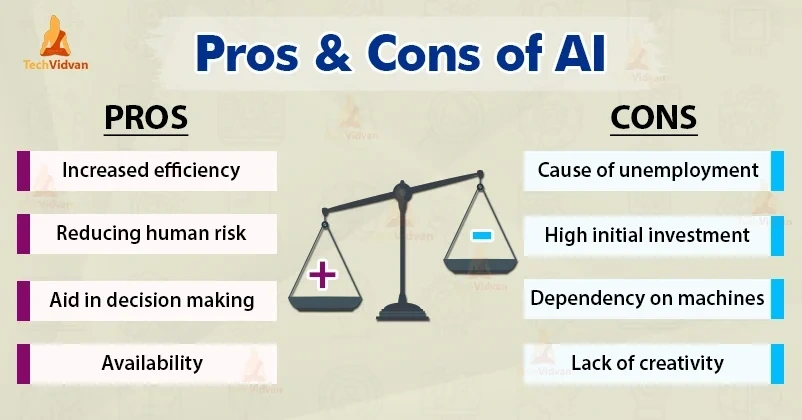
At the forefront of technology development, artificial intelligence (AI) has revolutionized everyday life, businesses, and societies. As artificial intelligence systems are increasingly being applied across a variety of sectors, including healthcare, finance, entertainment, and transportation, they offer several advantages. As with any other technology, artificial intelligence, however, is not free of issues and issues. To give an equal evaluation of AI’s global impact, both its advantages and disadvantages will be examined in this article.
Benefits of AI
1. An increase in production and efficiency
AI is very effective at mechanizing tedious and repetitive jobs, freeing human labor to work on more sophisticated and innovative endeavors. AI systems, for instance, can mechanize assembly lines, inventory management, and even predictive maintenance in industries such as manufacturing and logistics. This lowers the cost of operations, increases productivity, and generates quicker and more efficient results.
In sectors like customer care, AI-based chatbots are simplifying the process of communication and making instant responses to queries. Companies are saving money and time while maintaining customer satisfaction.
2. Medical advancements
Healthcare is among the most notable applications of AI with such enormous potential. Physicians are making diagnoses with higher accuracy than ever before using AI-driven technologies. In terms of early detection of diseases such as cancer, brain disorders, and cardiovascular diseases, medical image analysis algorithms prove more accurate than human doctors.
AI is also aiding personalized medicine through the analysis of patient data and forecasting the most appropriate action according to the specific needs of each patient. AI models assist in drug discovery, which accelerates the long process of research.
3. Enhancing Education
By presenting students with tailored learning experiences, AI is changing education. Adaptive learning platforms powered by AI can determine each student’s learning affinities and tailor the course content accordingly. This personalized strategy improves performance by allowing students to study at their rate.
Through innovative educational technologies, AI is also making remote learning possible and giving teachers and students the tools to create dynamic, interactive learning spaces. AI-based virtual classrooms make high-quality education accessible to more individuals around the globe.
4. Sustainability of the Environment
AI is driving initiatives in environmental sustainability. AI helps in mitigating the effects of climate change through climate pattern forecasting and building energy optimization. AI algorithms, for example, are being employed in predicting energy usage for cities, leading to better grids that are more efficient and wasteful.
Through monitoring vulnerable species and deforestation, AI systems are also assisting wildlife conservation by offering data that is critical in maintaining biodiversity.
AI’s Limitations
1. Job Displacement
AI’s capacity to displace jobs is one of the greatest concerns, especially for those industries that depend heavily on automation. AI enhances productivity but also has the risk of displacing manual and mundane labor, which may lead to massive unemployment in certain industries.
Jobs in customer service, manufacturing, and even some professional services, like accounting, for example, may be in jeopardy. While new opportunities may arise in AI-related fields, these may require advanced skills, leaving low-skilled workers vulnerable and at risk of being left behind.
2. Bias and Discrimination
AI systems are trained by data, and if the data with which these systems are trained contains bias, then the AI will reinforce or even enhance such biases. For instance, in recruitment or loan-dissemination processes, AI systems have been found to discriminate against particular ethnicities or genders because of biased historical data.
This problem raises crucial ethical issues, especially when using AI in decision-making that has direct impacts on individuals’ lives. Transparency and fairness in AI systems should be guaranteed to avoid the possibility of discrimination.
3. Privacy Issues
As AI becomes more widespread, privacy concerns are emerging. AI systems tend to use huge amounts of personal information in order to function optimally, which has raised questions about how that information is collected, stored, and used. Invasive surveillance technologies, including facial recognition, are one of the ways that AI can compromise individuals’ privacy.
Data security is another concern. The possibility of data breaches becomes a serious concern as AI systems gather vast datasets. To protect sensitive data, cybersecurity must advance alongside AI.
4. Human Autonomy Is Lost
While AI has the potential to enhance decision-making, too much reliance on AI can undermine human agency. Humans will lose their ability to make key decisions independently because AI systems take more and more decisions on our behalf, whether in driving, medicine, or managing money. It raises questions about the ethics of providing machines with the capacity to make key decisions.
In addition, the decision-making processes of certain AI models are hidden because they are “black box” in nature. Accountability can be undermined if a machine comes up with a false answer because it could be difficult to determine how or why it happened.
Finalization
AI most certainly does have tremendous potential to enhance all aspects of society. From medicine and learning to sustainability, the benefits are revolutionary. The problem is that these benefits come with considerations that need to be handled with great care. The possibility of job loss, prejudice, privacy violations, and loss of autonomy are concerns that cannot be dismissed.
As we innovate further and increasingly integrate AI into our everyday lives, it is important that we find a balance between getting the best out of it and preventing its adverse consequences. By encouraging responsible AI innovation, having clear ethical principles, and ensuring ongoing discussions, we can make AI a force for good, helping humanity without compromising basic rights and values.
Finally, what we create and control AI to be today will determine its influence on the future, so the discussion has just begun.
FAQs on the Positive and Negative Effects of AI
1. What are the main advantages of AI in the workplace?
AI greatly increases workplace productivity by performing repetitive tasks, simplifying processes, and offering data-driven insights. This frees up employees to concentrate on high-level tasks that involve creativity and problem-solving. AI-enabled tools also improve customer service, enhance supply chain management, and assist organizations in making sound strategic decisions based on analyzing large amounts of data rapidly.
2. How can AI influence the job market?
AI can displace jobs, particularly in industries such as manufacturing or call centers that involve manual or routine work. However, it also creates new jobs as a data scientist, robot developer, or AI programmer. The primary hindrance is reskilling and ensuring employees can shift into these new jobs, which requires adequate training programs and government incentives.
3. Can AI err?
AI systems are not infallible. Although AI is able to process information and spot patterns, it’s not perfect. Missteps are induced by poorly constructed algorithms, faulty training data, or variables not considered in the decision-making process. These mistakes can have serious consequences in key sectors such as healthcare, which is why human supervision is often needed to ensure AI’s reliability.
4. Is AI biased?
Bias can occur in artificial intelligence (AI) if there is bias in the data it is trained against. A system of AI can perpetuate or even exaggerate existing biases, for example, if trained on data that mirrors discrimination within a criminal justice system or discriminatory hiring practices. Developers need to use fairness protocols and a range of representative datasets in order to minimize bias within AI models.
5. What effect does AI have on personal privacy?
To perform effectively, a significant amount of personal information is often required for AI systems. Especially in the wake of observation devices such as face recognition, this has privacy implications. Invasive use of personal information or privacy intrusion may stem from misuse of the data. To ensure personal privacy, AI systems need to be transparent and subject to stringent data protection legislation.
6. How can AI assist the medical sector?
AI is transforming medicine by assisting in the more accurate diagnosis of diseases. AI systems can analyze medical images, predict patient outcomes, and even recommend personalized treatment plans. AI also accelerates clinical studies and drug development, enhancing the efficacy and accessibility of medicine.
We need rigorous legislation, moral codes, and continuous monitoring to be able to fit into society. To ensure that AI is used responsibly and transparently, governments, technology companies, and scientists need to collaborate to create standards. In addition, investing in training and upskilling programs will help people adapt to a rapidly evolving labor market. In order to ensure AI benefits society, it is critical that the ethical considerations of the technology are debated publicly.
Written by: Muhammad Hamdan
Dated: July 5, 2025
Like this project
Posted Jul 14, 2025
Article on AI's advantages and disadvantages published on Medium.
Likes
0
Views
3
Timeline
Jul 2, 2025 - Jul 4, 2025