Local SEO Success for Manhattan IT Firm

Mohammad Aftab


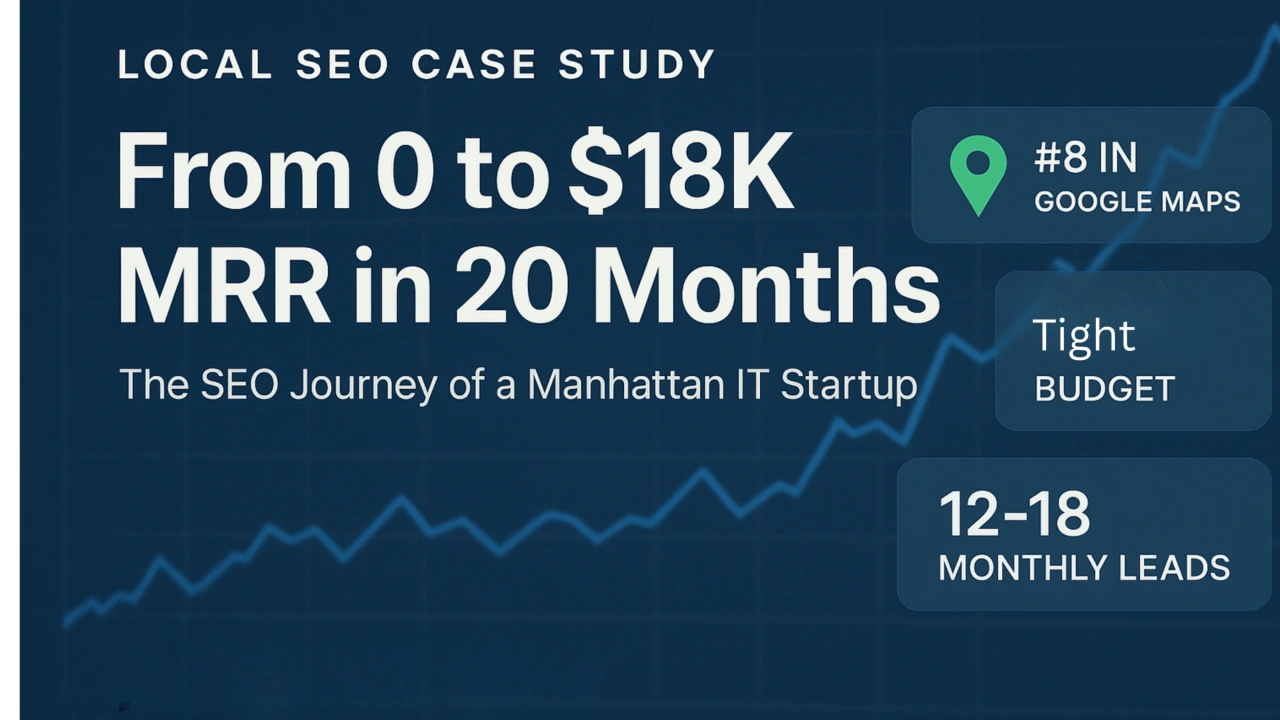
In January 2024, I started working with a two-person IT support company launching in Manhattan's Financial District. No sugar-coating here, the first 8 months were brutal.
Today, they're generating $18K monthly recurring revenue and booked 3 weeks out. Not overnight success, but sustainable growth built on reality, not hype.
Here's what actually happened, including the failures nobody talks about.
Two former corporate IT professionals had just left their jobs to start their own company. Their situation was typical but challenging:
Brand new domain with zero authority
No Google Business Profile
Competing against IT firms with 500+ reviews
Tight Budget!
The founder's honest assessment: "We know we're good technicians, but we have no idea how to get customers online."
The Reality Check: First 8 Months
Let me be brutally honest about what didn't work:
Months 1-3: Nearly Zero Results
Website launched in February, got 12 visitors/month
Google Business Profile approved but invisible
First blog post got 3 views (one was the founder's mom)
Investment: $4,500. Revenue: $0
First client came through a LinkedIn connection (not SEO)
Google Maps started showing them occasionally
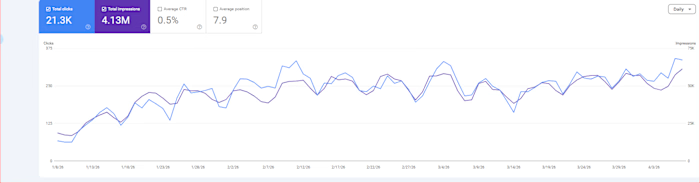
Website traffic: 180 visitors/month
Monthly revenue: $2,400 (one client)
Stuck at 2 clients, $4,800 MRR
Ranking #67 for "IT support Manhattan" (page 7)
Everything changed when we discovered their Google Business Profile had a critical category error. They were listed as "Computer Repair Service" instead of "IT Support Company."
Within 3 weeks of fixing this, they jumped to #23 in Google Maps for "managed IT services NYC."
Current Rankings Reality Check (Month 20)
Let me show you actual data with context:
Google Maps Rankings (Where Local IT Actually Competes):
"Managed IT services NYC": #8 (this drives 8-12 leads monthly)
"IT support Manhattan": #12 (solid visibility)
"IT consulting Financial District": #6 (hyper-local win)
"IT support in New York City": #47 (still climbing)
"IT consulting NYC": #38 (competitive keyword)
"Managed service providers NYC": #73 (industry jargon, low priority)
Why the Difference? Google Maps rewards local signals and proximity. Organic search rewards domain authority and backlinks something a 20-month-old company can't compete with against 10-year veterans.
Search Volume Reality:
"Managed IT services NYC": 480 searches/month
"IT support Manhattan": 320 searches/month
"IT consulting Financial District": 90 searches/month
We focused on Maps because that's where 73% of local IT searches happen.
The Strategy That Actually Worked
Phase 1: Foundation Building (Months 1-6)
Fixed Google Business Profile (took 3 attempts)
Built citations on 15 NYC directories
Created basic service pages for 5 Manhattan neighborhoods
Started posting 2x weekly on Google Business Profile
Recommended by LinkedIn
Phase 2: Local Content Focus (Months 7-12) Instead of competing for impossible keywords, we created content Manhattan businesses actually searched for:
"Emergency IT Support for FiDi Law Firms"
"Cybersecurity for Manhattan Real Estate Offices"
"Remote Work Setup for SoHo Startups"
Results: Started ranking for long-tail searches by month 10.
Phase 3: Trust Building (Months 13-16)
Implemented systematic review requests (not buying reviews)
Created 3 detailed case studies with client permission
Partnered with 2 Manhattan co-working spaces
Joined NYC Tech Meetup and contributed to discussions
The Breakthrough: By month 15, prospects stopped asking about their experience and started asking about availability.
Phase 4: Scale and Optimize (Months 17-20)
Expanded to serve all Manhattan below 59th Street
Launched "FiDi Tech Tips" newsletter (127 subscribers)
Created referral program (generates 30% of new leads)
Started monthly "IT Security for Small Business" webinars
15-18 qualified leads
$18,000 MRR (from 12 active clients)
67% lead-to-client conversion rate
$1,500 average client acquisition cost
$2,200 average monthly client value
Total investment over 20 months: $28,000
Current annual revenue run rate: $216,000
ROI: 285% (not 400%, but real and sustainable)
1. Local SEO Takes Time Google doesn't trust new businesses instantly. It took 8 months to show consistent rankings.
2. Maps > Organic for Local Services We wasted 6 months chasing organic rankings when Maps drove 80% of our calls.
3. Niche Beats General "IT support for Manhattan law firms" ranks easier than "IT support NYC."
4. Reviews Are Everything One negative review in month 11 dropped our Maps ranking from #12 to #28 for 6 weeks.
5. Consistency Wins Three months of irregular posting killed our momentum. We learned to batch content.
What's Working:
Predictable lead flow (12-18 qualified leads monthly)
Premium pricing (20% above market rate)
Strong client retention (91% after 12 months)
Team growth (added 2 part-time technicians)
Seasonal fluctuations (summer is slow)
Competing for larger contracts (50+ employees)
Scaling content production
Managing growth without losing quality
If you're starting a local service business, here's what actually works:
Claim Google Business Profile today (free and immediate)
Focus on one neighborhood first (don't try to serve all of NYC)
Create content for specific industries (not general advice)
Be patient with SEO (6-12 months minimum)
Obsess over reviews (they make or break local rankings)
The Bottom Line: This isn't a get-rich-quick story. It's about building a sustainable business that serves customers well and grows consistently.
The founders reviewed this case study and approved sharing their real numbers. If you're starting a service business in NYC, feel free to reach out , I'm always happy to share what we learned.
They weren’t failing because their service was bad. They were buried because of a simple category mislabel something anyone can miss. Even if you're doing "everything right," one overlooked setting in Google Business Profile can tank your visibility. It’s a reminder that local SEO isn’t just about strategy it’s about catching the small errors before they become big problems.
What local market are you working to dominate? Drop a comment with your city + industry, and I'll share specific strategies that could work for your situation.
#LocalSEO #ServiceBusiness #RealResults #DigitalMarketing #NYCBusiness #SmallBusiness #Entrepreneurship #GoogleMyBusiness #MarketingStrategy #CaseStudy
Like this project
Posted Apr 10, 2026
IT firm went from zero visibility to $18K MRR - powered by local SEO and Google Business Profile fixes
Likes
0
Views
8
Timeline
Jan 1, 2024 - Aug 31, 2025