Decision Fatigue for Users in Online Streaming Platforms

Martins Audu
Decision Fatigue for Users in Online Streaming Platforms
STRATEGYMIXED METHODS RESEARCH
OVERVIEW
Streaming platforms have a paradox at their core: more content, less satisfaction. Users open Netflix to relax and instead spend thirty minutes scrolling, abandoning the search or defaulting to a rerun. This project set out to understand why choice becomes a burden and what design can do about it. For my research I studied decision fatigue in movie and TV selection through a mixed-methods study of 15 people, then translated the findings into concrete design directions for context-aware recommendation systems.
THE PROBLEM
Recommendation engines are built on past behavior, but past behavior is a poor proxy for present need. Watch one heavy drama and the algorithm serves more heavy dramas even when you're in the mood for something else. The result is a system that feels impersonal precisely when personalization is the entire promise.
The research literature framed my hypothesis: more options produce more decision-making stress, and AI recommendations can lower satisfaction when they override user autonomy. I wanted to see how this played out in real selection behavior, not just self-report.
The research question: How do users experience decision fatigue when choosing what to watch, and how might personalized, context-aware recommendations reduce it?
METHODS
I ran two rounds with separate participant pools to triangulate behavior against stated preference.
Round 1, Contextual observation (8 participants, ~15 min each): Participants demonstrated how they'd recommend a show to a friend, recorded and observed in person. I analyzed sessions with the AEIOU framework (Activities, Environments, Interactions, Objects, Users) and built sequence/flow models of the recommendation process.
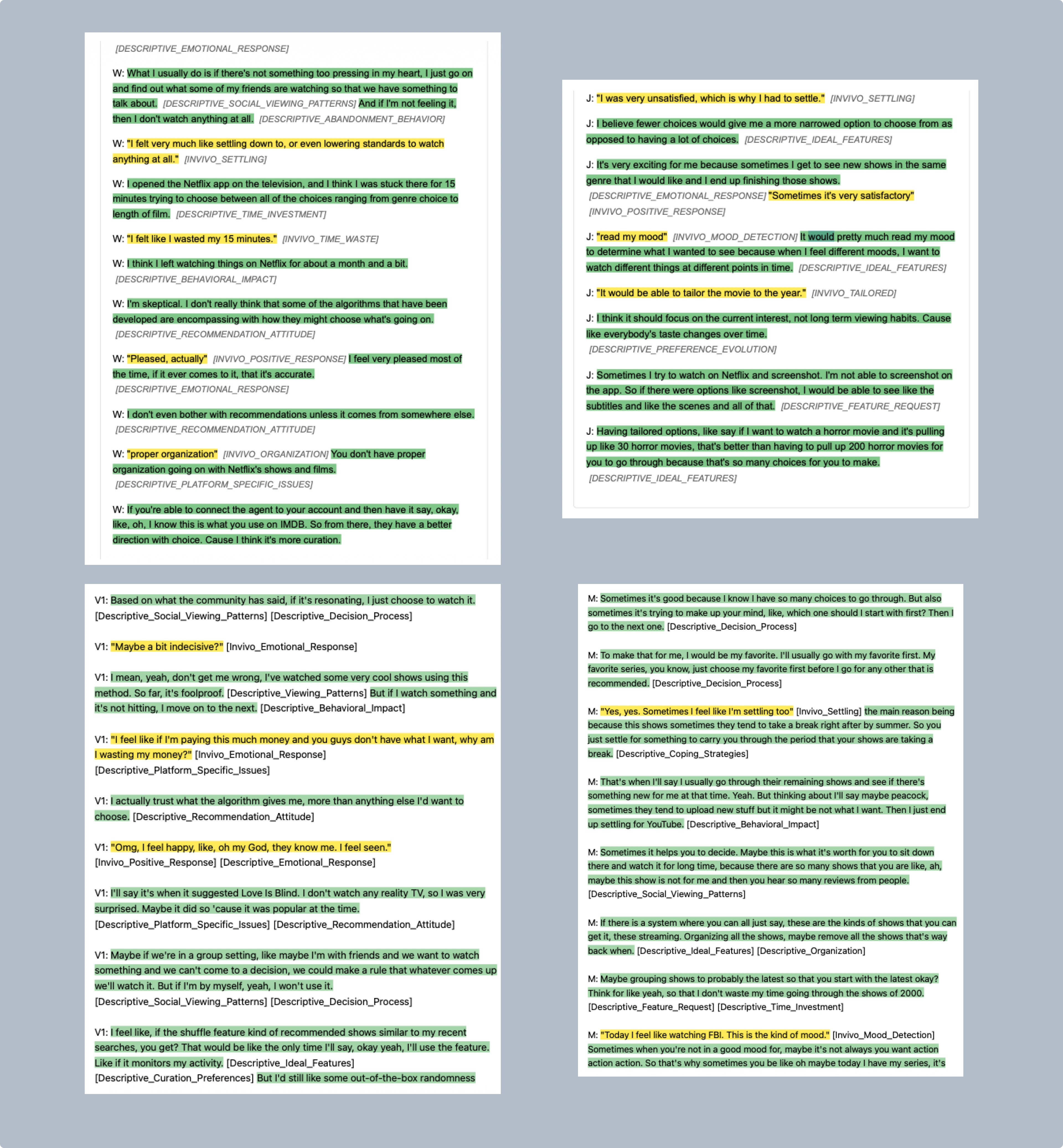
Round 2, Semi-structured interviews (7 participants, 20–30 min each): Conducted in person and over Zoom, focused on decision-making processes, experiences with recommendation systems, and streaming habits. Each transcript was descriptively coded in Atlas.ti, then reconciled into a shared codebook.
Participants spanned ages 19–62 across a range of occupations and tech fluency, screened for recent streaming use.
WHAT I DISCOVERED
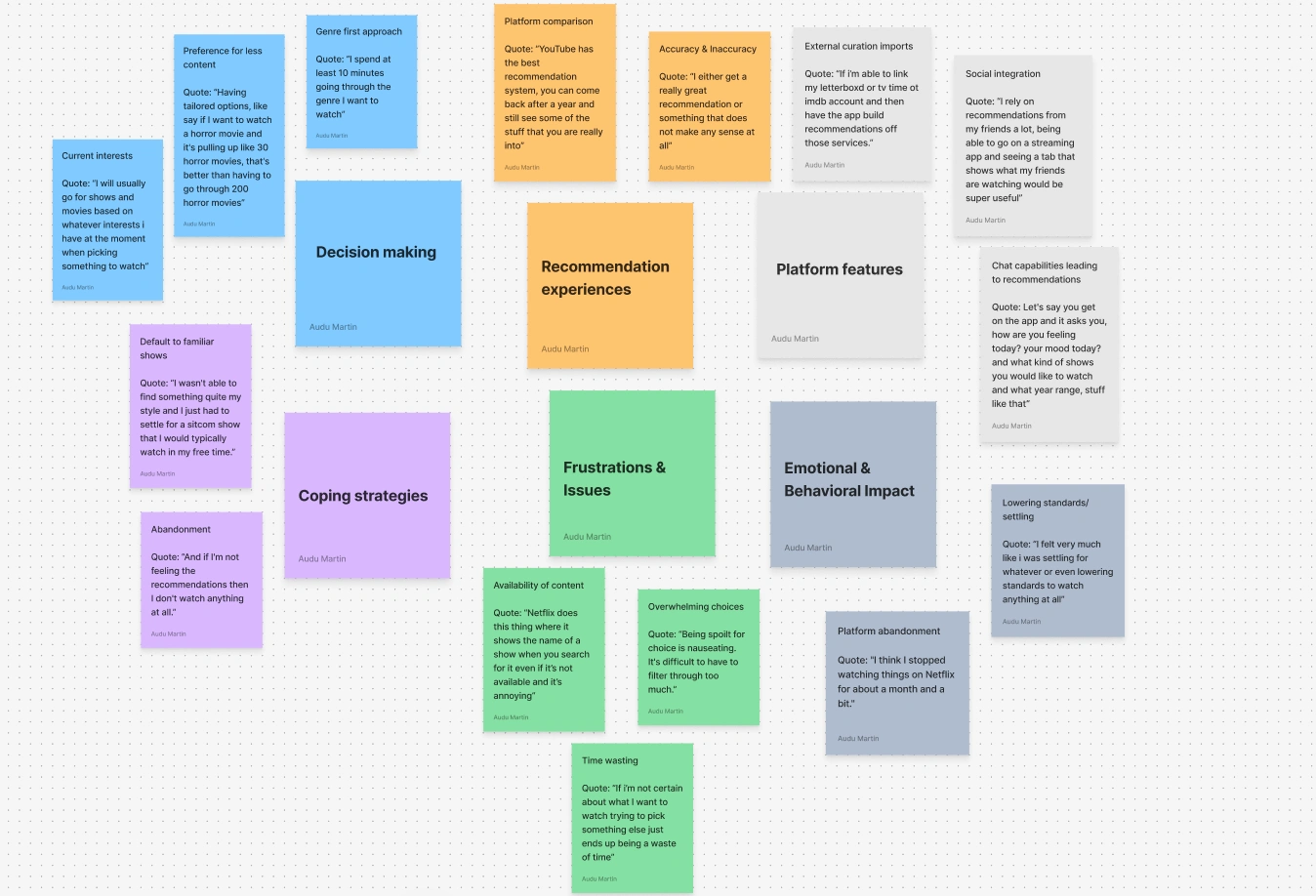
Three themes appeared consistently across both observation and interview data.
Trusted sources beat the algorithm: Most participants consulted several sources, friends, critics (Letterboxd, IMDb, Rotten Tomatoes), before committing to platform-native recommendations, which were treated with distrust. Features like “Trending Now” were widely ignored for being transparent marketing tools.
Abundance triggers avoidance: Faced with endless rows on the home screen, participants frequently abandoned the search, settled for something, or rewatched familiar content. The volume of choice didn't add value, it compounded the problem.
People decide by shortcut: Decision clustered around three heuristics: favorite actors, current mood/season, and seasonal relevance. These mental shortcuts were how users cut a vast catalog down to a selection, yet the platforms gave them almost no way to filter along these lines.
PERSONAS
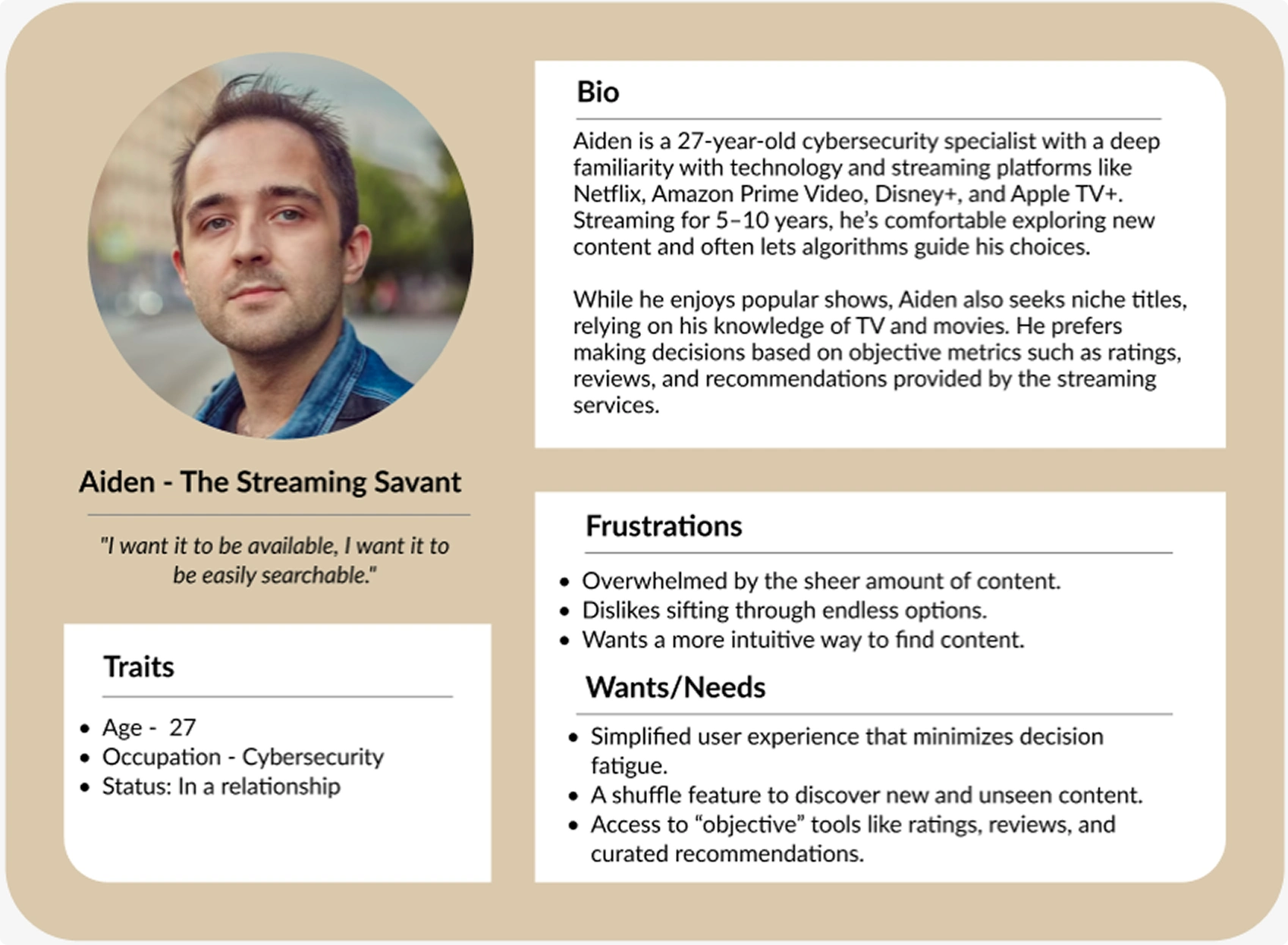
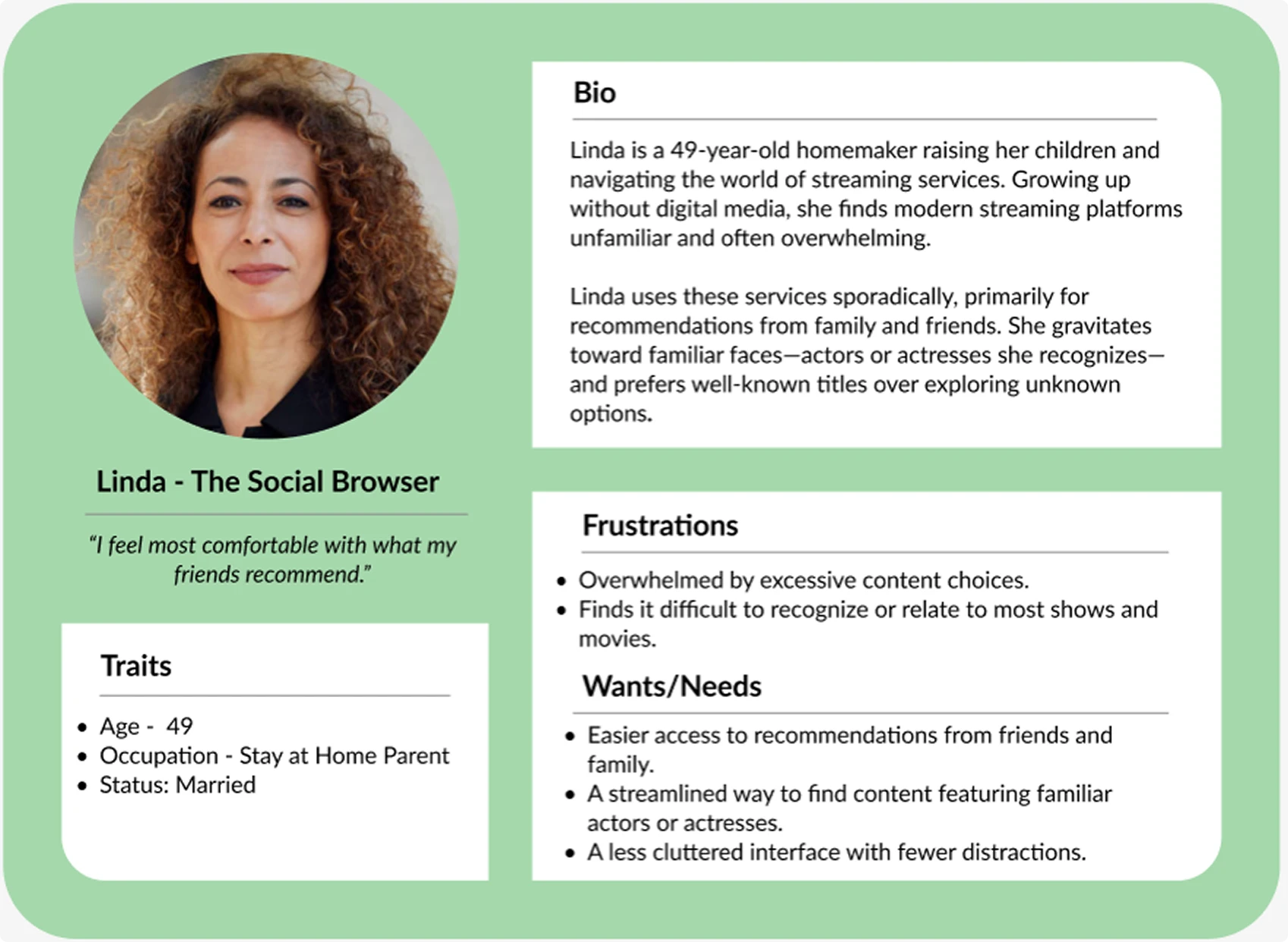
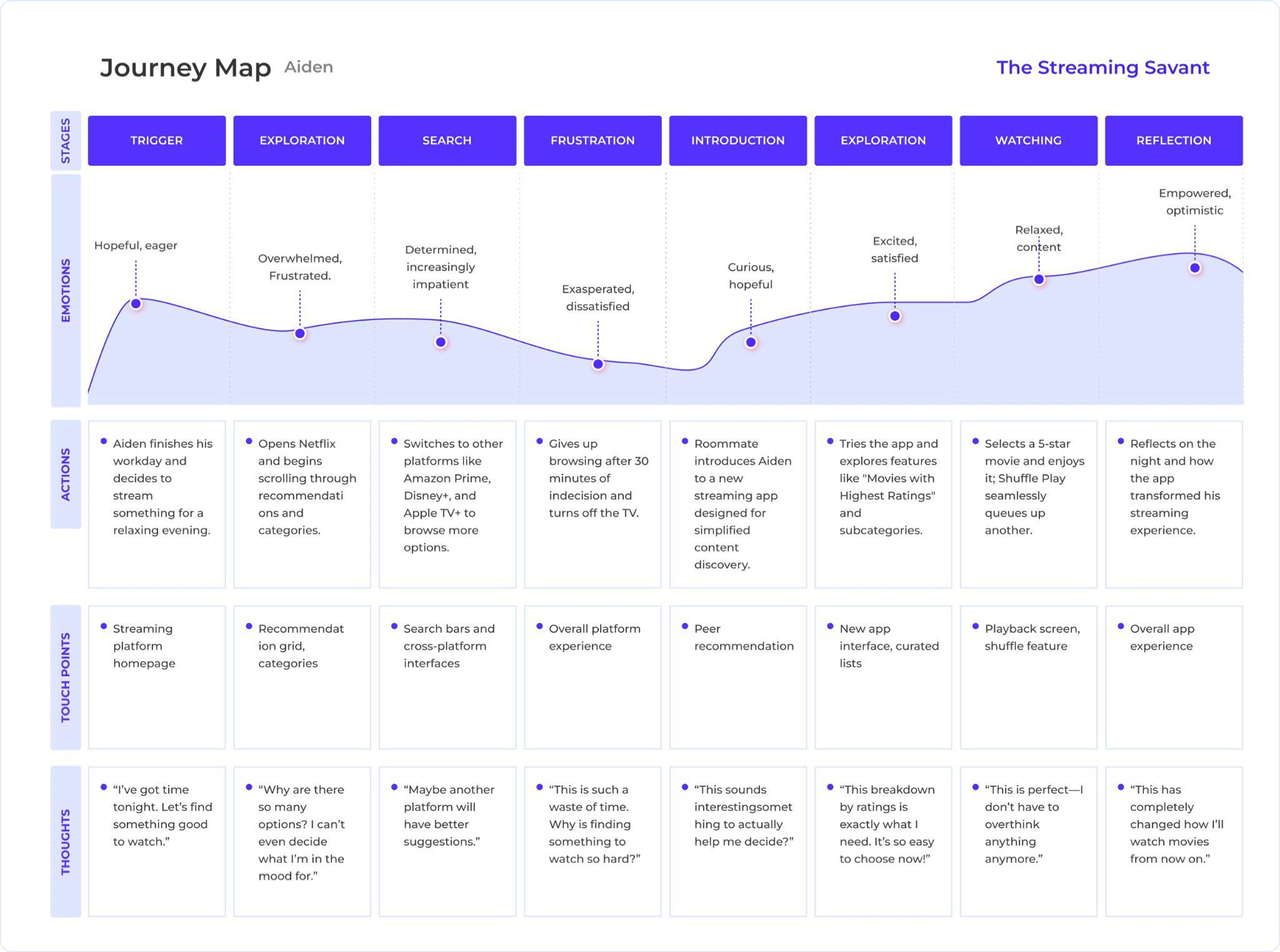
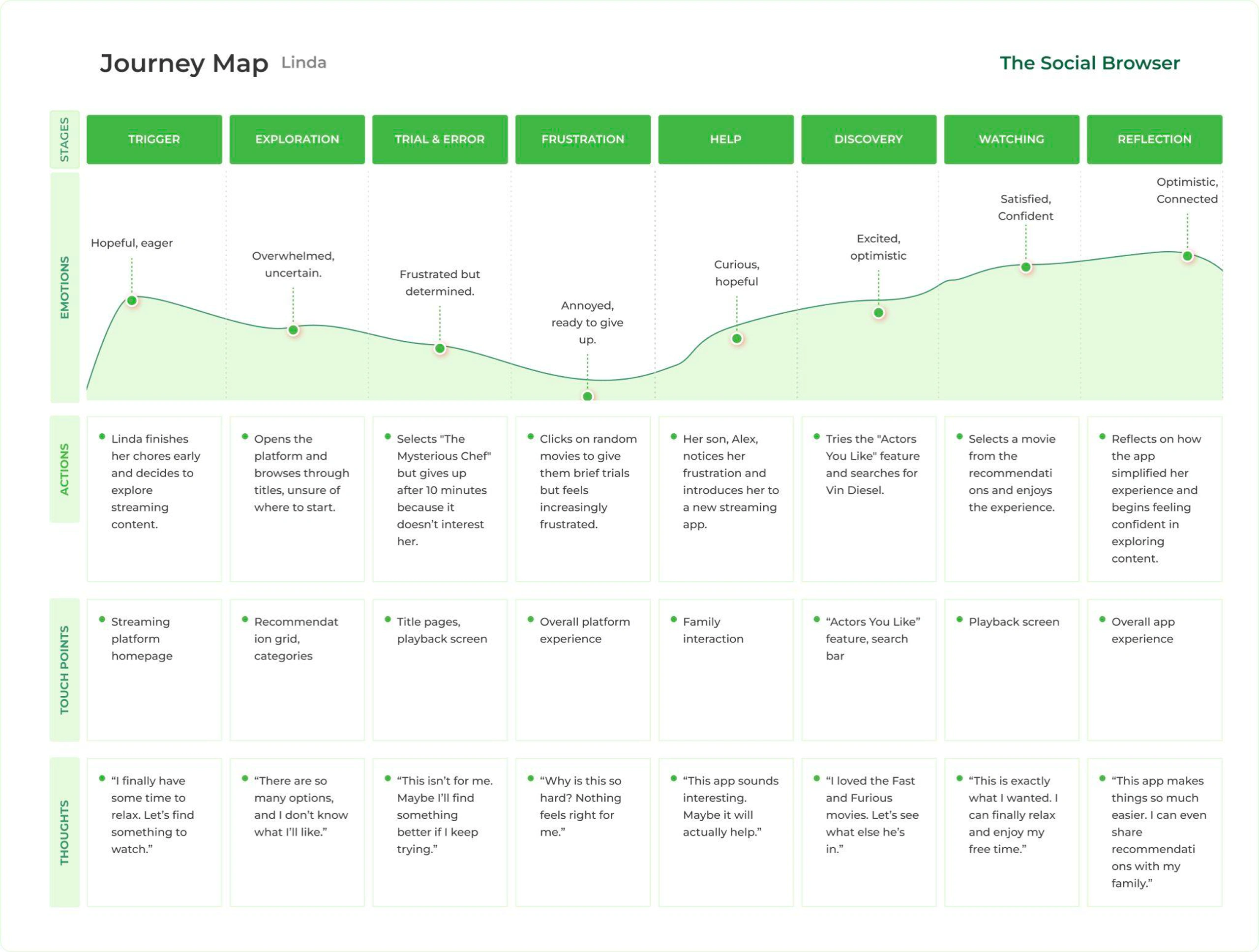
Two personas anchored the design thinking and the contrast between them matters because one user wants the system to quantify quality, the other wants it to socialize discovery meaning a single recommendation model serves neither well.
DESIGN IMPLICATIONS
The findings pointed to six directions for a less fatiguing experience:
Context-aware recommendations driven by real-time inputs (mood, genre, actor) rather than viewing history alone.
Balance familiarity and discovery: a lane for comfort rewatches alongside curated, approachable new content.
Filtering that matches how people actually decide: sort by actor, season, release window, or emotional tone.
Social proof built in: friend-based recommendations, collaborative lists, and links to the external reviews users already trust.
Mood-based browsing: let users pick an emotional state and get recommendations tuned to it.
Personalized “trending”: relevance scoped to a user’s social circle instead of platform-wide noise.
A through-line surfaced in the data: users defaulted to Netflix not for its catalog but for its familiarity. Reducing decision fatigue isn't only about better recommendations, it's about an interface comfortable enough to lower the cost of choosing at all.
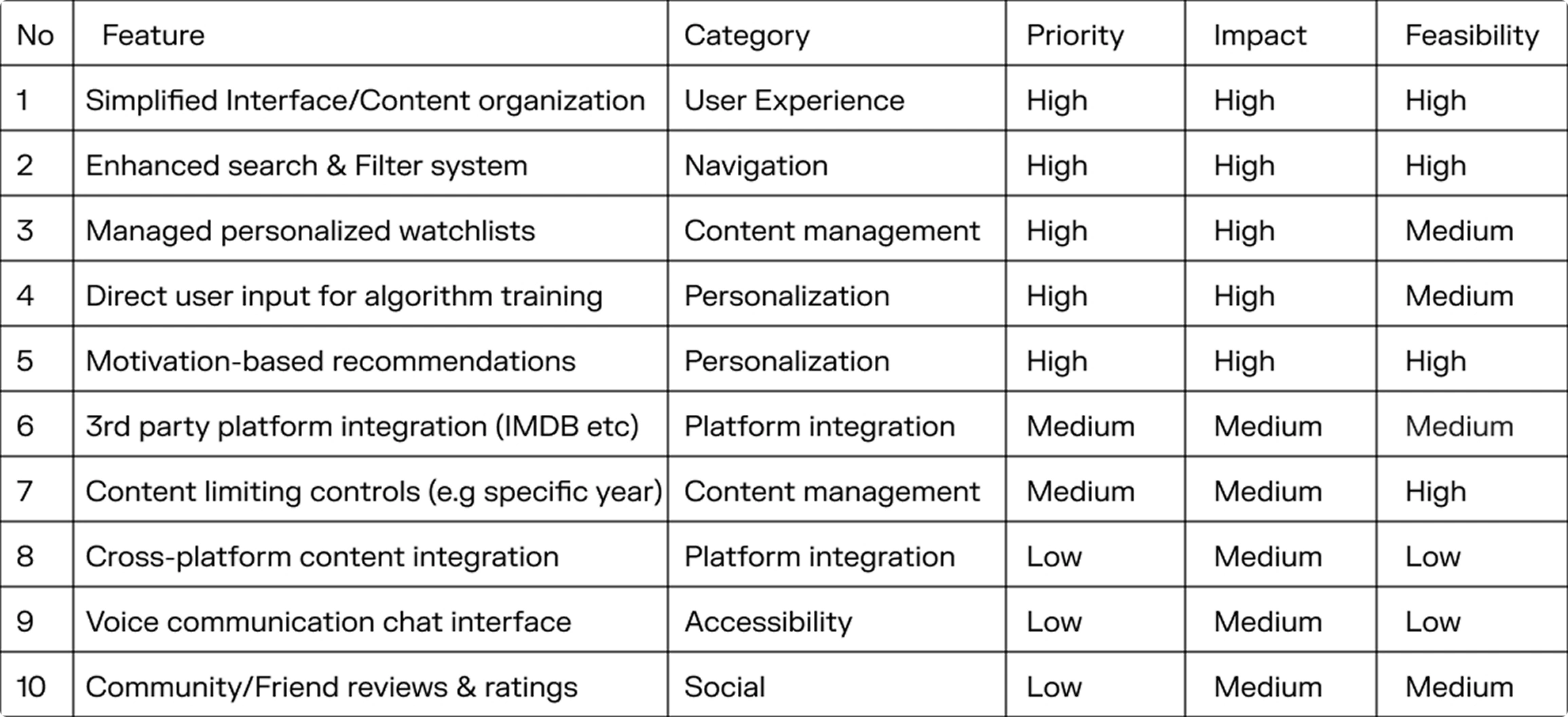
Proposed features plotted by impact against development feasibility.
LIMITATIONS & NEXT STEPS
The small sample limits generalizability. Future work would broaden the participant pool, move from implications into a tested prototype, run cross-platform comparison, and probe the social features more deeply, which is the area participants responded to most strongly.
TAKEAWAY
The instinct in recommendation design is to add intelligence. My research suggested the opposite: the fix for choice overload is often less, fewer options surfaced at once, clearer reasons behind each suggestion, and controls that map to the shortcuts people already use to decide.
Like this project
Posted Jul 14, 2026
Mixed-methods research into decision fatigue on streaming platforms using observations and interviews, producing design implications to reduce choice overload.
Likes
0
Views
1