Redesigning Automotive Workshop Management Platform

Melissa Fuentes


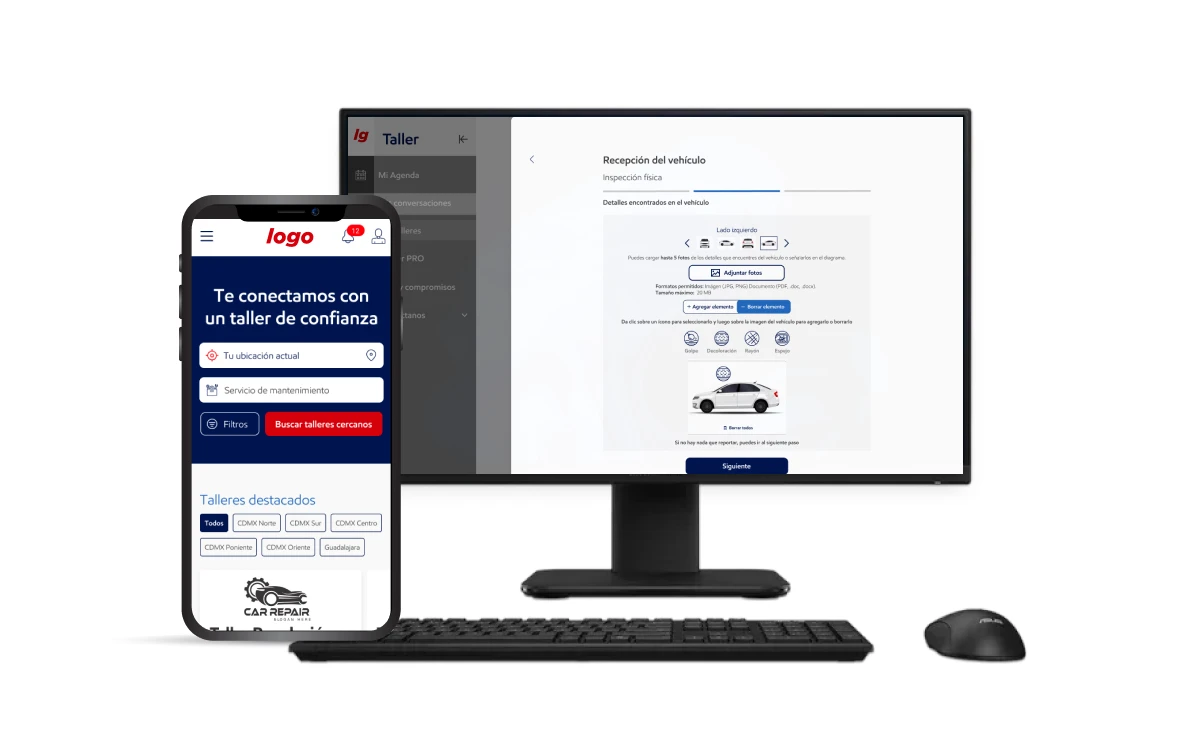
Product: Digital platform connecting car owners with automotive workshops
Team: Product team, developers team, design team later expanded to include additional designers
Translation: Headline-Shift your workshop management into high gear. Secondary text- Boost your workshop or service center towards a digital professionalization, helping you manage your client relations and control your operation in real time. CTA- Register your workshop
Challenge: The platform contained high complexity and low adoption risk due to traditional workflows in car workshops, no perceived differential value for end users.
Outcome: Delivered a simplified, more intuitive platform aligned with real workshop routines, while building a scalable UI foundation under tight time and resource constraints. This helped deliver real value not only to car owners, but also to the automotive workshops listed on the platform, to give them a reason beyond visibility to use the service.
Product lens: This project influenced the roadmap by validating what car workshop operators and end users where really looking for to improve their experience. It also helped understand what the MVP should be focused on to avoid getting distracted by feature nausea and only focus on what could truly bring value to potential clients, helping refine the business value proposition and validate product market fit and make sure they were offering a real solution.
The platform aimed to modernize how car owners book services and how workshops manage jobs. However, workshops, the backbone of the system, operate under high time pressure, fragmented workflows, and strong resistance to change.
If the product simply replicated the traditional, offline process in a digital interface, it would fail to justify adoption.
• Wide diversity of workshop sizes and setups (from small informal shops to large chains)
We focused on reducing complexity and friction, even when that meant postponing more advanced digital features that could increase cognitive or operational load.
Research was conducted using two complementary approaches, as workshops and end users represented very different profiles and needs.
Some behaviors, including space usage, multitasking and tool accessibility, could only be understood on location, making in-person research essential.
• Workflows rely heavily on paper and pencil due to speed, flexibility, and physical conditions (e.g. greasy hands)
• Adoption only happens when a tool fits existing routines, not when it asks users to change them
The core UX/UI effort focused on stripping functionality down to its essential components, removing distractions and unnecessary steps.
However, simplification was not applied indiscriminately. In some cases, research revealed that missing information or components were actually increasing confusion.
Rather than forcing full digital adoption, we chose to work with existing behaviors.
One major usability issue for end users was not knowing what was wrong with their car or how to describe the problem. They also had issues with the complex, time consuming step-by-step forms pattern that was previosly being used to book services with workshops.
• Guided users through booking without requiring technical car knowledge or a lot of complexity to request a service.
• Opportunity to scale into a more powerful AI tool that helps users identify potential car issues based on a brief description or selected symptoms, and more accurately match them with workshops by filtering for those that offer the required services..
This chatbot feature guides users to help them select the service their vehicle needs. It asks a structured series of questions to identify the appropriate service and request a quote from the workshop. For more complex issues, it helps users articulate the right questions and information so the workshop can diagnose and assist them effectively.
• Built a scalable UI Kit as a foundation (with the intent to expand later)
This allowed the team to:
For most of the project, I handled both UX/UI design and user research independently, which required balancing execution and analysis.
• The team worked in an Agile methodology, with strong communication and alignment across roles.
Presenting research findings in business-relevant language was a critical part of the process.
This project reinforced that modernizing a workflow doesn’t mean replacing it entirely. True adoption happens when digital tools respect existing routines and quietly remove friction rather than introduce new complexity.
Balancing UX design, research, and cross-functional communication under real constraints proved challenging, but ultimately rewarding, and led to more grounded, effective product decisions.
When I was onboarded onto this project, it was made up of many overcomplicated features. It felt like, in an attempt to create value, the initial focus had been on adding more and more functionality rather than continuously refining the core features users actually needed. As a result, the product ended up with a large number of features but only superficial value, rather than a few key features delivering profound, meaningful impact.
For products built from scratch, I believe it’s critical to solve one main problem exceptionally well before trying to address multiple smaller ones. Offering many tiny solutions that don’t truly move the needle dilutes focus and weakens the overall value proposition.
A complete focus on crafting an excellent core solution creates far more value than layering on unnecessary bells and whistles. Those additions often distract both the product team and the end user, who may struggle to understand what the real value is within an ocean of proposed solutions.
Validating the user’s primary problem is the first and most important step in building a product that genuinely improves their everyday life.
Like this project
Posted Feb 25, 2026
Redesigned a platform for car owners and workshops, focusing on intuitive use and real value.