
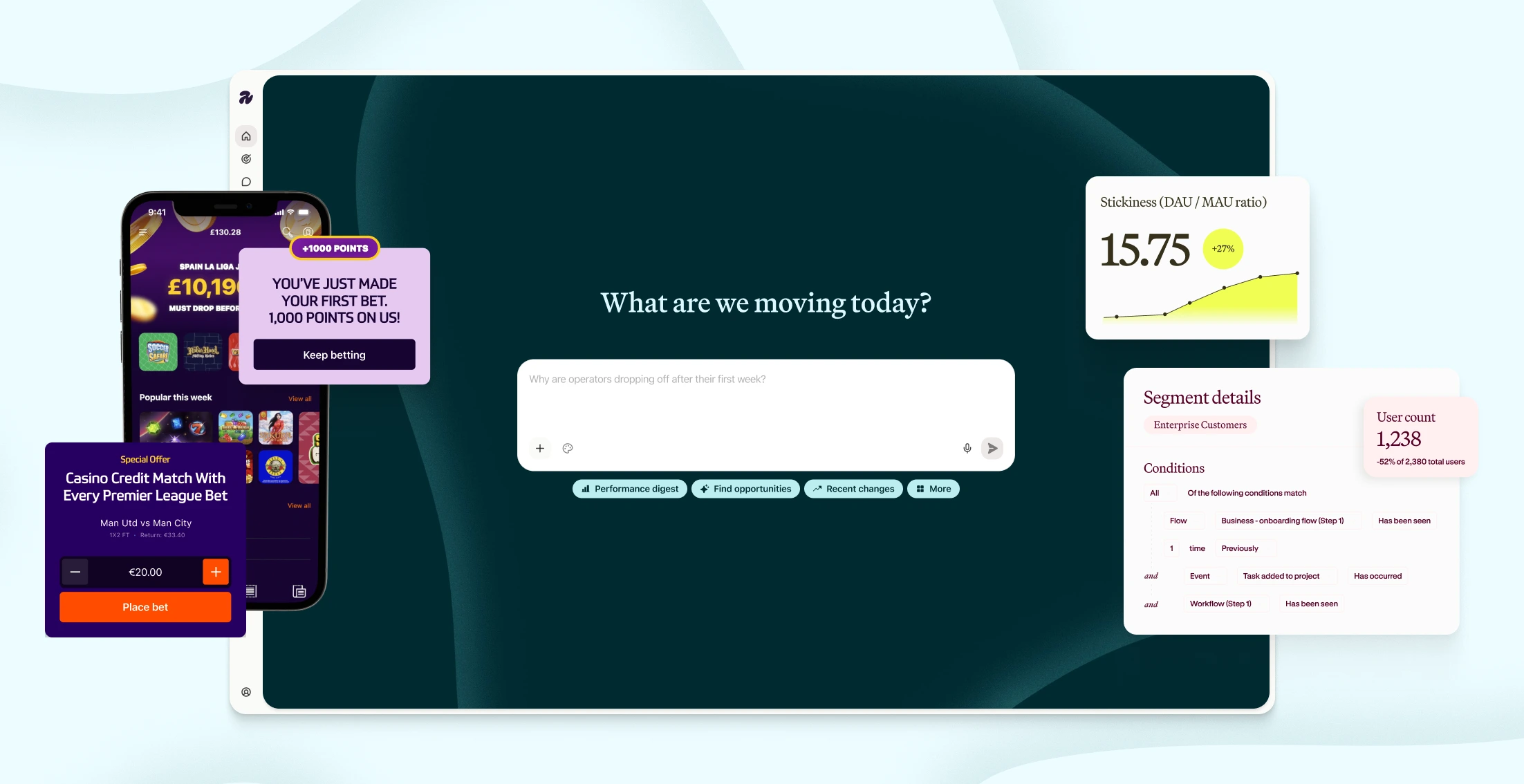
In March, Appcues' CEO told the company it would relaunch on 1 July as an agentic-first product. Two days after that note, I joined Appcues to reimagine how it shows up for customers: a full redesign, rebuild and repositioning. In under four months, the new Appcues was live with customers. By late October, more than 90% of them were activated on it.
Since 2013, product and marketing teams have used Appcues to build tours, checklists and banners inside their products, each meant to move something: onboarding, engagement, awareness or activation. Whether it worked depended on who built it: their expertise in campaign strategy, copywriting and design, and whether they had colleagues to work on it with.
The new Appcues had to change what the product is for, from a tool that helps you make a thing to a partner that helps you reach an outcome. The request moves from "Help me build this tour" to "Help me get more accounts activated."
Appcues set the direction and built the agents. I led the product strategy, design strategy and design: the model customers work in, how Appcues AI behaves with people, and a working prototype of the whole product, from that first workshop to the last design drop in June.
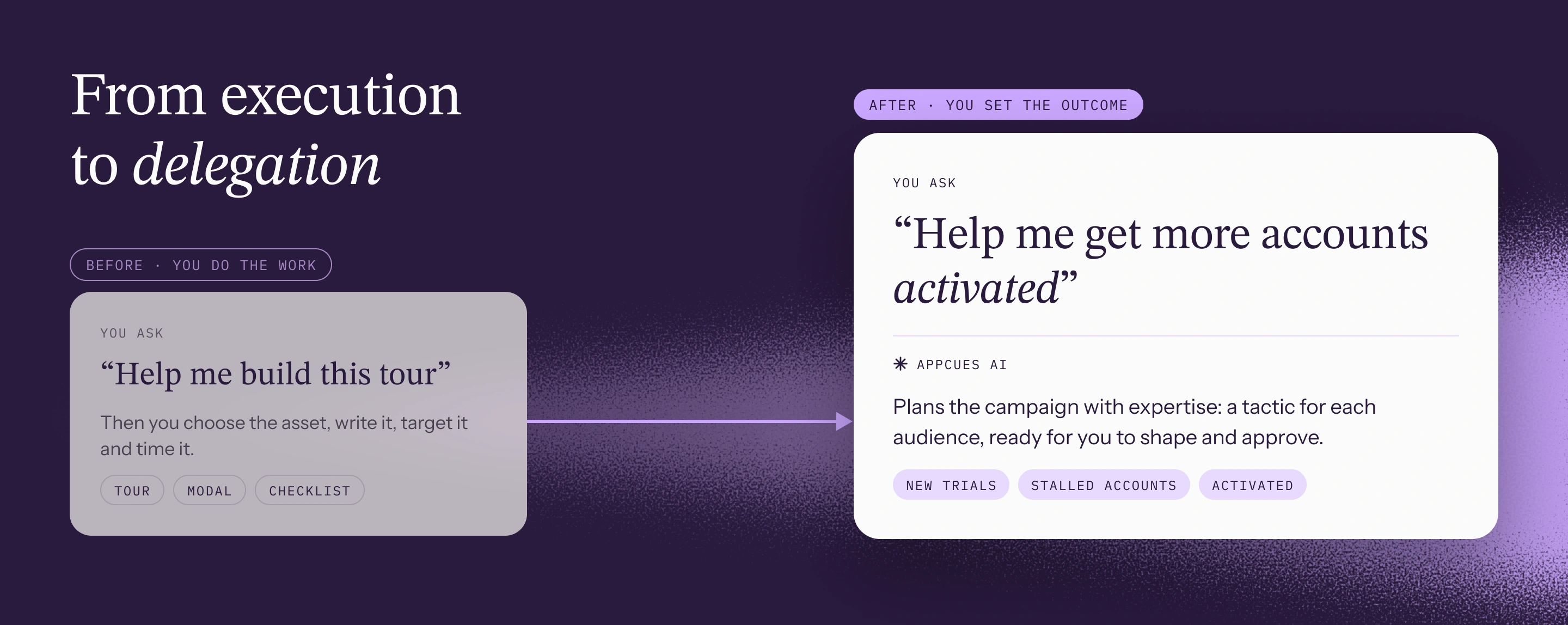
The change at the centre of the new Appcues: from building an asset on a hunch to delegating an outcome.
Stop organising messages; start from the campaign
In the old Appcues, every tooltip, pop-up and flow was its own experience, created on its own and chained together by hand. Accounts filled up with them, and the team was looking for better ways to organise them, with folders, tags and naming rules.
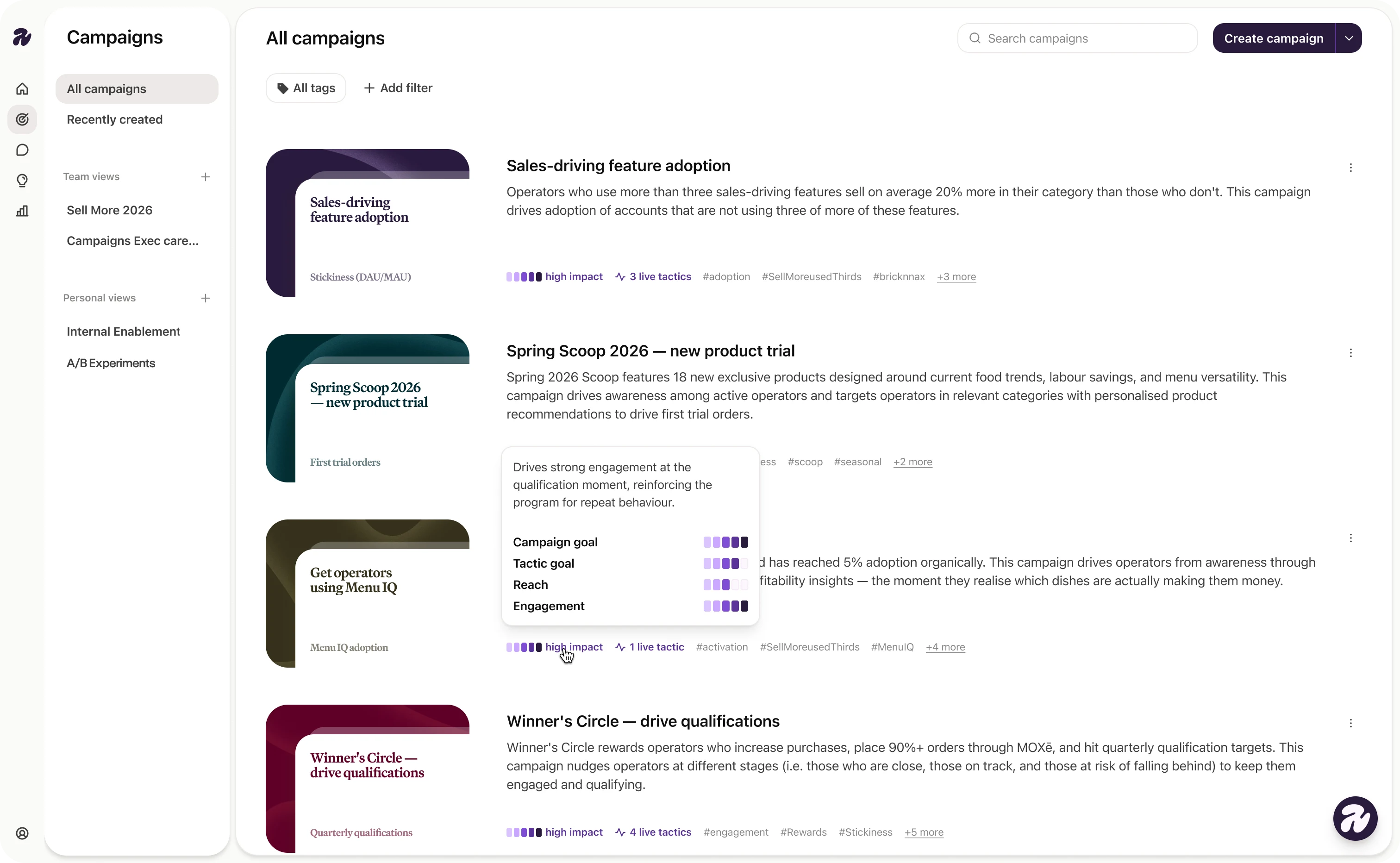
A live campaign: one objective, with tactics for each audience and moment beneath it.
At the first product strategy workshop, in Boston, I argued that organising experiences wasn't the problem to solve. Experiences exist to serve a campaign, so the product should start from what the customer is trying to achieve.
I reframed Appcues around the campaign. A campaign is driven by an objective tied to a Key Moment, the measurable action that matters. Tactics are how you get there: one or more messages for a particular audience, shown when its triggers fire rather than in a fixed sequence. One campaign can hold several. To make a product stickier, one audience might be steered towards two features and another towards two different ones, all under the same objective. Each campaign and tactic carries a brief, so the context travels with the work and the next campaign starts from it.
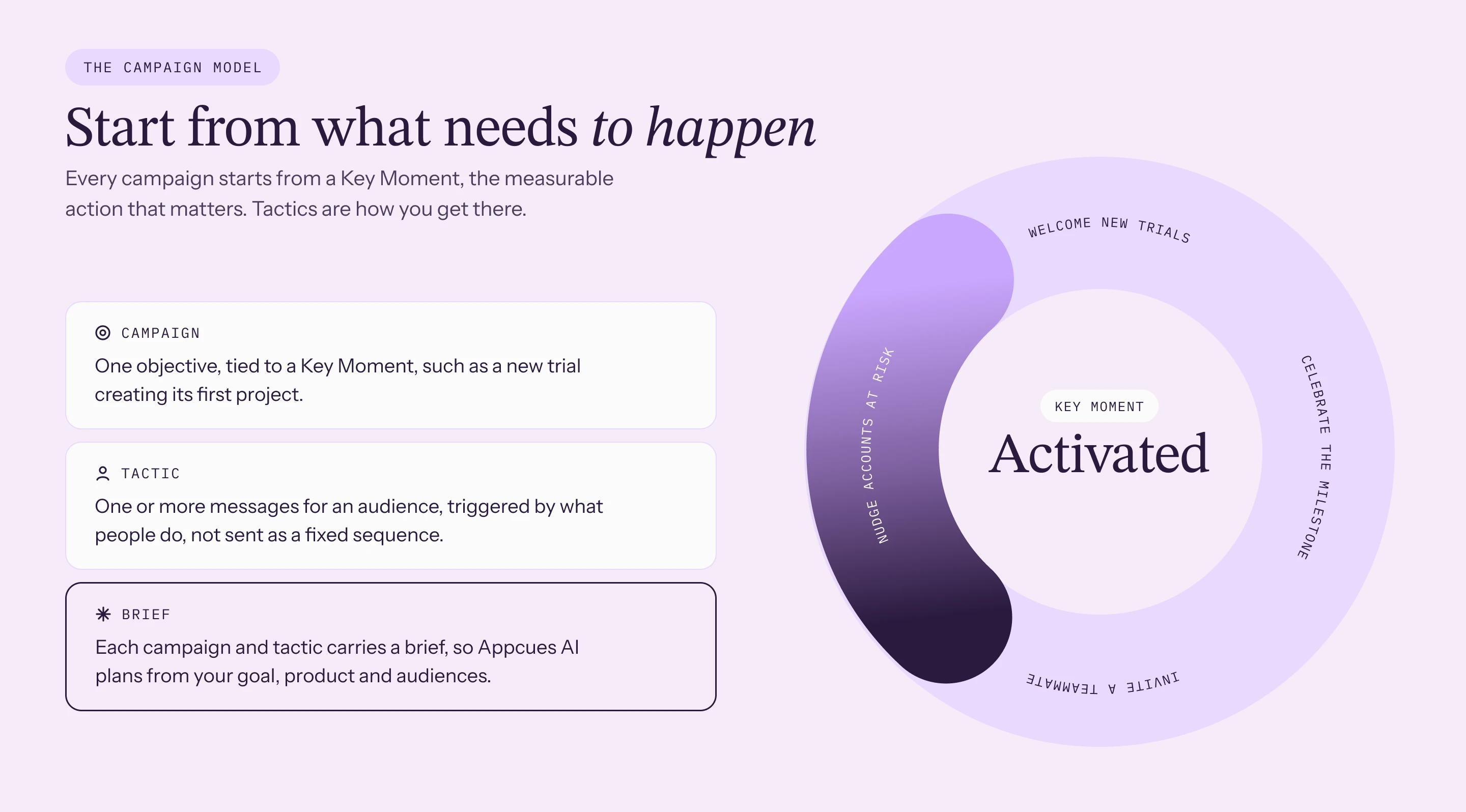
Every campaign starts from a measurable Key Moment; tactics and experiences work towards it, with a brief at campaign and tactic level.
Appcues now describes the framework as starting with "what needs to happen" instead of "what should I build?"
One teammate, with the experts behind it
A general assistant connected through MCP can build the same campaigns faster, but it doesn't know the product, the users or what has worked before, and it only gets as good as the person setting it up.
Appcues' answer was a multi-agent engine working from each company's own context. I designed how customers meet it: as one teammate, Appcues AI. Behind it, specialist agents cover areas such as UX, product marketing, customer marketing and analytics. Customers never choose one, set one up or manage one.
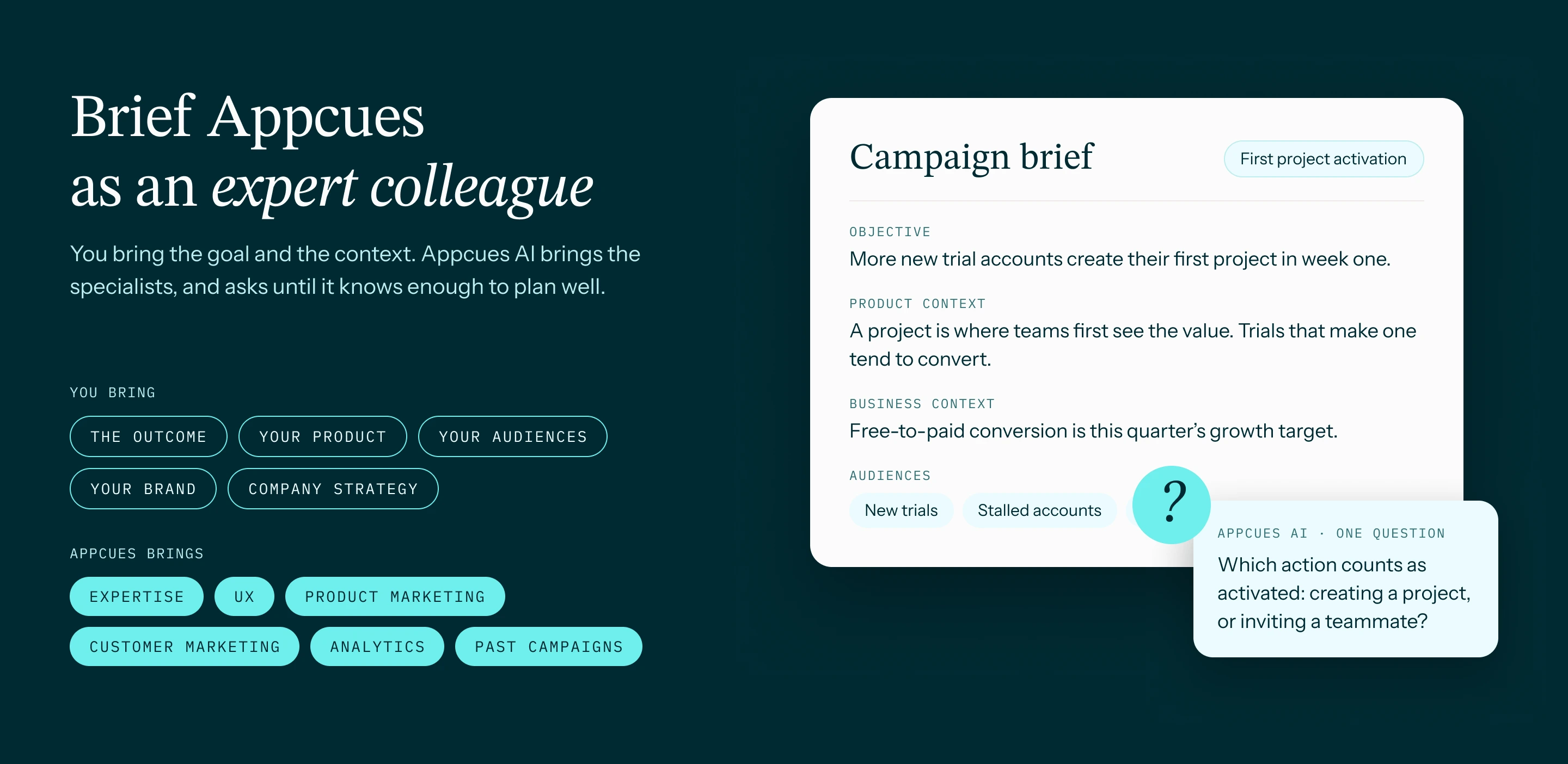
The customer brings the outcome and the context; Appcues brings the expertise to reach it.
Customers brief Appcues AI as they would an expert colleague: the goal and why it matters, how the product works, who the audiences are and how the brand sounds. They share it once and Appcues keeps it. In return, Appcues AI recommends the tactics and experiences most likely to work. It applies the customer's design system and writes in the brand's voice, while speaking differently to a new trial user and a long-standing admin, and draws on past campaigns, both the customer's own and patterns from across Appcues. That expertise now comes with the product, whether the goal is adoption, activation, free-to-paid conversion, retention or cross-sell.
When Appcues' head of product built the campaign to move Appcues' own customers across, Appcues AI "acted as a strategist that asked her questions she might have missed on her own", as Appcues' campaigns post puts it.
Ask less, show more
Appcues AI works out what it can, asks whats necessary whilst not executing on whim
A colleague who asks twenty questions, or checks in before every small step, soon becomes more work than doing it yourself. With AI, trust decides adoption. I wrote down how Appcues AI should behave, so the team could build and test against it:
Inference before interrogation. Never ask for something the product can look up. Work out the context first, then ask one question at a time.
Earn the right to have an opinion. Show what it found and why, then recommend.
Calibrated trust, not maximum trust. Before a consequential step, the AI says what it will do and why in the conversation, instead of interrupting with an "Are you sure?" dialogue.
Behind the conversation, Appcues AI keeps track of what it knows about the goal, the audiences, the product and the brand, and how sure it is of each. It proposes a campaign only once it knows enough to do it well; until then, it asks the one question that closes the biggest gap. I designed that behaviour with Appcues' engineers, down to how the AI's knowledge is tracked and checked, because it shapes how the product feels far more than any screen.
It goes down to the small things: elapsed time instead of spinners, one speaker at a time, and alerts that name the exact gap, such as "Upload the image before publishing".
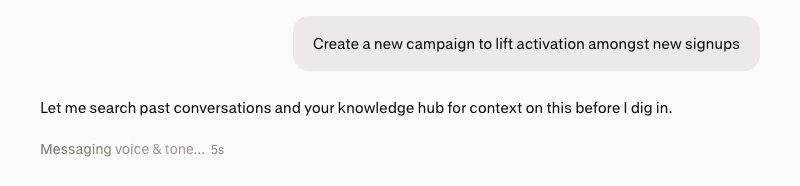
Elapsed time instead of a spinner, and a line saying what the AI is looking at.
Keep every message in view
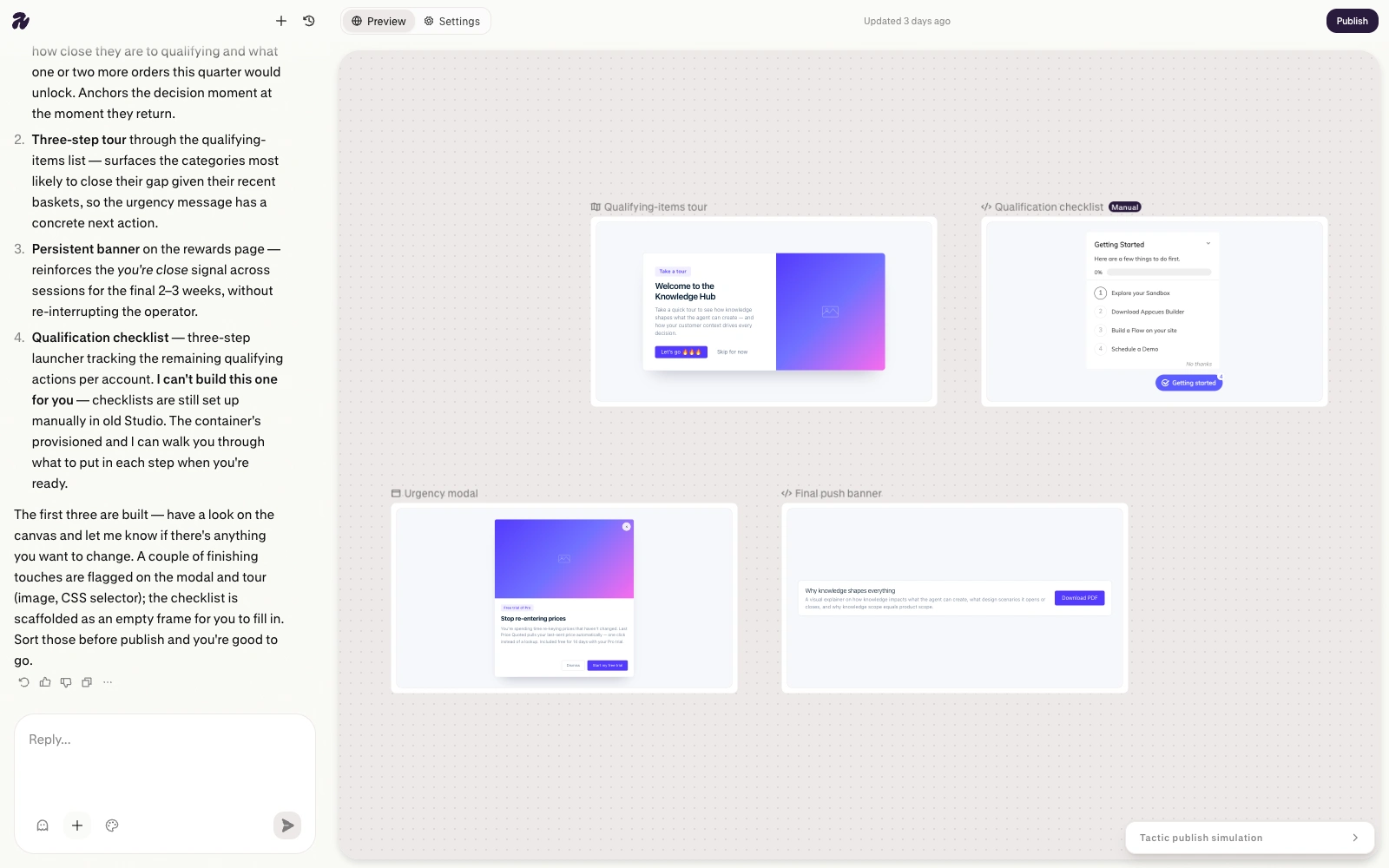
Every message in a tactic on one canvas, next to the conversation that made it.
As more of the doing moves into conversation, the screen becomes the place to check, compare and approve. Inside each tactic, every message users will see sits on one canvas, like a design board, with its status.
Double-click a message and focus mode opens the full editor without leaving the campaign. The main way to edit is to ask: type a change, or draw round part of a message and describe what should change. Traditional controls stay for people who want them.
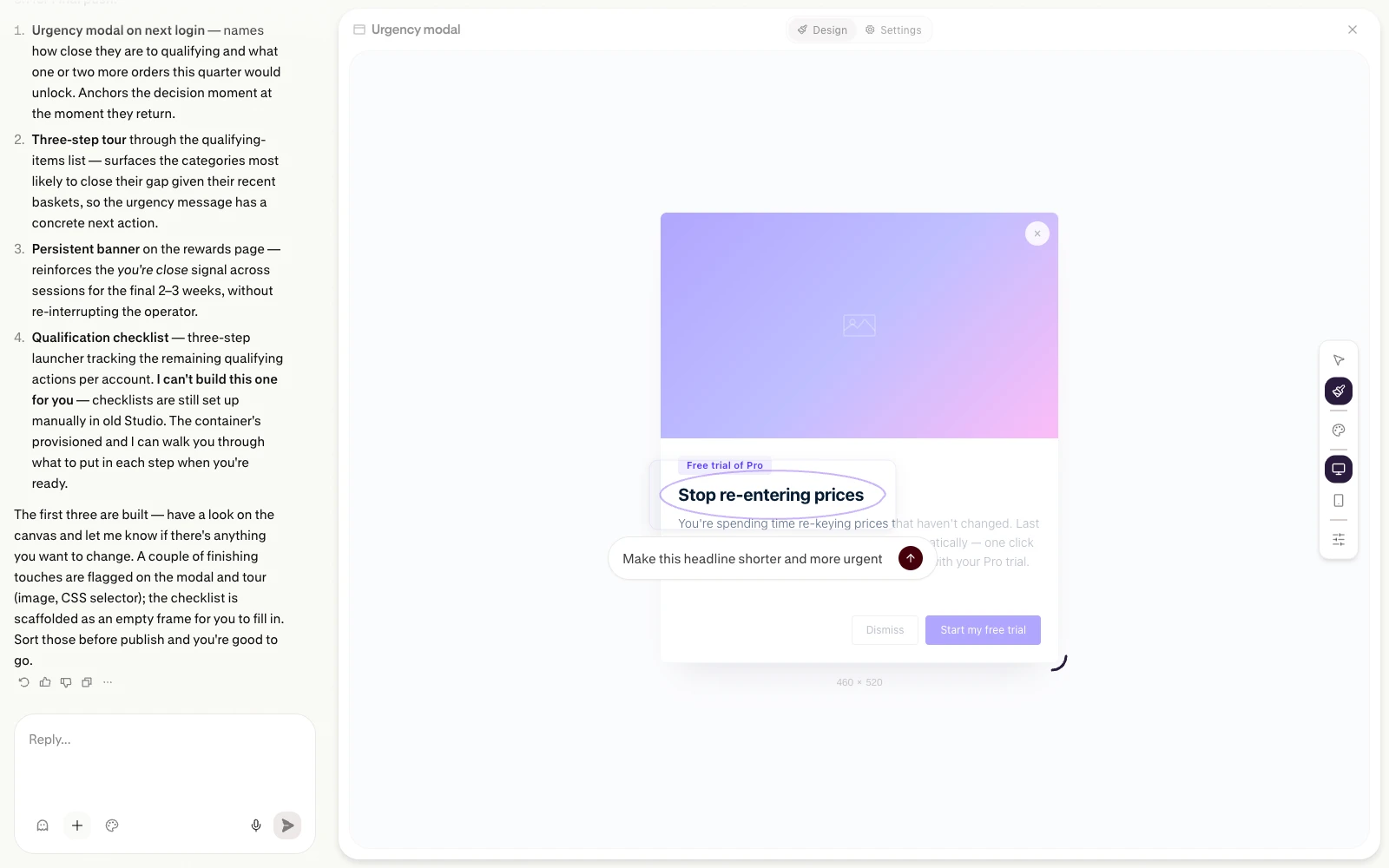
Draw round part of a message and say what should change.
Design the North Star, ship the first slice
I designed the full vision and the first release side by side. The North Star was a fully agentic canvas for planning and running campaigns. The first release had to give customers value from day one and show Appcues whether the new model worked.
The route between them became seven versions, each a hypothesis about how much the first release needed, and Appcues set its scope from them. The first release put the new campaign experience together with familiar Studio tools inside focus mode, so customers could move across without relearning everything at once. The drawing-led editor followed.
The result: a new Appcues, live for every customer
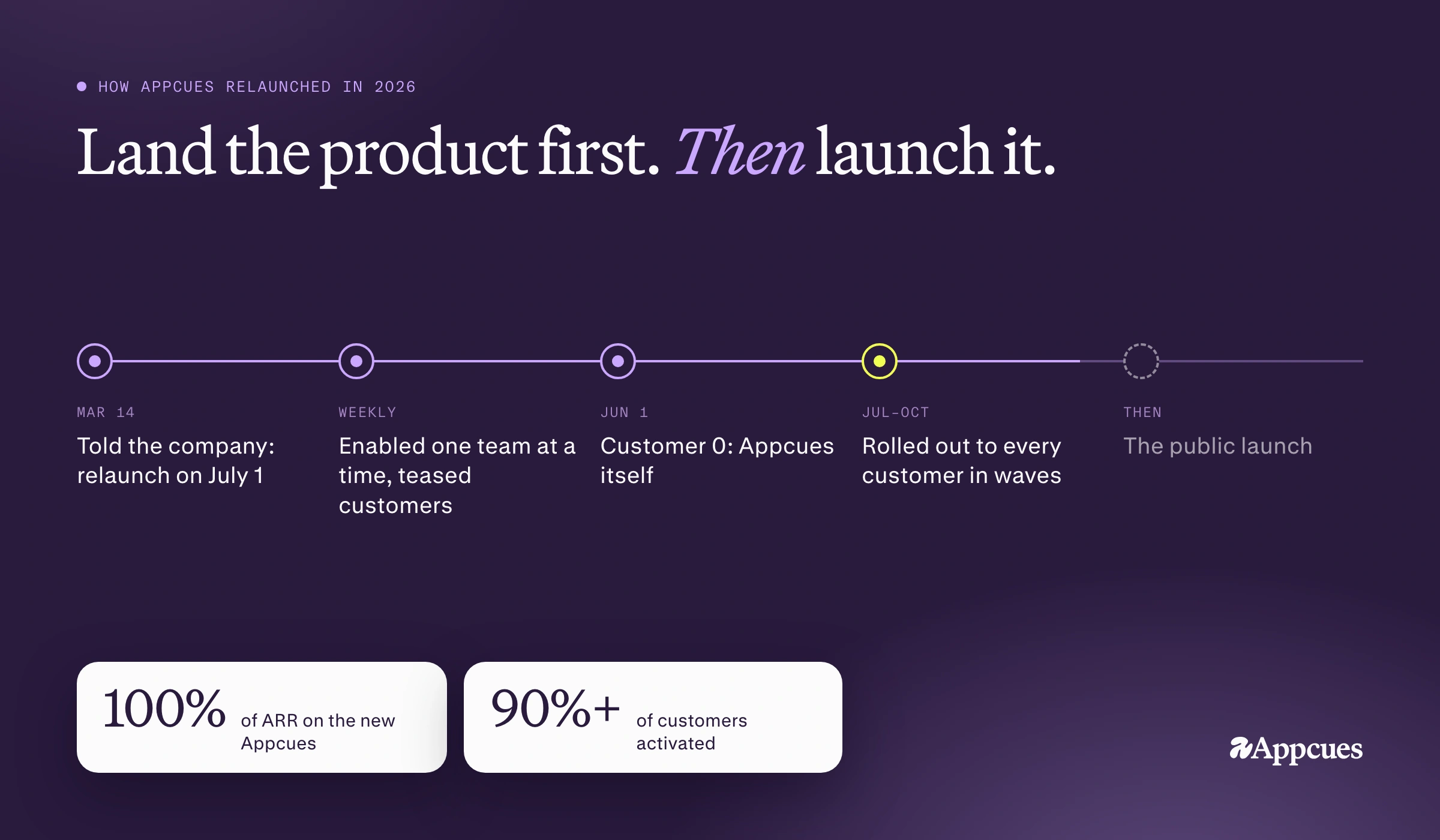
Appcues' own account of the relaunch, from the CEO's note to the late-October results.
On 1 June, Appcues became the new product's first customer, and it ran the move of its own customers as a campaign inside the new product. From July, new customers started on the new Appcues and existing customers moved across in stages.
Appcues reports that by late October 2026, 100% of its annual recurring revenue was on the new Appcues and more than 90% of customers were activated, hitting its second-half goal three months early. All before a public launch.
See the new Appcues 👇
0 likes · 0 views · Nov 20, 2026
Appcues relaunched as an agentic-first product. I led the design strategy: campaigns built around what customers want to happen
Timeline
Mar 16, 2026 - Jun 4, 2026


