How Possible Space Tourism In Future?

Ali Qureshi
THE FUTURE OF SPACE TOURISM
Space Travel with humans is a very hard task for all countries because of the budget. millions of dollars put into the mission to launch one person into space.
You think what about Apollo 11?
I will say this is very hard but possible in the future because Recent estimates suggest an extraordinary economic potential for the commercial space travel industry, with significant growth expected over the next decade.
WHAT IS SPACE TOURISM?
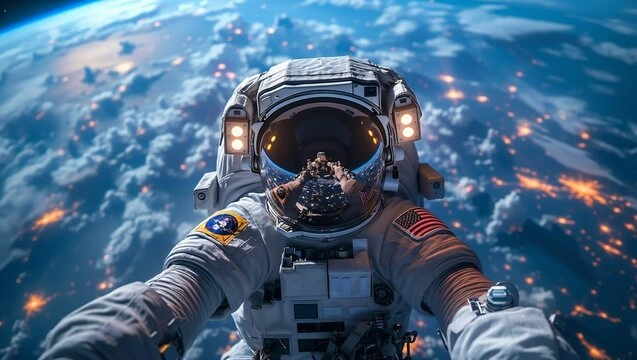
Space tourism, in simple terms, is travel beyond Earth's atmosphere for recreational purposes. It signifies the next evolution of travel, offering private citizens the unique opportunity to view Earth from an entirely new perspective and experience the thrill of weightlessness and space exploration.
This nascent industry is facilitating not only transportation to space but also space accommodation in orbital hotels; a symbol of technological advancements and scientific discovery.
HOW SPACE TRAVELS POSSIBLE IN THE FUTURE?
Let's take an example of how the Apollo 11 mission successfully did. This is very important to understand how Space Travel is possible in the future.
Apollo 11 mission
The Apollo 11 mission was the first mission of humans to land on the moon in 1969. This mission was conducted by NASA. As you can see, this was not the first of many challenges faced by Apollo 1 to 10 in the 70s.
Three astronauts completed this mission Neil A. Armstrong, Michael Collins, and Edwin E. “Buzz”. As you know, Neil A. Armstrong was the first person to step foot on the moon, and his first words for land on the moon ( That's one small step for a man, one giant leap for mankind ).
The mission used a Saturn V rocket, which was the launch vehicle designed to carry astronauts to the Moon.
Let's break it down into important components to understand the Saturn V rocket.
Command Module (CM): was where they lived and operated from, while This part of the spacecraft housed the astronauts.
Service Module (SM): contained systems necessary for the mission, including propulsion and life support.
Lunar Module (LM): This was a separate spacecraft that detached from the Command Module to land on the Moon. It had two stages: the descent stage, which allowed it to land on the lunar surface, and the ascent stage, which returned the astronauts to the Command Module.
Now let's know about how astronauts travel the Earth to the moon.
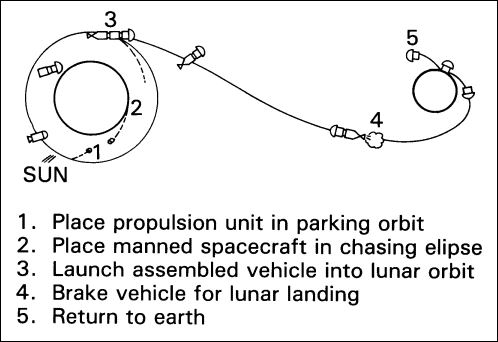
As you can see, this is a ceiling short out of Earth orbit and Entra moon orbit.
The average distance between the Earth and the Moon is 384 400 km (238 855 miles). It takes about 3 days for a spacecraft to reach the Moon. The specific distance depends on the specific path chosen.
I hope you understand how space travel is possible in the future.
WHAT IS THE MARKET POTENTIAL AND TECH ADVANCE OF THE SPACE TOURISM INDUSTRY?
A report by UBS indicates that the market for space tourism could reach $4 billion annually by 2030.1 Another report from Morgan Stanley predicts that the global space technology industry could generate revenue of $1 trillion or more in 2040.
And on the other hand, rapid technology advancements have greatly boosted the space tourism industry. Improved rocket technology allows not only for safer and more reliable travel but also for the reuse of rockets, which significantly cuts back on costs. Innovations in fuel efficiency, navigation systems, cabin design, and safety measures have all played a part in making space travel more accessible.
simulation training for passengers, ensuring they are adequately prepared for their journey into space. Traditional training regimens have been replaced or supplemented with virtual reality simulations that mimic the conditions passengers face during real-life space travel.
CURRENT SPACE TOURISM COMPETITORS
Whilst still relatively new the space tourism industry:
SpaceX
Blue Origin
Orion Span
Boeing
Zero-G
These companies are working to develop new technologies and services that will make space travel more accessible and affordable for a broader market.
Many more companies are working on their mission. They are tearing full safest travel missions because space is too dangerous for humans. One little mistake changed it into a big disaster.
FAQs
When will commercial space travel be available?
Commercial space travel is an exciting frontier that we're steadily approaching. Companies like SpaceX and Blue Origin are actively investing in technology to make space tourism a reality. SpaceX aims to send tourists around the moon by 2025 and is planning further manned missions to Mars. It's hard to give an exact timeline, but industry experts predict that affordable and regular commercial space travel will become a reality within the next 10-20 years.
What advancements can we anticipate in space technology that could impact tourism?
The advancements in space technology are broad, each driving us closer to easily accessible outer space travel. Looking forward, we will see improvements in rocket reusability, which will significantly reduce costs associated with launch—and hence passenger tickets. Scientists are also investigating different propulsion systems like nuclear thermal engines for fast transportation to far-flung destinations like Mars. Innovative designs for habitable modules are being conceptualized for comfortable stays in low-earth orbit or moon hotels. Advancements are also expected in spacesuit technology for civilian use so that tourists can enjoy extravehicular activities. Lastly, improvements in communication technology will keep space tourists well-connected with Earth, easing fears and ensuring safety.
Like this project
Posted Feb 1, 2025
This engaging article explores the rise of space tourism, its market potential, tech advancements, and industry leaders.
Likes
0
Views
0