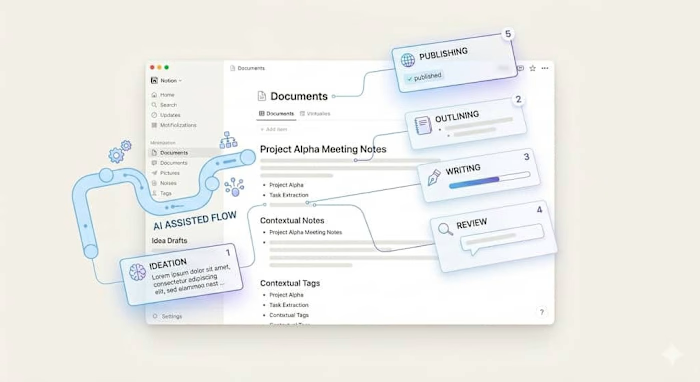
Boosting Orbita's Revenue Efficiency with NexaFlow

Abdulfatai Adebayo


How NexaFlow CRM Helped a SaaS Company Increase Sales Qualified Leads by 40% and Cut Churn in 90 Days
A B2B SaaS case study on revenue intelligence, RevOps strategy, and what actually moves the needle on churn and pipeline growth.
Follow
6 min read
·
May 1, 2026
Share
Press enter or click to view image in full size

Revenue intelligence isn’t about having more data , it’s about finally seeing what your data has been trying to tell you.
There’s a number every SaaS founder knows by heart and it’s rarely the one they want to talk about. Churn. CAC payback. Stalled pipelines.
These aren’t abstract metrics on a quarterly slide. They’re the difference between a business that scales and one that spins its wheels while burning runway.
Orbita knew that difference intimately by the time Q1 2026 arrived. Their product was solid. Their team was capable. But somewhere between lead generation and revenue retention, things were breaking down quietly, consistently, and expensively.
What the next 90 days looked like is worth understanding closely. Not because the technology was extraordinary, but because the strategy behind it was.
Orbita
Orbita is a cloud-based HR compliance software serving mid-market businesses across North America. With 120 employees and a growing but unstable pipeline, they had reached the stage many SaaS companies hit around the Series A to Series B transition revenue was coming in, but the underlying metrics told a different story. Churn was sitting at 18%. Their CAC payback period had stretched to 14 months.
Sales cycles were long, inconsistent, and heavily dependent on individual rep performance rather than any systematic process. And perhaps most critically, their sales team had no reliable way of identifying which leads in the pipeline were genuinely sales-qualified versus which ones were simply active.
They needed more than a CRM. They needed revenue intelligence.
The Tools They Chose
NexaFlow is an AI-powered CRM and revenue intelligence platform built specifically for B2B SaaS companies managing complex, multi-touch sales cycles. Unlike traditional CRMs that function primarily as data storage systems, NexaFlow’s core value is in what it does with that data surfacing signals, flagging at-risk accounts, scoring leads automatically, and giving RevOps teams a single source of truth across the entire revenue funnel.
Orbita’s implementation focused on three specific outcomes from day one. Improving SQL identification and qualification accuracy. Reducing churn by catching at-risk accounts earlier in their lifecycle. And shortening the sales cycle by removing the manual bottlenecks that were slowing their team down.
The implementation timeline was eight weeks from onboarding to full deployment a realistic window for a company of Orbita’s size and technical infrastructure.
The Before and After
This is where the real story lives and it’s where most case studies either win or lose their reader entirely. Numbers without context are just numbers. What matters is the distance between where a company started and where they landed, and what specifically closed that gap.
Before NexaFlow
Orbita’s sales team was manually reviewing lead activity to determine qualification status a process that was inconsistent across reps and consuming an estimated 12 hours per week per person. Churn conversations were happening reactively, typically after a customer had already mentally decided to leave. And the leadership team was working from CRM reports that were, at best, two weeks behind reality.
Press enter or click to view image in full size
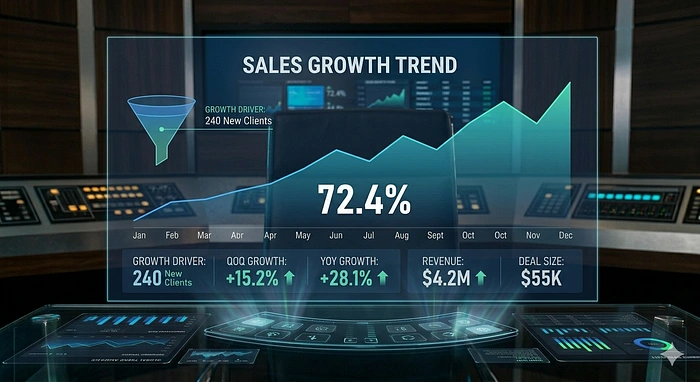
After NexaFlow - 90 days post-implementation
Sales Qualified Leads increased by 40% month over month not because more leads entered the pipeline, but because NexaFlow’s AI scoring identified genuinely qualified accounts that were previously being overlooked or deprioritised manually.
Get Adebayo Abdulfatai’s stories in your inbox
Join Medium for free to get updates from this writer.
Subscribe
Subscribe
Remember me for faster sign in
Churn dropped from 18% to 15.3% across two quarters. NexaFlow’s account health monitoring flagged 23 at-risk accounts in the first 60 days that Orbita’s customer success team was able to re-engage proactively. Of those 23, 17 renewed. That single outcome recovered $220K in at-risk ARR.
CAC payback period shortened from 14 months to 9 months a direct result of faster, more accurate qualification reducing wasted sales cycles on low-intent leads.
Sales cycle length reduced by an average of 22 days as reps stopped spending time manually chasing pipeline status and started working from NexaFlow’s automated activity summaries and next-step recommendations.
What Made This Work
Press enter or click to view image in full size
The implementation worked because the strategy behind it was deliberate from day one.
The technology was only part of the equation. What actually drove these results was how Orbita approached the implementation and this is the part of the case study that most SaaS businesses miss when they read competitor success stories.
They defined success metrics before they started. Churn reduction, SQL growth, and CAC payback were agreed upon as the three primary KPIs before NexaFlow was even fully deployed. That clarity kept the implementation focused rather than sprawling into every feature the platform offered.
They assigned a dedicated RevOps lead to own the integration. One person with clear accountability, sitting between the sales team and the platform, ensured that the data going into NexaFlow was clean and that the insights coming out were actually being actioned.
And critically they treated the first 30 days as a listening period. Rather than immediately restructuring their entire sales process, they used NexaFlow’s initial data outputs to understand where their current process was breaking down before making any changes. That patience paid off significantly in the accuracy of the adjustments they made in weeks five through eight.
What This Means for B2B Content Writers
If you write for SaaS companies, case studies are one of the most powerful content formats you will ever produce for a client — and one of the most consistently underutilised.
A well-constructed case study does something that no blog post, whitepaper, or social campaign can fully replicate. It shows a prospective buyer exactly what working with the company looks like, from a real problem through a real process to a real outcome. It removes abstraction from the sales conversation entirely.
The structure that works consistently is straightforward. Open with the problem in terms the reader immediately recognises. Introduce the solution in context, not in isolation. Let the metrics tell the transformation story. Then extract the strategic lessons that make the case study useful beyond the specific client scenario.
What separates a case study that converts from one that just gets read is specificity. Specific metrics, specific timelines, specific decisions made at specific moments. Vague outcomes "we improved efficiency significantly" tell a reader nothing they can trust. Concrete outcomes "we reduced MTTR by 40% and recovered $220K in at-risk ARR" tell them exactly what’s possible.
That specificity is what you’re responsible for as the writer. It’s your job to ask the right questions, extract the right numbers, and build a narrative that makes those numbers mean something to the next company reading it.
The Bottom Line
Orbita didn’t transform their revenue metrics because they bought better software. They transformed them because they implemented it with a clear strategy, clean data, and the discipline to measure what actually mattered.
NexaFlow gave them visibility they didn’t have before. What they did with that visibility was entirely their own.
That’s the story behind every great B2B SaaS case study not that a tool fixed everything, but that the right tool in the right hands, pointed at the right problem, changed the trajectory of a business.
For B2B content writers: the ability to find that story, structure it clearly, and make it credible is one of the most valuable skills you can build in this industry. Master the case study format and you’ll never struggle to demonstrate your value to a client.
Note: NexaFlow and Orbita are simulated companies created for illustrative purposes. The metrics and scenarios presented reflect realistic outcomes based on industry benchmarks for AI-powered CRM implementation in B2B SaaS environments.
Like this project
Posted Jun 28, 2026
Implemented NexaFlow CRM for Orbita, boosting SQLs by 40% and reducing churn.
Likes
0
Views
2
Clients
Orbita