Development of Launch.et Platform for Ethiopian Makers

Ismael Kedir


Launch.et
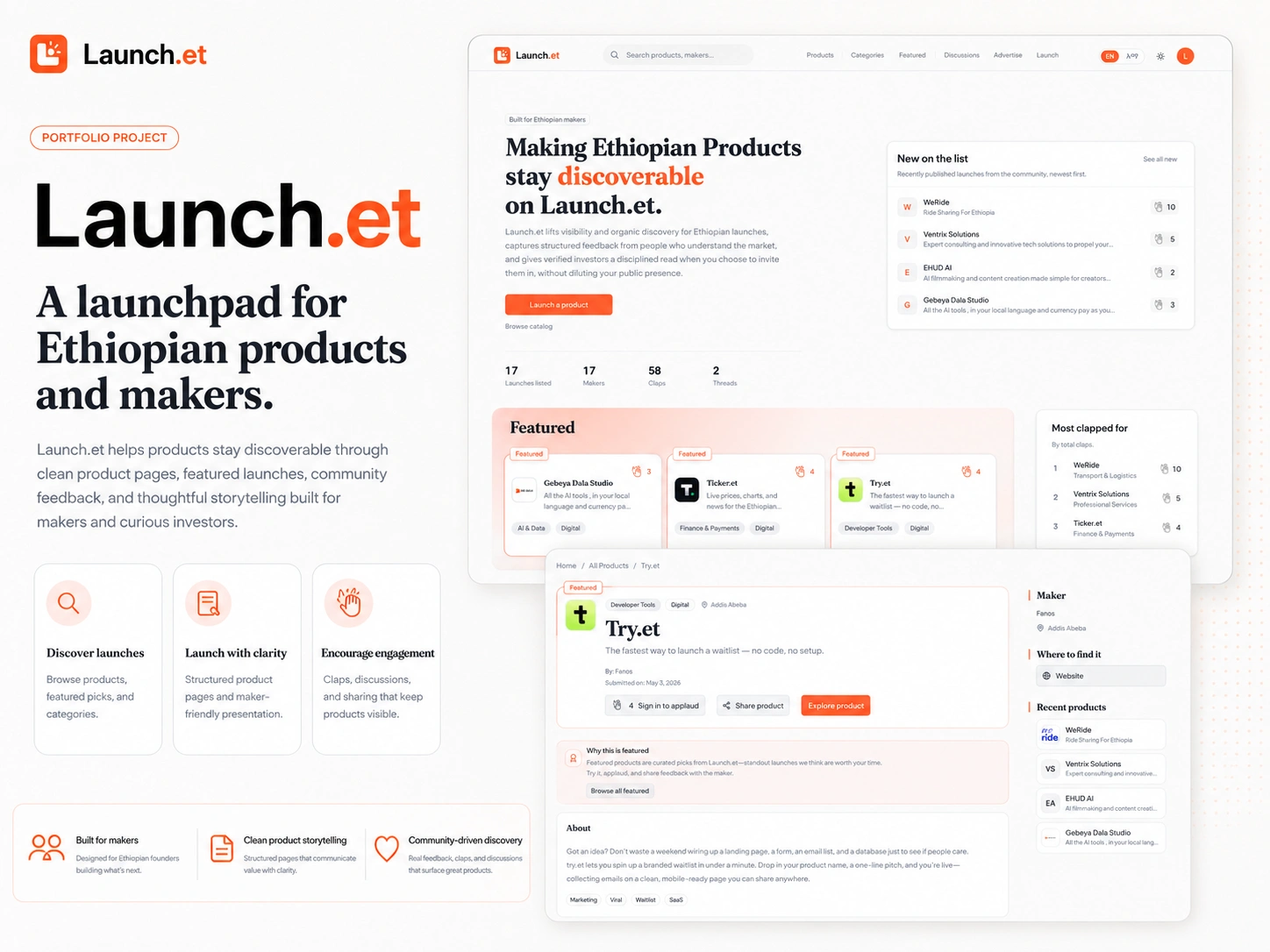
A launchpad for Ethiopian products and makers
Launch.et is a web platform I built to help Ethiopian makers, startups, and product builders make their work more discoverable.
The idea came from a simple problem I kept noticing: people were building interesting products, but there was no focused place where those products could be launched, explained, discovered, discussed, and shared within the local ecosystem.
Global launch platforms exist, but they are often too crowded, too broad, and not built around the realities of emerging markets. For Ethiopian makers, getting attention is not only about publishing a product. It is about helping people understand what it does, why it matters, who it is for, and how to trust it.
Launch.et was designed to solve that.
The problem
Many early-stage products in Ethiopia struggle with visibility.
A product might be shared once on social media, talked about for a day, and then disappear. Makers often do not have a clean product page, structured storytelling, community feedback, or a simple way to show that their product is active and worth checking out.
At the same time, investors, partners, and curious users do not always have a clear way to discover what is being built locally.
The gap was not only discovery. It was presentation, trust, and continuity.
The solution
Launch.et gives makers a place to introduce their products with clarity.
The platform allows products to be listed, categorized, featured, applauded, discussed, and shared. Each product gets a clean public page where visitors can understand the idea, explore the product, see maker information, and engage through claps or replies.
I also added features that go beyond a basic catalog, including:
A conversational product submission flow
Featured product sections
Product detail pages with clearer storytelling
Community claps and discussions
Social sharing with dynamic metadata
An embeddable “Now live on Launch.et” badge
Private investor-focused data for selected products
The bigger vision is to turn product discovery into a more structured launch experience for Ethiopian makers.
My role
I designed and built Launch.et from the ground up.
My work included product strategy, UX planning, interface design, frontend development, backend integration, database structure, authentication flows, product submission logic, social sharing metadata, and launch-focused growth features.
I was responsible for both the technical implementation and the product direction.
Product thinking
The key design decision was to make Launch.et feel simple at first, but powerful underneath.
For makers, submitting a product should not feel intimidating. The platform should guide them into explaining their product better without forcing them to write a pitch deck from scratch.
For visitors, the experience should be quick and easy to understand. They should be able to browse, discover, applaud, and explore products without unnecessary friction.
For investors or serious viewers, the platform should eventually provide a more structured view of the product’s market, traction, story, and readiness.
This shaped the direction of the product: public simplicity, private depth.
Key features
Conversational launch flow
Instead of making product submission feel like a long static form, I started moving the experience toward a guided conversational flow.
The goal is to help makers answer the right questions step by step, especially if they are launching for the first time.
This makes the submission process feel more natural while still collecting structured information that can later be used to improve product pages, storytelling, and investor-facing summaries.
Product discovery
The homepage highlights new launches, featured products, popular products, categories, and platform activity.
This helps products stay visible beyond the first announcement.
Product pages
Each product has a dedicated page with its name, description, category, maker details, website link, claps, replies, and featured status where applicable.
The product page is designed to feel clean and focused, so visitors can quickly understand what the product does and why it matters.
Community engagement
Launch.et includes claps and discussions to encourage lightweight interaction.
The goal is not just to list products, but to create signals around them. A product with claps, replies, and discussion becomes easier to trust and easier to notice.
Embeddable badge
I created an embeddable Launch.et badge that makers can add to their own websites.
This gives them a simple way to show that their product is live on Launch.et while also sending traffic back to their product page.
It turns the relationship between Launch.et and makers into a two-way visibility loop.
Design direction
The visual direction for Launch.et is clean, light, and product-focused.
I used a simple interface with strong typography, soft cards, rounded components, and orange as the primary accent color. The goal was to make the platform feel modern and credible without making it too flashy or complicated.
The design needed to work for different types of products, including digital tools, services, creative projects, and physical products.
Challenges
One of the biggest challenges was defining what Launch.et should be.
It could have easily become just another product directory. I wanted it to become something more useful: a launch layer for local products.
That meant thinking beyond listing and asking questions like:
How do makers explain their products better?
How do products stay visible after launch day?
How do visitors know what is worth exploring?
How can investors quickly understand the story behind a product?
How can Launch.et support both early-stage ideas and more mature startups?
These questions shaped the current product and the future roadmap.
Outcome
Launch.et is now live with real products listed on the platform.
Makers can submit products, visitors can browse and engage, and featured launches can be highlighted across the platform. The product has already started attracting submissions from local builders and companies.
The current version proves the core idea: there is a need for a focused discovery platform for Ethiopian products.
What I learned
Building Launch.et helped me think more deeply about product ecosystems, not just software features.
A launch platform is not only about pages, buttons, and forms. It is about trust, positioning, visibility, and storytelling.
I learned that early-stage makers often need more than exposure. They need help presenting their work in a way that others can quickly understand and believe in.
That insight is now shaping the next version of Launch.et.
Next steps
The next phase of Launch.et focuses on making the launch experience more intelligent and more valuable.
Planned improvements include stronger AI-assisted submission, richer product storytelling, better investor-facing summaries, improved discovery, and monetization features for makers who want more visibility and structured launch support.
The long-term goal is to make Launch.et the place where Ethiopian products are introduced, discovered, discussed, and taken seriously.
Like this project
Posted May 12, 2026
Developed Launch.et, a platform for Ethiopian makers to showcase products.