
Case Study: Versioned Deployment & Rollback Pipeline (Without Kubernetes)
The Problem:
Many teams struggle with deployments that aren't traceable or reversible. Using latest tags creates ambiguity, you never know exactly which image is running, and rollbacks often mean rebuilding from scratch. This is costly and risky.
The Solution:
I designed a CI/CD pipeline that brings versioning, traceability, and fast rollback to a non-Kubernetes environment, proving that strong DevOps practices don't require heavy orchestration.
What I Built:
* Automated Image Pipeline
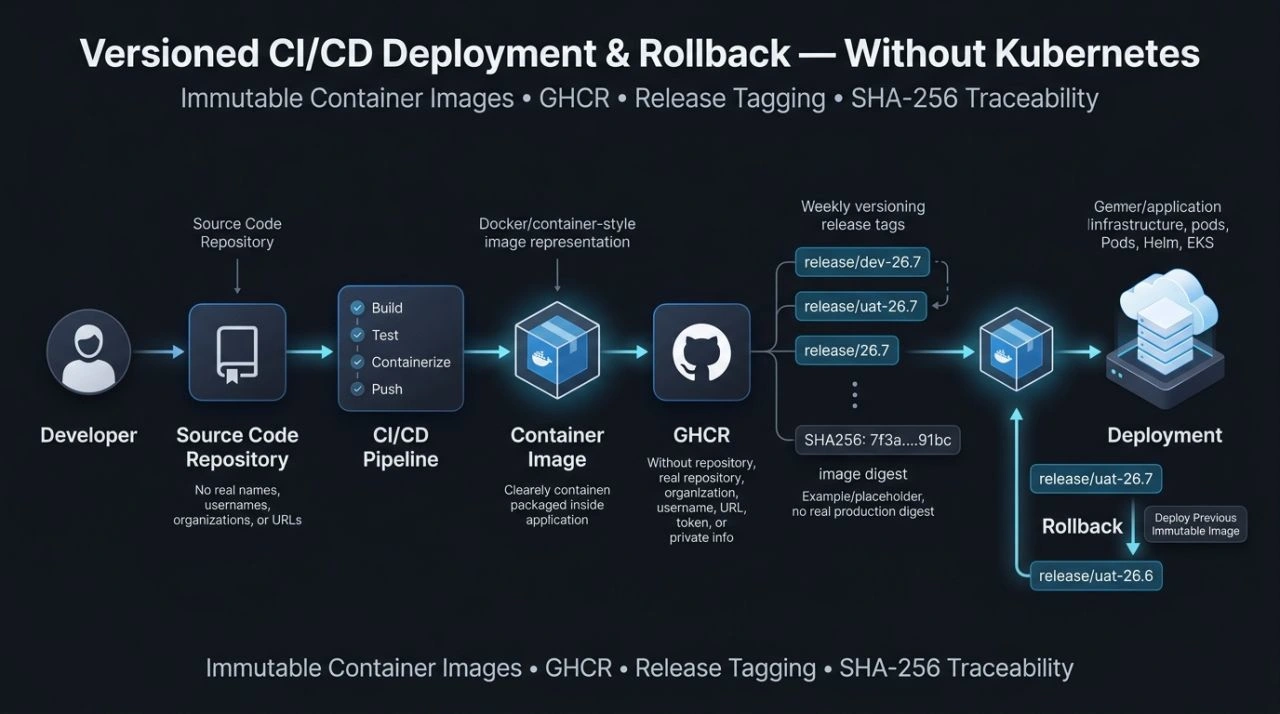
Application images are built and pushed to GitHub Container Registry (GHCR) automatically on every release.
* Structured Release Tags
Instead of latest, I used environment and release-based tagging:
release/dev-26.7
release/uat-26.7
Where 26 = year, 7 = month. Weekly versioning can be layered in when needed.
* Immutable Image Identification
Every deployment is tied to a SHA-256 image digest, an immutable reference to the exact image running in that environment. No more guessing what's deployed.
* Fast, Reliable Rollbacks
Since each release maps to a specific digest, rollback is instant, no rebuild required. Just point the deployment back to the previously verified image:
text
The Result:
A lightweight, production-grade deployment system with:
✅ Automated CI/CD
✅ Full deployment traceability
✅ Immutable image references
✅ Predictable, fast rollbacks
✅ No unnecessary orchestration overhead
Key Takeaway:
Reliable deployments aren't exclusive to Kubernetes. With the right container lifecycle design, even simple infrastructure can have versioning, traceability, and rollback, without the complexity.
Need a similar pipeline for your team?
I build secure, traceable CI/CD systems for teams that want reliability without over-engineering. Let's talk.
0 likes · 0 views · Oct 3, 2026
Case Study: Versioned Deployment & Rollback Pipeline (Without Kubernetes) The Problem: Many teams struggle with deployments that aren't traceable or reversib...

