Research Data Analysis and Visualization

Hadi

Hadi Rajabbeigi

Table of contents

Author

Importing Data

Data was imported from spss file james.sav which was provided by Dr. Dellaneve:
library(tidyverse)
library(haven)
df <- read_spss("data/james.sav")

Selecting Required Data

Some of the columns was omitted from dataset and a report from current variables and their frequency created as a PDF file and the data saved as a new data file:
#Removing Unnecessary Columns from Dataset (Tidying Dataset)
df <- df |>
select(13:210) |>
relocate(ID, 1) |>
arrange(ID) |>
relocate(q2z, q3z, q5z, .after = scale8)

#View the Cleaned Dataset:
sjPlot::view_df(df, show.frq = TRUE)

#Save Cleaned Data
saveRDS(df, "data/clean.rds")

Creating Categorical Variables

In this step, the categorical variables such as gender, race, education, etc. was created from related questions:
library(tidyverse)
library(sjlabelled)
library(sjPlot)

## Reading Clean Dataset:
df <- readRDS("data/clean.rds")

### Changing Management Status (Q136) to Categorical (manager)
df |>
count(Q136)
df <- df |>
mutate(manager = factor (case_when(
Q136 == 1 ~ "manager",
Q136 == 2 ~ "staff"
))) |>
relocate(manager, .after = Q136)

### Changing Q2 to Gender (Factor = categorical)
df <- df |>
mutate(gender = factor (case_when(Q2==1~"male",
Q2==2~"female",
Q2>2~NA))) |>
relocate(gender, .after = Q2)

### Changing Q1 to Categorical Generation
df <- df |>
mutate(generation = factor(case_when(Q1==1~"BabyBoomers",
Q1==2~"GenX",
Q1==3~"GenY",
Q1==4~"GenZ"
))) |>
relocate(generation, .after = Q1)

## Changing Q3 to Categorical Race
df$race <- as_label(df$Q3, keep.labels = TRUE)
df <- df |>
relocate(race, .after = Q3)

## Changing State to Categorical
df$states <- as_label(df$State, keep.labels = TRUE)
df <- df |>
relocate(states, .after = State)

## Changing Q4 to Categorical Education
df$education <- as_label(df$Q4, keep.labels = TRUE)
df <- df |>
relocate(education, .after = Q4)

## Change Q5 (Employment Status) to Categorical empstat
df$empstat <- as_label(df$Q5, keep.labels = TRUE)
df <- df |>
relocate(empstat, .after = Q5)

## Changing Q6 to Categorical Industry
df$industry <- as_label(df$Q6, keep.labels = TRUE)
df <- df |>
relocate(industry, .after = Q6)

## Save Transformed Clean Ready for Analysis Dataset
saveRDS(df, "data/transformd.rds")

Computing Continuous Variables

In this step, continuous (dependent) variables was calculated (took mean):
##Computing Variables of the Study as a New Pivot Table
library(tidyverse)
library(haven)
df <- readRDS("data/transformd.rds")

##Anxiety
df <- df |>
mutate(anxiety = round ((Q10 + Q13 + Q14 + Q15 + Q18 + Q19 + Q20)/7, 2),
.after = Q20)
##Avoidance
##1st Step: Reversing Questions 11, 8, 16, 17
df <- df |>
mutate(Q11New = 6 - Q11, .after = Q11) |>
mutate(Q8New = 6 - Q8, .after = Q8) |>
mutate(Q16New = 6 - Q16, .after = Q16) |>
mutate(Q17New = 6 - Q17, .after = Q17)
##2nd Step: Computing Avoidance from Revised Questions
df <- df |>
mutate(avoidance = round((Q9 + Q12 + Q8New + Q11New + Q16New + Q17New)/6, 2),
.after = Q17New)
##Interpersonal Deviance
##1st Step: Revised Q21
df <- df |>
mutate(Q21New = 6 - Q21, .after = Q21)
##2nd Step: Interpersonal Deviance Variable
df <- df |>
mutate(intpersdev = round((rowSums(across(Q21New:Q27)))/7, 2), .after = Q27)

##Organizational Deviance
df <- df |>
mutate(orgdev = round((rowSums(across(Q28:Q39)))/12, 2), .after = Q39)

##ACE
##1st Step: Reversing Q40-Q44 and Setting Missing Values(NA) for DK/DA values
df <- df |>
mutate(Q40New = case_when(Q40 == 1 ~ 2, Q40 == 2 ~1, Q40 == 3~0,
Q40 == 4~0), .after = Q40)
df <- df |>
mutate(Q41New = case_when(Q41 == 1 ~ 2, Q41 == 2 ~1, Q41 == 3~0,
Q41 == 4~0), .after = Q41)
df <- df |>
mutate(Q42New = case_when(Q42 == 1 ~ 2, Q42 == 2 ~1, Q42 == 3~0,
Q42 == 4~0), .after = Q42)
df <- df |>
mutate(Q43New = case_when(Q43 == 1 ~ 2, Q43 == 2 ~1, Q43 == 3~0,
Q43 == 4~0), .after = Q43)
df <- df |>
mutate(Q44New = case_when(Q44 == 1 ~ 2, Q44 == 2 ~1, Q44 == 3~0,
Q44 == 4~0), .after = Q44)

#2nd Step: Q45-Q50 Missing Values (NA) for DK/DA
df <- df |>
mutate(Q45New = case_when(Q45 == 1 ~ 1, Q45 == 2 ~2, Q45 == 3~3,
Q45 == 4~0, Q45 == 5~0), .after = Q45)
df <- df |>
mutate(Q46New = case_when(Q46 == 1 ~ 1, Q46 == 2 ~2, Q46 == 3~3,
Q46 == 4~0, Q46 == 5~0), .after = Q46)
df <- df |>
mutate(Q47New = case_when(Q47 == 1 ~ 1, Q47 == 2 ~2, Q47 == 3~3,
Q47 == 4~0, Q47 == 5~0), .after = Q47)
df <- df |>
mutate(Q48New = case_when(Q48 == 1 ~ 1, Q48 == 2 ~2, Q48 == 3~3,
Q48 == 4~0, Q48 == 5~0), .after = Q48)
df <- df |>
mutate(Q50New = case_when(Q50 == 1 ~ 1, Q50 == 2 ~2, Q50 == 3~3,
Q50 == 4~0, Q50 == 5~0), .after = Q50)
#3rd Step: Compute ACE from New Revised Questions
df <- df |>
mutate(ace = round((Q40New + Q41New + Q42New + Q43New + Q44New + Q45New
+Q46New + Q47New + Q48New + Q50New), 2), .after = Q50New)

##Phubbing
df <- df |>
mutate(phubbing = round((Q51 + Q52)/2, 2), .after = Q52)

#Employee Engagement
df <- df |>
mutate(empengage = round((rowSums(across(Q60:Q100)))/41, 2), .after = Q100)

#Self-Attachment
##1st Step: Reversing Questions 102, 103, 104, 106, 107, 111
df <- df |>
mutate(Q102New = 6 - Q102, .after = Q102) |>
mutate(Q103New = 6 - Q103, .after = Q103) |>
mutate(Q104New = 6 - Q104, .after = Q104) |>
mutate(Q106New = 6 - Q106, .after = Q106) |>
mutate(Q107New = 6 - Q107, .after = Q107) |>
mutate(Q111New = 6 - Q111, .after = Q111)

##2nd Step: Computing Self-Attachment
df <- df |>
mutate(selfattach = (Q101 + Q102New + Q103New + Q104New + Q105 + Q106New +
Q107New + Q109 + Q111New + Q112)/10, .after = Q112)

#Remote
df <- df |>
mutate(remote = round((Q118 + Q119 + Q120)/3, 2), .after = Q120)

#Focus
df <- df |>
mutate(focus = (Q134 + Q135),
.after = Q135)

#Save File in CSV
write_csv(df, "data/variables.csv")

Categorical Visualization

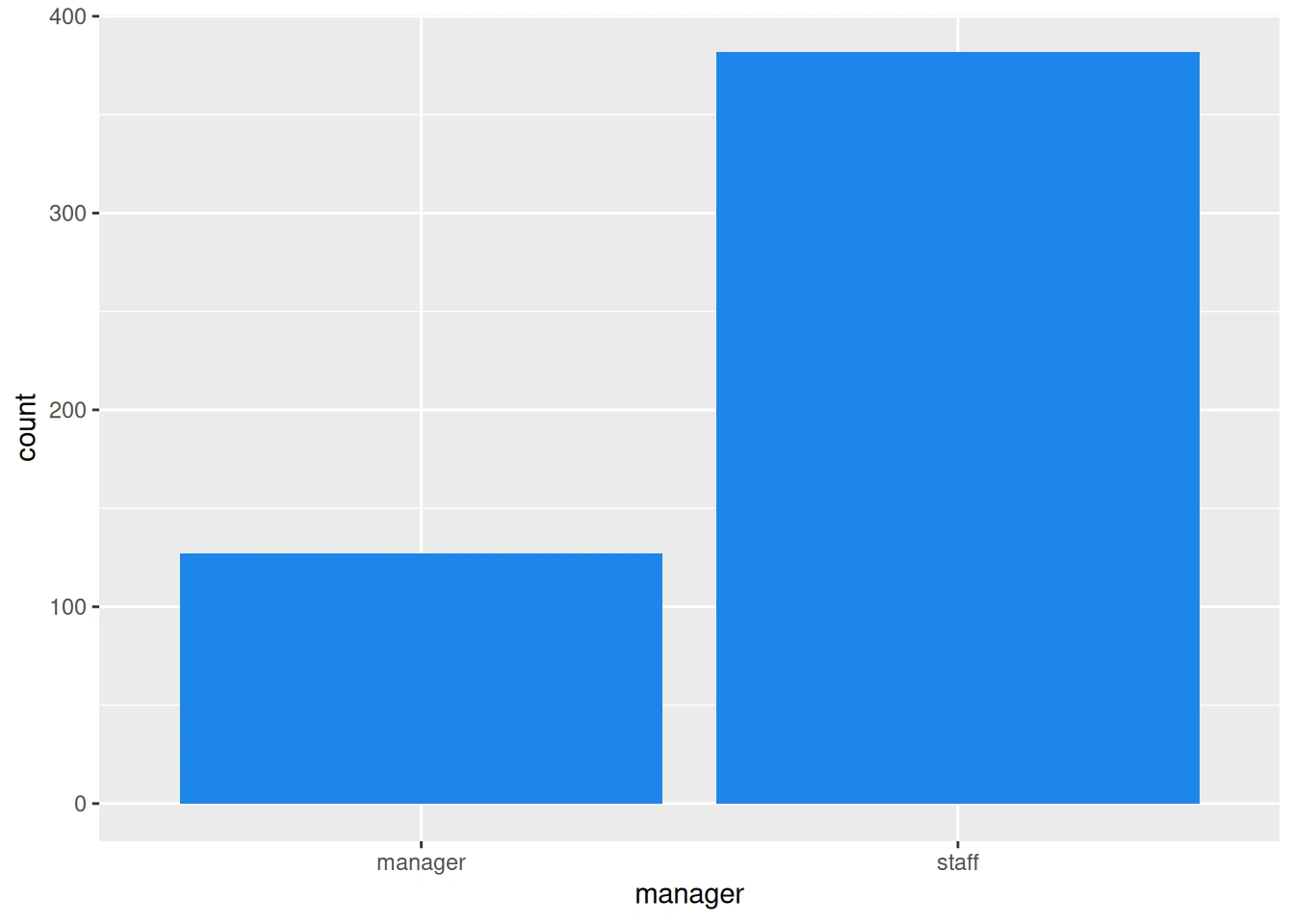
Management Status Bar Chart:

Gender Bar Charts:

Generation

Race

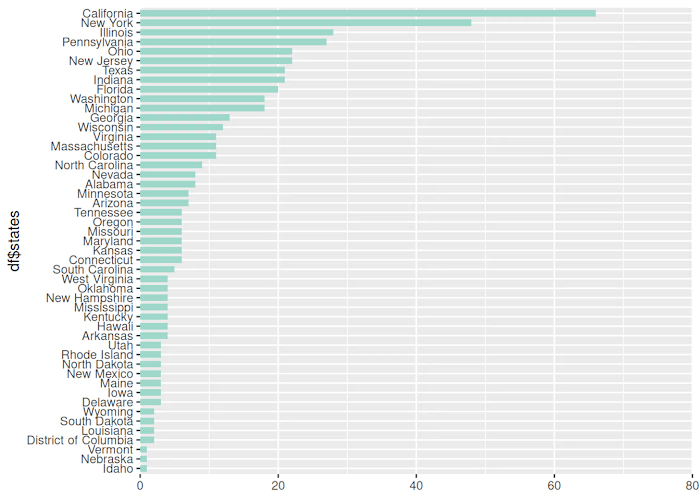
States

Education

Employment Status

Industries

Spearman Correlations

In this step the Spearman correlations between questions of the study is created:

Anxiety Items

Avoidance Items

Interpersonal Deviance Items

ACE Items

Self-Attachment Items

All Items (Q08 to Q112)

Scatter Plots

Anxiety vs. Avoidance

Interpersonal Deviance vs. Anxiety

Interpersonal Deviance vs. Avodiance

Organizational Deviance vs. Avoidance

OrgDev vs. Anxiety

Test of Normality

Employee Engagement


Shapiro-Wilk normality test

data: df$empengage
W = 1, p-value = 8e-09

Self-Attachment


Shapiro-Wilk normality test

data: df$selfattach
W = 1, p-value = 2e-04

Phubbing


Shapiro-Wilk normality test

data: df$phubbing
W = 0.8, p-value <2e-16

Remote Teams


Shapiro-Wilk normality test

data: df$remote
W = 0.9, p-value = 9e-13

Focus


Shapiro-Wilk normality test

data: df$focus
W = 0.7, p-value <2e-16

Anxiety


Shapiro-Wilk normality test

data: df$anxiety
W = 1, p-value = 1e-10

Avoidance


Shapiro-Wilk normality test

data: df$avoidance
W = 1, p-value = 3e-04

Interpersonal Deviance


Shapiro-Wilk normality test

data: df$intpersdev
W = 0.7, p-value <2e-16

Organizational Deviance


Shapiro-Wilk normality test

data: df$orgdev
W = 0.8, p-value <2e-16

ACE


Shapiro-Wilk normality test

data: df$ace
W = 0.9, p-value = 1e-15

Kruskal Wallis Test

Since our continuous variables are not normally distributed, we used non-parametric test of Kruskal Wallis to find how the variables diverse among demographics:

Employee Engagement Vs. Demographics

As we see in the following results there is not any significant difference regarding employee engagement among demographics:

Asymptotic Kruskal-Wallis Test

data: empengage by
race (American Indian/Native American or Alaska Native, Asian, Black or African American, Native Hawaiian or Other Pacific Islander, Other, Prefer not to say, White or Caucasian)
chi-squared = 10, df = 6, p-value = 0.1

Asymptotic Kruskal-Wallis Test

data: empengage by
education (Associates or technical degree, Bachelor’s degree, Graduate Degree, High school diploma or GED, Some college, but no degree, Less than HS)
chi-squared = 5, df = 5, p-value = 0.5

Asymptotic Kruskal-Wallis Test

data: empengage by
generation (BabyBoomers, GenX, GenY, GenZ)
chi-squared = 5, df = 3, p-value = 0.2

Asymptotic Kruskal-Wallis Test

data: empengage by gender (female, male)
chi-squared = 0.04, df = 1, p-value = 0.8

Self-Attachment Vs. Demographics

As the following results show, the self-attachment difference is significant for education and generation at p = 0.05

Asymptotic Kruskal-Wallis Test

data: selfattach by
race (American Indian/Native American or Alaska Native, Asian, Black or African American, Native Hawaiian or Other Pacific Islander, Other, Prefer not to say, White or Caucasian)
chi-squared = 6, df = 6, p-value = 0.5

Asymptotic Kruskal-Wallis Test

data: selfattach by
education (Associates or technical degree, Bachelor’s degree, Graduate Degree, High school diploma or GED, Some college, but no degree, Less than HS)
chi-squared = 19, df = 5, p-value = 0.002

Asymptotic Kruskal-Wallis Test

data: selfattach by
generation (BabyBoomers, GenX, GenY, GenZ)
chi-squared = 55, df = 3, p-value = 6e-12

Asymptotic Kruskal-Wallis Test

data: selfattach by gender (female, male)
chi-squared = 4, df = 1, p-value = 0.05

Phubbing

The results below show that phubbing has a significant difference in generation.

Asymptotic Kruskal-Wallis Test

data: phubbing by
race (American Indian/Native American or Alaska Native, Asian, Black or African American, Native Hawaiian or Other Pacific Islander, Other, Prefer not to say, White or Caucasian)
chi-squared = 3, df = 6, p-value = 0.8

Asymptotic Kruskal-Wallis Test

data: phubbing by
education (Associates or technical degree, Bachelor’s degree, Graduate Degree, High school diploma or GED, Some college, but no degree, Less than HS)
chi-squared = 4, df = 5, p-value = 0.5

Asymptotic Kruskal-Wallis Test

data: phubbing by
generation (BabyBoomers, GenX, GenY, GenZ)
chi-squared = 25, df = 3, p-value = 2e-05

Asymptotic Kruskal-Wallis Test

data: phubbing by gender (female, male)
chi-squared = 2, df = 1, p-value = 0.2

Remote Teams

Results indicate a significant difference for Remote Teams regarding generation

Asymptotic Kruskal-Wallis Test

data: remote by
race (American Indian/Native American or Alaska Native, Asian, Black or African American, Native Hawaiian or Other Pacific Islander, Other, Prefer not to say, White or Caucasian)
chi-squared = 9, df = 6, p-value = 0.2

Asymptotic Kruskal-Wallis Test

data: remote by
education (Associates or technical degree, Bachelor’s degree, Graduate Degree, High school diploma or GED, Some college, but no degree, Less than HS)
chi-squared = 6, df = 5, p-value = 0.3

Asymptotic Kruskal-Wallis Test

data: remote by
generation (BabyBoomers, GenX, GenY, GenZ)
chi-squared = 12, df = 3, p-value = 0.009

Asymptotic Kruskal-Wallis Test

data: remote by gender (female, male)
chi-squared = 0.08, df = 1, p-value = 0.8

Focus

Results indicate focus has a significant difference regarding generation

Asymptotic Kruskal-Wallis Test

data: focus by
race (American Indian/Native American or Alaska Native, Asian, Black or African American, Native Hawaiian or Other Pacific Islander, Other, Prefer not to say, White or Caucasian)
chi-squared = 10, df = 6, p-value = 0.1

Asymptotic Kruskal-Wallis Test

data: focus by
education (Associates or technical degree, Bachelor’s degree, Graduate Degree, High school diploma or GED, Some college, but no degree, Less than HS)
chi-squared = 4, df = 5, p-value = 0.6

Asymptotic Kruskal-Wallis Test

data: focus by
generation (BabyBoomers, GenX, GenY, GenZ)
chi-squared = 28, df = 3, p-value = 3e-06

Asymptotic Kruskal-Wallis Test

data: focus by gender (female, male)
chi-squared = 2, df = 1, p-value = 0.1

Anxiety

Anxiety shows a significant difference in generation and gender

Asymptotic Kruskal-Wallis Test

data: anxiety by
race (American Indian/Native American or Alaska Native, Asian, Black or African American, Native Hawaiian or Other Pacific Islander, Other, Prefer not to say, White or Caucasian)
chi-squared = 5, df = 6, p-value = 0.5

Asymptotic Kruskal-Wallis Test

data: anxiety by
education (Associates or technical degree, Bachelor’s degree, Graduate Degree, High school diploma or GED, Some college, but no degree, Less than HS)
chi-squared = 6, df = 5, p-value = 0.3

Asymptotic Kruskal-Wallis Test

data: anxiety by
generation (BabyBoomers, GenX, GenY, GenZ)
chi-squared = 39, df = 3, p-value = 2e-08

Asymptotic Kruskal-Wallis Test

data: anxiety by gender (female, male)
chi-squared = 5, df = 1, p-value = 0.03

Avoidance


Asymptotic Kruskal-Wallis Test

data: avoidance by
race (American Indian/Native American or Alaska Native, Asian, Black or African American, Native Hawaiian or Other Pacific Islander, Other, Prefer not to say, White or Caucasian)
chi-squared = 6, df = 6, p-value = 0.4

Asymptotic Kruskal-Wallis Test

data: avoidance by
education (Associates or technical degree, Bachelor’s degree, Graduate Degree, High school diploma or GED, Some college, but no degree, Less than HS)
chi-squared = 8, df = 5, p-value = 0.2

Asymptotic Kruskal-Wallis Test

data: avoidance by
generation (BabyBoomers, GenX, GenY, GenZ)
chi-squared = 20, df = 3, p-value = 2e-04

Asymptotic Kruskal-Wallis Test

data: avoidance by gender (female, male)
chi-squared = 0.7, df = 1, p-value = 0.4

Interpersonal Deviance


Asymptotic Kruskal-Wallis Test

data: intpersdev by
race (American Indian/Native American or Alaska Native, Asian, Black or African American, Native Hawaiian or Other Pacific Islander, Other, Prefer not to say, White or Caucasian)
chi-squared = 21, df = 6, p-value = 0.002

Asymptotic Kruskal-Wallis Test

data: intpersdev by
education (Associates or technical degree, Bachelor’s degree, Graduate Degree, High school diploma or GED, Some college, but no degree, Less than HS)
chi-squared = 10, df = 5, p-value = 0.08

Asymptotic Kruskal-Wallis Test

data: intpersdev by
generation (BabyBoomers, GenX, GenY, GenZ)
chi-squared = 29, df = 3, p-value = 3e-06

Asymptotic Kruskal-Wallis Test

data: intpersdev by gender (female, male)
chi-squared = 10, df = 1, p-value = 0.001

Organizational Deviance


Asymptotic Kruskal-Wallis Test

data: orgdev by
race (American Indian/Native American or Alaska Native, Asian, Black or African American, Native Hawaiian or Other Pacific Islander, Other, Prefer not to say, White or Caucasian)
chi-squared = 2, df = 6, p-value = 0.9

Asymptotic Kruskal-Wallis Test

data: orgdev by
education (Associates or technical degree, Bachelor’s degree, Graduate Degree, High school diploma or GED, Some college, but no degree, Less than HS)
chi-squared = 6, df = 5, p-value = 0.3

Asymptotic Kruskal-Wallis Test

data: orgdev by
generation (BabyBoomers, GenX, GenY, GenZ)
chi-squared = 16, df = 3, p-value = 0.001

Asymptotic Kruskal-Wallis Test

data: orgdev by gender (female, male)
chi-squared = 8, df = 1, p-value = 0.006

ACE


Asymptotic Kruskal-Wallis Test

data: ace by
race (American Indian/Native American or Alaska Native, Asian, Black or African American, Native Hawaiian or Other Pacific Islander, Other, Prefer not to say, White or Caucasian)
chi-squared = 8, df = 6, p-value = 0.2

Asymptotic Kruskal-Wallis Test

data: ace by
education (Associates or technical degree, Bachelor’s degree, Graduate Degree, High school diploma or GED, Some college, but no degree, Less than HS)
chi-squared = 20, df = 5, p-value = 0.001

Asymptotic Kruskal-Wallis Test

data: ace by
generation (BabyBoomers, GenX, GenY, GenZ)
chi-squared = 6, df = 3, p-value = 0.1

Asymptotic Kruskal-Wallis Test

data: ace by gender (female, male)
chi-squared = 1, df = 1, p-value = 0.2

Post-Hocs

Interpersonal Deviance vs. Race

dunn.test(df$intpersdev, df$race, method = "bonferroni")
  Kruskal-Wallis rank sum test

data: x and group
Kruskal-Wallis chi-squared = 20.9622, df = 6, p-value = 0

Comparison of x by group
(Bonferroni)
Col Mean-|
Row Mean | American Asian Black or Native H Other Prefer n
---------+------------------------------------------------------------------
Asian | 2.275638
| 0.2401
|
Black or | 0.663769 -3.205398
| 1.0000 0.0142*
|
Native H | -0.822720 -2.382108 -1.355908
| 1.0000 0.1807 1.0000
|
Other | 2.386945 0.394801 3.007857 2.487716
| 0.1784 1.0000 0.0276 0.1350
|
Prefer n | 0.557103 -1.208623 0.151427 1.196141 -1.372575
| 1.0000 1.0000 1.0000 1.0000 1.0000
|
White or | 1.268746 -2.424650 1.587176 1.728215 -2.328179 0.314108
| 1.0000 0.1609 1.0000 0.8815 0.2090 1.0000

alpha = 0.05
Reject Ho if p <= alpha/2

Interpersonal Deviance vs. Generation

dunn.test(df$intpersdev, df$generation, method = "bonferroni")
  Kruskal-Wallis rank sum test

data: x and group
Kruskal-Wallis chi-squared = 28.6773, df = 3, p-value = 0

Comparison of x by group
(Bonferroni)
Col Mean-|
Row Mean | BabyBoom GenX GenY
---------+---------------------------------
GenX | -0.768167
| 1.0000
|
GenY | -3.420578 -2.640559
| 0.0019* 0.0248*
|
GenZ | -4.650167 -3.870110 -1.247611
| 0.0000* 0.0003* 0.6365

alpha = 0.05
Reject Ho if p <= alpha/2

Organizational Deviance vs Generation

dunn.test(df$orgdev, df$generation, method = "bonferroni")
  Kruskal-Wallis rank sum test

data: x and group
Kruskal-Wallis chi-squared = 15.6705, df = 3, p-value = 0

Comparison of x by group
(Bonferroni)
Col Mean-|
Row Mean | BabyBoom GenX GenY
---------+---------------------------------
GenX | -0.359073
| 1.0000
|
GenY | -3.451875 -3.080037
| 0.0017* 0.0062*
|
GenZ | -2.201194 -1.836456 1.227717
| 0.0832 0.1989 0.6587

alpha = 0.05
Reject Ho if p <= alpha/2

ACE vs. Education

dunn.test(df$ace, df$education, method = "bonferroni")
  Kruskal-Wallis rank sum test

data: x and group
Kruskal-Wallis chi-squared = 20.266, df = 5, p-value = 0

Comparison of x by group
(Bonferroni)
Col Mean-|
Row Mean | Associat Bachelor Graduate High sch Less tha
---------+-------------------------------------------------------
Bachelor | 0.933954
| 1.0000
|
Graduate | 2.520125 1.948237
| 0.0880 0.3854
|
High sch | 0.383112 -0.568113 -2.300443
| 1.0000 1.0000 0.1607
|
Less tha | -0.528918 -0.825682 -1.398067 -0.659302
| 1.0000 1.0000 1.0000 1.0000
|
Some col | -1.636658 -2.914011 -4.331049 -2.164880 -0.012443
| 0.7628 0.0268 0.0001* 0.2280 1.0000

alpha = 0.05
Reject Ho if p <= alpha/2

Avoidance vs. Generation

dunn.test(df$avoidance, df$generation, method = "bonferroni")
  Kruskal-Wallis rank sum test

data: x and group
Kruskal-Wallis chi-squared = 19.5935, df = 3, p-value = 0

Comparison of x by group
(Bonferroni)
Col Mean-|
Row Mean | BabyBoom GenX GenY
---------+---------------------------------
GenX | 2.574562
| 0.0301
|
GenY | 1.733197 -0.843147
| 0.2492 1.0000
|
GenZ | 4.345403 1.774295 2.617525
| 0.0000* 0.2280 0.0266

alpha = 0.05
Reject Ho if p <= alpha/2

Anxiety vs. Generation

dunn.test(df$anxiety, df$generation, method = "bonferroni")
  Kruskal-Wallis rank sum test

data: x and group
Kruskal-Wallis chi-squared = 38.8801, df = 3, p-value = 0

Comparison of x by group
(Bonferroni)
Col Mean-|
Row Mean | BabyBoom GenX GenY
---------+---------------------------------
GenX | -0.592811
| 1.0000
|
GenY | -3.214476 -2.610278
| 0.0039* 0.0271
|
GenZ | -5.539950 -4.930446 -2.340168
| 0.0000* 0.0000* 0.0578

alpha = 0.05
Reject Ho if p <= alpha/2

Interpersonal Deviance vs. Gender

dunn.test(df$intpersdev, df$generation, method = "bonferroni")
  Kruskal-Wallis rank sum test

data: x and group
Kruskal-Wallis chi-squared = 28.6773, df = 3, p-value = 0

Comparison of x by group
(Bonferroni)
Col Mean-|
Row Mean | BabyBoom GenX GenY
---------+---------------------------------
GenX | -0.768167
| 1.0000
|
GenY | -3.420578 -2.640559
| 0.0019* 0.0248*
|
GenZ | -4.650167 -3.870110 -1.247611
| 0.0000* 0.0003* 0.6365

alpha = 0.05
Reject Ho if p <= alpha/2

Wilcoxon Test

Since Gender has two categories in our study (male and female) we used Wilcoxon test to find out about the difference among groups:

Employee Engagement vs. Gender

wilcox.test(empengage~gender, data = df, na.rm = TRUE)

Wilcoxon rank sum test with continuity correction

data: empengage by gender
W = 31678, p-value = 0.8
alternative hypothesis: true location shift is not equal to 0

Self-Attachment vs. Gender

wilcox_test(selfattach~gender, data = df)

Asymptotic Wilcoxon-Mann-Whitney Test

data: selfattach by gender (female, male)
Z = 2, p-value = 0.05
alternative hypothesis: true mu is not equal to 0

Phubbing vs. Gender

wilcox_test(phubbing~gender, data = df)

Asymptotic Wilcoxon-Mann-Whitney Test

data: phubbing by gender (female, male)
Z = 1, p-value = 0.2
alternative hypothesis: true mu is not equal to 0

Remote vs. Gender

wilcox_test(remote~gender, data = df)

Asymptotic Wilcoxon-Mann-Whitney Test

data: remote by gender (female, male)
Z = 0.3, p-value = 0.8
alternative hypothesis: true mu is not equal to 0

Focus vs. Gender

wilcox_test(focus~gender, data = df)

Asymptotic Wilcoxon-Mann-Whitney Test

data: focus by gender (female, male)
Z = 2, p-value = 0.1
alternative hypothesis: true mu is not equal to 0

Anxiety vs. Gender

wilcox_test(anxiety~gender, data = df)

Asymptotic Wilcoxon-Mann-Whitney Test

data: anxiety by gender (female, male)
Z = -2, p-value = 0.03
alternative hypothesis: true mu is not equal to 0

Avoidance vs. Gender

wilcox_test(avoidance~gender, data = df)

Asymptotic Wilcoxon-Mann-Whitney Test

data: avoidance by gender (female, male)
Z = 0.8, p-value = 0.4
alternative hypothesis: true mu is not equal to 0

Interpersonal Deviance vs. Gender

wilcox_test(intpersdev~gender, data = df)

Asymptotic Wilcoxon-Mann-Whitney Test

data: intpersdev by gender (female, male)
Z = -3, p-value = 0.001
alternative hypothesis: true mu is not equal to 0

Organizational Deviance vs. Gender

wilcox_test(orgdev~gender, data = df)

Asymptotic Wilcoxon-Mann-Whitney Test

data: orgdev by gender (female, male)
Z = -3, p-value = 0.006
alternative hypothesis: true mu is not equal to 0

ACE vs. Gender

wilcox_test(ace~gender, data = df)

Asymptotic Wilcoxon-Mann-Whitney Test

data: ace by gender (female, male)
Z = 1, p-value = 0.2
alternative hypothesis: true mu is not equal to 0

Means Across Demographics

We took mean for variables with a significant difference to see how different categories behave

Interpersonel Deviance vs. Race

# A tibble: 7 × 2
race mean_intpersdev
<fct> <dbl>
1 American Indian/Native American or Alaska Native 1.61
2 Asian 1.21
3 Black or African American 1.49
4 Native Hawaiian or Other Pacific Islander 1.75
5 Other 1.16
6 Prefer not to say 1.35
7 White or Caucasian 1.33

Interpersonal Deviance vs. Generation

# A tibble: 4 × 2
generation mean_intpersdev
<fct> <dbl>
1 BabyBoomers 1.20
2 GenX 1.26
3 GenY 1.43
4 GenZ 1.54

Interpersonal Deviance vs. Gender

# A tibble: 3 × 2
gender mean_intpersdev
<fct> <dbl>
1 female 1.29
2 male 1.42
3 <NA> 1.38

Organizational Deviance vs. Generation

# A tibble: 4 × 2
generation mean_orgdev
<fct> <dbl>
1 BabyBoomers 1.39
2 GenX 1.42
3 GenY 1.63
4 GenZ 1.62

Organizational Deviance vs. Gender

# A tibble: 3 × 2
gender mean_orgdev
<fct> <dbl>
1 female 1.45
2 male 1.58
3 <NA> 1.70

Self-Attachement vs. Education

# A tibble: 6 × 2
education mean_self_attach
<fct> <dbl>
1 Associates or technical degree 3.52
2 Bachelor’s degree 3.61
3 Graduate Degree 3.59
4 High school diploma or GED 3.34
5 Some college, but no degree 3.54
6 Less than HS 3.28

Phubbing vs. Generation

# A tibble: 4 × 2
generation mean_phubbing
<fct> <dbl>
1 BabyBoomers 1.49
2 GenX 1.73
3 GenY 1.91
4 GenZ 1.87

Remote vs. Generation

# A tibble: 4 × 2
generation mean_remote
<fct> <dbl>
1 BabyBoomers 3.41
2 GenX 3.73
3 GenY 3.76
4 GenZ 3.58

Focus vs. Generation

# A tibble: 4 × 2
generation mean_focus
<fct> <dbl>
1 BabyBoomers 3.52
2 GenX 3.51
3 GenY 3.12
4 GenZ 3.18

Anxiety vs. Generation

# A tibble: 4 × 2
generation mean_anxiety
<fct> <dbl>
1 BabyBoomers 1.94
2 GenX 2.01
3 GenY 2.23
4 GenZ 2.47

Anxiety vs. Gender

# A tibble: 3 × 2
gender mean_anxiety
<fct> <dbl>
1 female 2.08
2 male 2.24
3 <NA> 2.38

Avoidance vs. Generation

# A tibble: 4 × 2
generation mean_avoidance
<fct> <dbl>
1 BabyBoomers 3.35
2 GenX 3.08
3 GenY 3.19
4 GenZ 2.91

ACE vs. Education

# A tibble: 6 × 2
education mean_ace
<fct> <dbl>
1 Associates or technical degree 12.8
2 Bachelor’s degree 12.4
3 Graduate Degree 11.8
4 High school diploma or GED 12.7
5 Some college, but no degree 13.7
6 Less than HS 13.8
Like this project

Posted May 25, 2025

Data analysis and visualization for Dr. Dellaneve's research.