Shipping Forecast: Generative Sleep Music

Toby Godden


A generative music installation driven by the BBC Radio 4 Shipping Forecast. The forecast plays as music, continuously, updating with every broadcast. Playable at ffilm.org/shippingforecast.
I woke up at 1pm. This is not my usual relationship with sleep. I'm an insomniac. Have been for years. But I'd left something running on my laptop, and somewhere in the small hours it did what I'd hoped it might, and I was out.
The Shipping Forecast
If you grew up with Radio 4 in the house, you already know what this is. Four times a day, BBC Radio 4 broadcasts a list of weather conditions for 31 sea areas around the British Isles. It has been doing this, in roughly the same format, since 1867. The areas go clockwise from the top: Viking, North Utsire, South Utsire, Forties, Cromarty. Names that are partly geography and partly incantation. Each area gets wind direction and force, sea state, visibility, weather.
The midnight broadcast, at 00:48, is preceded by a piece of music called Sailing By: a light orchestral waltz by Ronald Binge, used as a tuning signal so ships at sea can find the frequency. It exists solely to fill the gap. It is absurd and perfect.
Most of the people listening are not on ships. They are in bed, half-asleep, in houses all over Britain, finding the rhythm of it comforting in the way that rituals are comforting: not because of what it says but because it says it the same way every time. Dogger. Fisher. German Bight. Moderate or good.
The idea
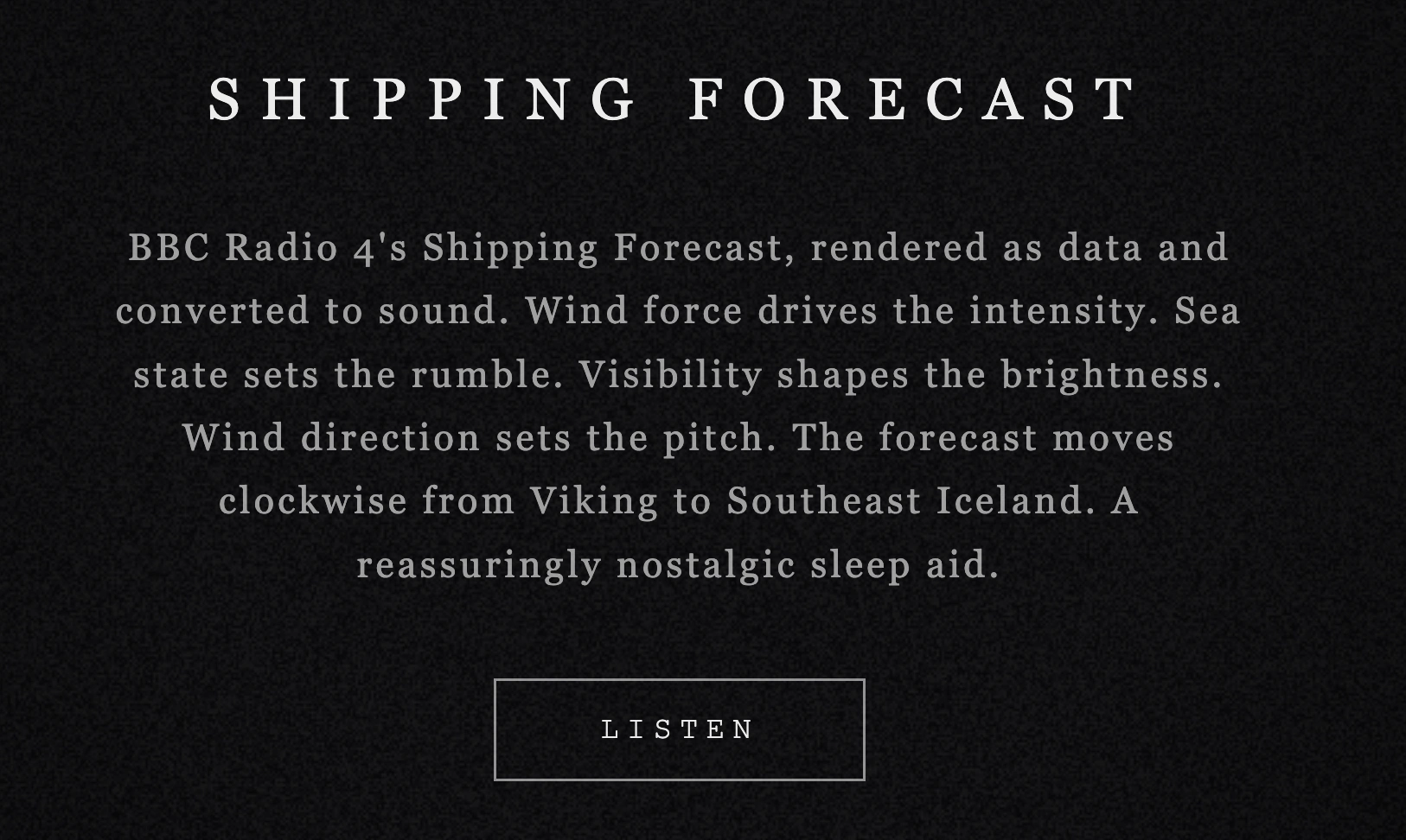
The forecast is already a kind of music. Fixed structure, specific vocabulary, read at the same pace by the same calm voices. What if you took that literally? Not illustrated by sound, not a visualiser or an ambient accompaniment, but actually converted into it. Each area's conditions become its sonic character. Wind force, sea state, visibility, weather type: all mapped directly to synthesis parameters in real time.
The whole coast, playing once every twenty minutes. Then looping. Updating when a new broadcast arrives.
How it works
A cron job runs every 30 minutes, checks an RSS feed that publishes recordings of each broadcast captured from the 198kHz longwave signal, and if there's a new one, downloads it. The audio goes to Groq's speech recognition API, which transcribes it. The transcript goes to a language model, which extracts the per-area conditions as structured data. That data is what the browser receives.
In the browser, everything is synthesised from scratch using the Web Audio API. No samples, no pre-recorded music. Each of the 31 areas generates its own sound from its conditions.
Wind direction maps to a pitch centre: north is low, south slightly higher, the full compass rose becomes a scale. Six sine wave oscillators, spaced at octave intervals, all gliding slowly upward over the area's duration, creating the sensation of perpetual ascent without ever arriving anywhere. This is called a Shepherd tone. It's the musical equivalent of an Escher staircase. It felt right for something that loops forever.
Wind force drives noise: nearly silent for calm seas, dominant for storm force. Sea state adds texture and a low rumble at 30Hz, mostly felt rather than heard. Visibility sets a filter that darkens the sound as conditions worsen. Fog is almost smothered. Good visibility is bright.
The actual BBC recording plays underneath everything: filtered to sound like a voice through walls, or from another room. It phases slowly in and out. It sounds like a memory.
What it sounds like
Reassuring. Calm areas are tonal and musical; rough areas sound like weather. The whole thing moves slowly around the coast, and by the time it's back to Viking you've probably stopped listening consciously.
It is, as I discovered, a functional sleep aid.
September
On 26 September 2026, BBC Radio 4 longwave shuts down permanently. The Shipping Forecast has been broadcast on longwave since 1925: a hundred years of the same ritual on the same frequency. After September, it will still exist, but not on longwave. Not the thing you could receive with a radio at sea, four hundred miles from shore.
There's a countdown in the corner of the page.
The installation will keep running after shutdown. The data pipeline uses archived recordings and an RSS feed, not the longwave signal directly. But it felt important to acknowledge that something is ending.
I built this partly as a sleep aid and partly as an act of remembering. The forecast at 00:48, the voice in the dark, the names of places that are mostly sea. I wanted to sit with it for a while before it changes.
You can leave it on all night. That's what it's for.
Like this project
Posted Jul 28, 2026
A generative music installation that converts BBC Shipping Forecast data into continuous synthesised sound. Wind, sea state, and visibility become music. Built as a sleep aid and an act of remembering before longwave shuts down in September 2026.
Likes
0
Views
8
Timeline
Mar 28, 2026 - Ongoing
Clients
Ffilm.org