Analyzing Threat Actor Evasion Tactics Using HTTP 302s

Hardi Limbachiya



How Threat Actors Leverage HTTP 302s and Browser Fingerprinting to Evade Security Scanners: Deconstructing Edge Cloaking
Format: Technical Analysis & Architecture Breakdown
Target Audience: Enterprise CISOs, Security Engineers, and B2B SaaS Product Managers
Executive Summary
The impersonation campaigns for web-based brand rely on multi tier redirect chains and client side inspection to bypass automated security sandboxes. Automated scanners and security crawlers are shown a static, benign page, while real human visitors are routed to a cloned single sign-on (SSO) login page designed to capture credentials. The threat actors create an LLM-observable routing asymmetry.
This breakdown analyzes the mechanics of a recent paid-ad impersonation campaign. It details the interaction between HTTP 302 Found responses and conditional edge routing.
Threat Campaign Sequence Diagram
Technical breakdown
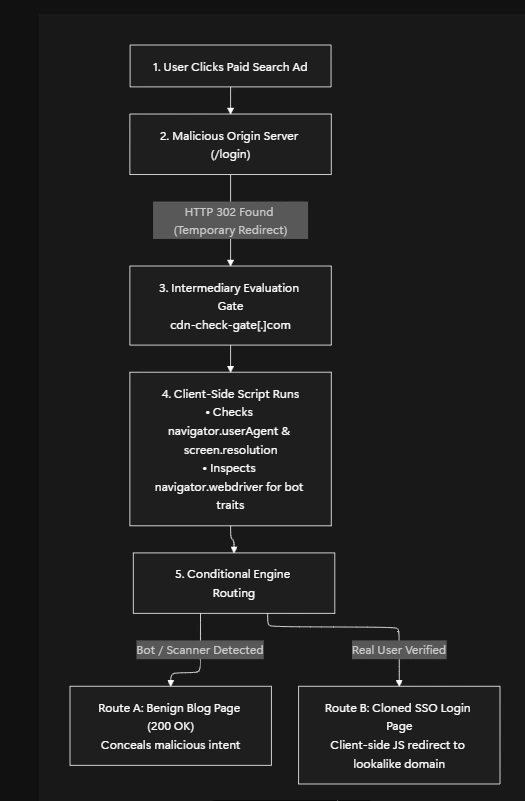
The Intercept: HTTP 302 vs. 301
The attack path begins with an HTTP request to an initial
/login path via a search ad. The origin server immediately issues an HTTP 302 Found status code:Why a 302 Redirect?
An HTTP 301 response instructs client browsers and crawlers to permanently cache the target destination. 302 forces the client to re-evaluate the routing path on every session. It gives the attacker full dynamic control over every single click.
2) Client-Side Fingerprinting & Bot Trait Inspection
Upon reaching the evaluation gate, the client browser executes an obfuscated JavaScript payload designed to inspect runtime execution attributes:
3) Strategic Impact: Defensive Takeaways
To defend against multi-tier cloaking campaigns, security operations teams must move beyond static IP reputation lists:
Inspect Evaluation Endpoints: Monitor network telemetry for fast-flux domain jumping following initial HTTP 302 responses.
Emulate Real Hardware Trait Execution: Ensure automated web sandboxes randomize screen geometry and strip
navigator.webdriver flags to force attackers into exposing payload routes.Like this project
Posted Sep 19, 2026
Uncover how threat actors leverage HTTP 302 redirects and browser fingerprinting to bypass security controls and stay hidden from detection.
Likes
0
Views
6