Theseus | Interactive Brand-Building for Founders

Khari Angel

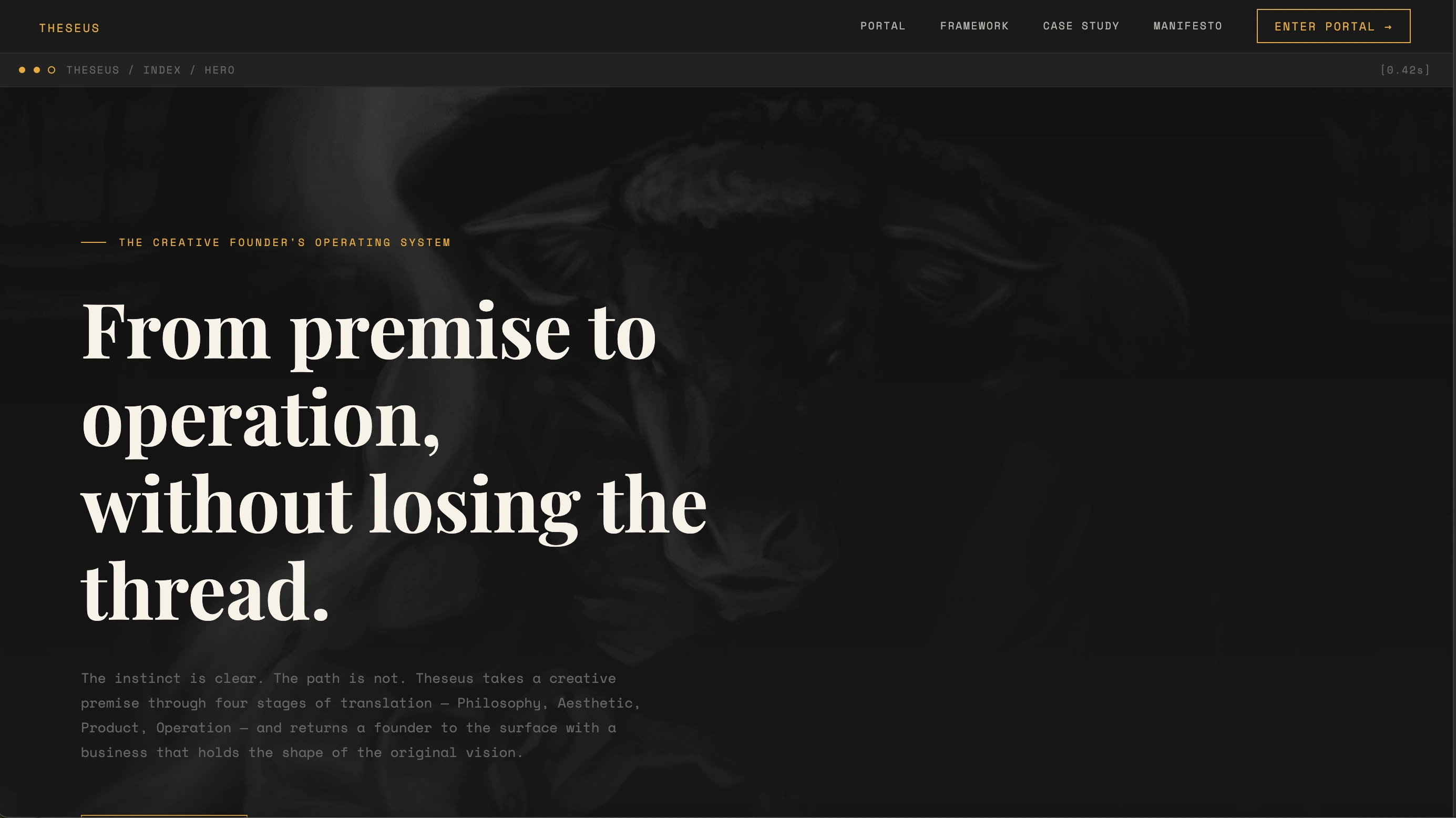
From premise to operation, without losing the thread.
Theseus is an interactive, personalized brand-building experience for creative founders. Built in Figma Make, it takes a founder through four stages of business clarity: Philosophy, Aesthetic, Product, and Operation. No account. No onboarding. No templates. Just one question at a time, and a system that listens.
The entire experience is structured around the myth of Theseus navigating the labyrinth. The founder is Theseus. The labyrinth is the complexity of building a business. And the thread, Ariadne's thread, is the connective logic that holds every decision together from the first question to the final document.
Theseus portal interface on obsidian canvas
The Design Language
The visual system is built on restraint. An obsidian canvas. Two typefaces: Space Mono for all UI and body text, Playfair Display for stage names and headings. The only color is Ariadne's Gold (#E5A93B), used exclusively for connective elements, active states, and the thread itself.
When a founder hovers over any navigation link, the letters scramble through random characters before resolving back to the real word. The effect is about 400 milliseconds. It communicates something specific: this system decodes. It reveals. It does not present.
The coordinates in the header (N 41°02′ E 028°58′) place the experience at Istanbul, the strait between Europe and Asia, near the mythological site of the labyrinth. A detail most users won't consciously register, but one that anchors the world-building.
The Portal Transition
Between every stage, a full-screen transition fires. A gold SVG circle draws itself clockwise around a centered monogram, a single T in Playfair Display. The T scrambles and resolves in a looping decode cycle. After a few seconds, the screen fades to obsidian and the next stage opens.
This is not decorative. It signals that the founder is moving from one mode of thinking into another.
Stage 1 — The Horn (Philosophy)
"What does this brand exist to do?"
The portal opens on a dark full-screen interface. A thin gold progress bar fills 25% of the screen width. A single question appears, centered in the viewport. Not a form. Not a list of fields. One question at a time.
The input field is minimal: a single bottom-border line, no box, no label. The founder types. They press Enter. The question fades upward. The next question fades in from below.
Each subsequent question references what came before. By the third question, the founder's brand name is embedded in the prompt. By the fifth, the system is quoting their own words back to them. The questions get more specific. More personal. More exacting.
After six questions, a stage complete screen appears: a structured summary assembled into a readable document. The output is The Mythos Manifest.
"You have named the thing. The labyrinth knows you are coming."
Stage 2 — The Maze (Aesthetic)
"Name the thing the customer feels before they read a word."
The second stage shifts the mode of interaction. Instead of open text fields, the founder makes visual and sensory choices. Word selections rendered as pill-shaped tags. Visual world options as stacked cards. Color temperature as a four-option choice.
The founder's brand name appears in every prompt. Their answer from Stage 1, the feeling they said the brand must create, is quoted back in the final question:
You said [brand] should make someone feel [their exact words]. What does that feeling look like before a single word is read?
The output is The Iconography Map: a visual brand direction document assembled entirely from their choices, written in their own language.
"The corridors have a shape now. You drew them yourself."
Stage 3 — The Heart (Product)
"What are you actually selling? Be specific."
The third stage is the hardest. The questions stop being philosophical and become concrete. What are you actually selling. What does it cost. Who is the first real buyer who would pay full price without being convinced by you personally.
Near the end, before the advance button appears, a single line fades in:
[Brand] is the only [delivery format] that [their differentiation].
This is the first time the founder sees their positioning statement as a single sentence. For most founders, this is the moment the entire session crystallizes. The output is The Architecture of Offerings.
"You looked at the thing directly. Most founders never do."
Stage 4 — The Sword (Operation)
"Which decisions repeat? Codify them."
The final stage is operational. Channel, objective, constraint, capacity, first action. The questions adapt based on what constraint the founder names. If they say no audience, the system asks a different follow-up than if they say no capital or no time.
The stage complete screen assembles the entire four-stage journey into a single sequential reveal. Each line fades in with a 600ms pause:
[Brand name].
[Their product in one sentence.]
For [their customer description].
At [their price point].
Through [their primary channel].
In 90 days: [their objective].
The thread holds.
The output is The Sovereign Rituals.
"The thread holds. You are a legend."
The Results
The results page shows all four generated documents in a single scrollable column. Each document is fully assembled from the founder's inputs. Not a template with blank fields, but a complete readable document using their exact words, their brand name, their philosophy, their product, their operational plan.
One button at the bottom: DOWNLOAD ALL DOCUMENTS. A single markdown file named after their brand.
The entire experience takes 12 to 20 minutes. No account, no login, no onboarding. It begins with a single question and ends with four documents and a thread that holds across all of them.
The Principle
Every interaction decision, the one-question-at-a-time format, the scramble effect, the transition statements, the sequential reveal, is designed to make the founder feel they are inside a system that is taking them somewhere. Not filling out a form. Not completing a checklist. Moving through a labyrinth that was built for them, and arriving somewhere real on the other side.
Like this project
Posted Jun 15, 2026
An interactive brand-building experience for creative founders, structured around the myth of Theseus. Four stages. One question at a time. Four documents on the other side.
Likes
0
Views
11