Digital Engagement Audit for Hospitality Brands

Simbarashe Able Mukondo


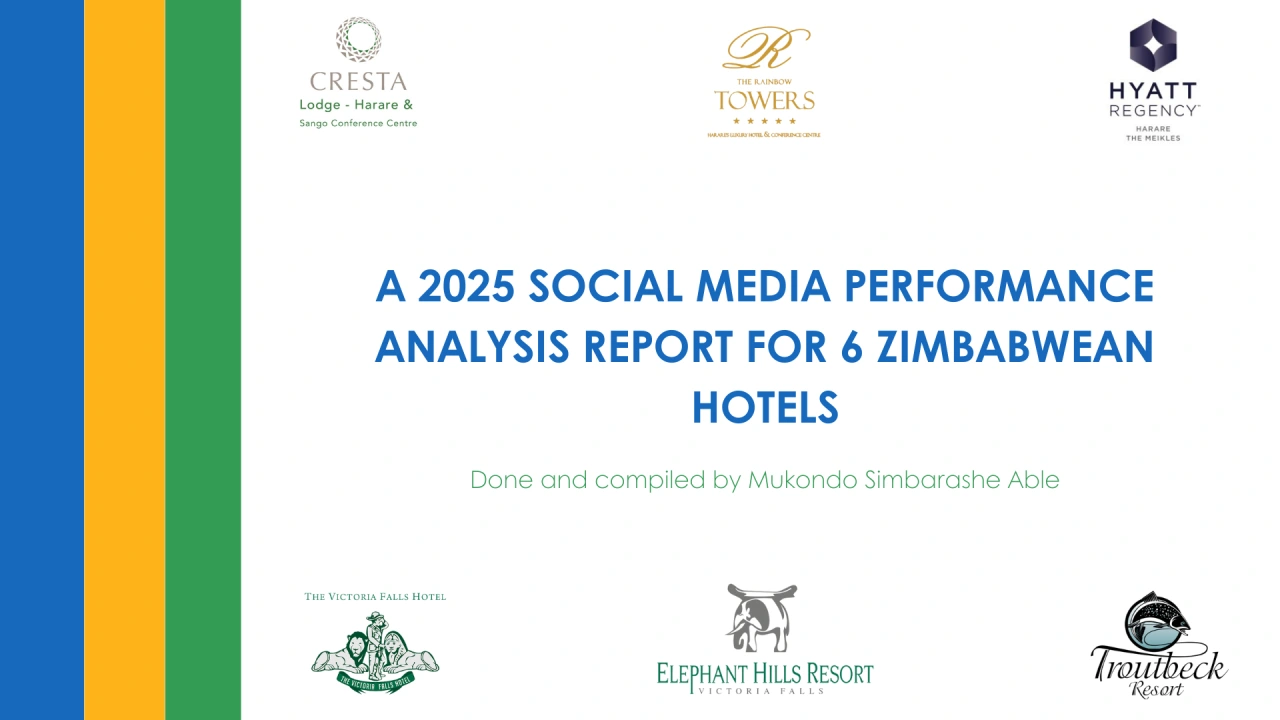
The hospitality industry is an industry that thrives on the visual labor of the public, effectively getting its visibility from travelers while its own official channels remain static. In this series, we chose to intentionally bypass the "group efforts," the corporate shields of African Sun , RAINBOW TOURISM GROUP , and Cresta Hotels . We wanted to peel back the corporate layer to see if the individual properties actually have a unique pulse or if they are simply resting on the reputation of the group. Unfortunately, the evidence suggests that individual property identities are quiet. Instead of showcasing the distinct soul and character that each property possesses. In this analysis we picked 6 hotels and resorts for the analysis.
Please Note: It is important to clarify from the onset that this analysis does not reflect actual business performance, financial revenue, net profits, or growth. This audit is strictly a measure of social media performance and digital engagement based on publicly available data.
To properly rank these brands and move beyond mere guesswork, we conducted a rigorous data analysis of audience responses over a 105-day period, with a specific three-month window dedicated to LinkedIn metrics.
These rankings are strictly engagement-based, focusing on how effectively a brand's content actually resonates with its audience. Our primary metric, the Engagement Score (ES), was calculated by taking the total number of likes generated across all posts in the period and dividing them by the total number of posts published. For Facebook, we went a step further to capture the nuance of social interaction by averaging the like-based score and the comment-based score, providing a more holistic view of how much conversation a brand actually sparks.
To ensure statistical relevance and weed out accounts that are effectively dormant, any brand that posted fewer than 10 times during the period was automatically awarded an ES of 0; consistency is a prerequisite for influence. Furthermore, we applied the Winsorization method to qualify outliers. This ensures the data remains honest and isn't skewed by a single viral post or an anomaly that doesn't reflect the brand’s day-to-day digital reality.
5 Troutbeck Resort
The reality is that this entire sector is Instagram-heavy, and for good reason, this is where they are supposed to thrive. Hotels and resorts are highly visual products; you aren't just selling a room, you’re selling an aesthetic and an aspirational experience. If your visuals aren't hitting, you effectively don't exist in the modern traveler's mind.
Hyatt seems to understand this better than most, maintaining a strategic presence across almost every platform except X, which they have wisely phased out. Their LinkedIn performance is a wake-up call for their competitors; with an Engagement Score (ES) of 74.5, they are outperforming companies with much larger digital departments. They have mastered the art of quality over quantity, choosing to post meaningful content rather than spamming the feed. They clearly understand the specific "vibe" of LinkedIn, TikTok, and Instagram and have tailored their content accordingly.
However, it isn’t all praise; Hyatt is currently sitting on a mountain of negative reviews for their restaurant, and the silence from the company is problematic. While we haven't seen a direct response, they seem to be attempting a service recovery path through a micro-influencer recently to push their brunch and buffet breakfast. It’s a start, but influencer marketing can't permanently fix deep-seated service issues.
Rainbow Towers stands out as one of the most significant missed opportunities in terms of digital branding. Despite having a physical presence that is iconic to the Harare skyline, they do not properly showcase the hotel on the Rainbow Towers pages. Frankly, the content feels lackluster and cheap. The pages do not feel classy or premium, failing to do any justice to the actual premises they are meant to sell.
You have the HICC and massive international events taking place on your grounds, built-in content gold, yet you fail to capitalize on that energy. There is a sense of complacency here; perhaps because their rooms stay full, they don’t see the need to push the hotel as a distinct unit. But filling rooms today doesn't guarantee relevance tomorrow. If your digital footprint looks like a budget lodge while you claim to be a 5-star destination, that disconnect will eventually damage the brand's long-term value.
On the other hand, Victoria Falls Hotel is exactly the "classy bae" she thinks she is. They have a firm grasp of their value proposition, and they allow that heritage and classiness to luminate through their socials. When you scroll through their feed, the branding is so consistent that if you can afford it, you don't even have to think twice about booking, the visuals have already done the heavy lifting.
However, even the most prestigious hotels need to evolve. They are currently thin on video content and are completely missing the boat by not tapping into TikTok. Being old-school and prestigious is a great niche, but if you don't adapt to the short-form video era, you risk becoming a museum piece rather than a living destination for the next generation of luxury travelers.
The situation at Elephant Hills Resort and Troutbeck is nothing short of an administrative nightmare. Elephant Hills managed to lose their Facebook page with 61,000 followers, a loss that can only be described as professional negligence. To make matters worse, they lost their Instagram account twice, once in 2019 and again in September 2025, leaving them with a staggering 2 followers at the moment. There is a new TikTok account that surfaced in October, which suggests they finally have a new hire trying to pick up the pieces, but right now, the strategy is still "here nor there."
Because of this chaos, losing accounts, starting over, and losing them again, they have almost no digital history to show for themselves. Troutbeck suffered the same blow, likely because they are under the same parent umbrella and share the same lack of digital security and strategy. While Troutbeck is active on Instagram and X, they should drop X immediately. It is a waste of resources for a resort. They need to pivot to TikTok and double down on Facebook activity while actually securing their digital assets for the long haul.
Cresta Lodge Harare is currently the definition of "posting into the void." They maintain a presence on LinkedIn, Facebook, Instagram, and X, but it is a ghost town in terms of engagement. They are posting regularly without receiving any likes or comments in return, which signals that the content is either too generic or the algorithm has entirely written them off.
As someone who is also part of the hospitality industry, I recognize that coming up with fresh content ideas for a single property is difficult and can feel repetitive. However, we have to move past the "look at our bed, look at our pool" phase. It has become monotonous and, quite frankly, boring for the audience. Hotels need to stop just showcasing amenities and start telling stories if they want people to actually click the "Like" button.
The Way Forward: Strategy Over Monotony
The Zimbabwean hospitality sector is at a critical digital crossroads. For too long, these properties have relied on the sheer beauty of their physical locations or the administrative safety of their parent groups to carry their marketing efforts. However, as this audit reveals, relying on "accidental" user-generated content without a deliberate strategic backbone is a recipe for long-term invisibility.
Digital relevance is no longer an optional luxury; it is the new baseline for survival. If these hotels do not begin to tell their own stories with class, consistency, and a modern understanding of platforms like TikTok, they will eventually find themselves managed by the narratives of others, and they might not like how that story ends.
Like this project
Posted Jun 8, 2026
Conducted a digital engagement audit of Zimbabwean hospitality brands.