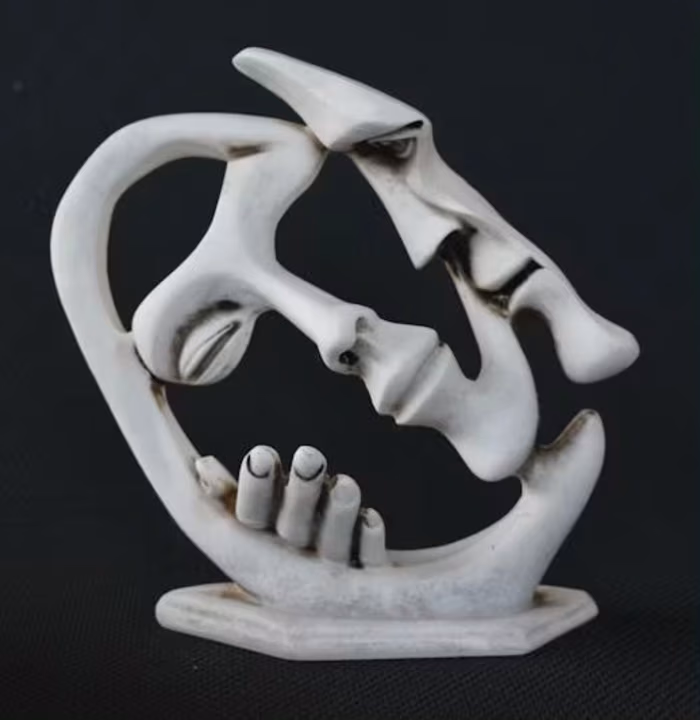
Breaking the Silence: A Journey to Empowerment

L A KuFu


“You’re really going to drag your poor great-grandmother into this,” my mother needled as she watched me stuff my suitcase. “She doesn’t need to be involved. We need to keep our business private.”
It was a typical situation.
My father’s abuse had reached a level I couldn’t endure without reaction.
I stood up for myself; he stood a bit taller.
He towered over my sixteen-year-old self, glaring down into my eyes with the arctic blue contempt that was all too familiar.
What exactly I had done to earn his ire this time, I no longer remember, but I do remember the realization that I could get away.
I could escape.
I was a new driver with a car all my own. My great-grandmother lived about ten minutes away, and I knew I’d be welcome at her home. Though dysfunctional in her own ways that I had not yet come to recognize, in that moment of life, I regarded her as a safe space.
After the confrontation with my father, I fled to my bedroom. My mother sensed that this time, something in my energy was different.
She followed me to my room and stood silently as I pulled my battered green suitcase from the top of the closet.
She stared as I began stuffing it with clothing, my energy frantic, my rage palpable.
In my mind, I was thinking: This is the last time. The last time this guy screams in my face. The last time he intimidates me. The last time he condemns me for nothing at all.
I barely perceived my mother’s presence as I packed with my mind racing. But somehow, I misinterpreted her stillness for pity- for care.
I figured she must understand.
After all, her own father was very much the same.
Finally, as the suitcase was nearly filled and I flipped the lid closed, she spoke.
“Where do you plan to go?” she asked.
“Nanny’s house,” I replied.
“So, you’re really going to drag your poor great-grandmother into this,” my mother scoffed. “She doesn’t need to be involved. We need to keep our business private.”
“Where else would you have me go?” I replied, exasperated.
“Nowhere. You don’t need to go anywhere. Just give him a chance to calm down and it’ll be fine. It always is,” she said. “But if you really feel the need to do this, you’re going to embarrass all of us. We don’t need everyone in the family knowing that you guys had a little argument.”
I stood silently, just looking at her, a displaced sense of betrayal creeping around the edges of my mind. I wouldn’t dare express it, in fact at the time I barely allowed myself to perceive it, but it was that same dull ache I’ve come to recognize as my suppressed pain toward my mother.
Never my protector. Always his defender.
So many times I’d tried to turn to her for support or understanding while navigating the extremely volatile relationship with my father, and she was unwavering in her consistency.
Minimize his actions. Put the burden right back on me.
Always some variation of: “Well, just stop letting it bother you. Be less sensitive.”
She and I stood in my bedroom next to the closed and yet still unzipped suitcase for a long moment. My hand rested on it, ready to zip it. Ready to leave.
Finally, she said, “Well, you do what you feel is right. You’re my daughter and I’ll always love you, but it isn’t Nanny’s problem that you two can’t get along. If you go over there, you’re just going to cause a bunch of drama and embarrass us and piss him off more… but you do what you’ve got to do.”
And with that, she left me standing alone in the room.
I stood there for a long time, still and quiet.
I pictured myself going out to my car, driving to Nanny’s, telling her I needed to stay there full-time.
She would’ve let me. I know she would.
But then the shiver ran down my back.
I’d wind up having to see him again.
Somehow, I’d wind up having to come back home.
I feared his reaction.
And I feared for my mother, left alone there with him.
Despite her lack of care and loyalty to me, I still felt that toward her.
I knew his ire would turn towards her in my absence, and I couldn’t do that to her.
I couldn’t leave her alone and defenseless.
Her shaming tactic worked.
The sense of defeat and entrapment washed over me.
I walked to my bedroom door and locked it.
I wouldn’t leave that room again until the next day, when I knew he was gone at work and I’d be “safe.”
I unpacked my suitcase and put it away.
That night wasn’t unique. It was just the first time I had the means to consider escape.
I lived different variations of this same encounter countless times.
So many other times that most of the anecdotes just swirl together into a big ball of feelings, even if I can’t remember the actual exchanges.
But I can still feel his penetrating glare. His icy blue eyes, cold as sharks. I can still feel the resolve in my spine to hold his gaze with my own and not let him see how scared I was. I always tried to show power and bravery, though on the inside, my heart was trembling.
Every time, my mother watching nearby but never coming to my defense- even on the few occasions when his words and glares escalated to pushes or hits.
I think this story stands so firm in my memory because finally, for the first time, I had the will and the tools to protect myself. I was going to leave.
And yet when I rose up, ready to act… the ultimate betrayal from my mother came.
She manipulated my loyalty and shame to keep me silenced and small.
She, who should’ve always been my protector but wasn’t, coerced me into maintaining the privacy within which they abused me.
***
It took a long time for me to realize that my best weapon, my truest means of defense, was my voice.
What had flourished in the shadows of our lives- the endless shaming, degradation, belittlement, and intimidation- would have shriveled like a raisin under the scrutinizing and judgmental gaze of someone they actually respected.
Then would’ve come the excuses and deflections, thrown like daggers as I stood against the wall.
“You just don’t understand. She doesn’t respond to reason. You have to get mean.”
“She’s just unparentable.”
What was really happening at home was that my father was on an endless quest to feel respected.
But with choosing never to behave in a respectable manner, it didn’t come naturally… and he hated that.
He would seethe in my direction at all times.
Because he couldn’t earn my respect through the dignity and kindness that would’ve evoked it, but that he couldn’t provide- he would demand the illusion of it by instilling fear.
And so, we lived that way- for all the years I can recall.
That was, until I grew a backbone.
Until I found my inner resolve and self-respect and realized that I would rather meet him eye to eye and force him to hurt me if he would rather than to cower away and give him the satisfaction he craved.
Sometimes, he did hurt me.
Sometimes, he would throw up his hands and explode with frustration.
“Who do I think I am? Why don’t I respect him? Why am I such an awful and noncompliant child?”
I endured this cycle for my entire life under their care.
And the saddest realization of all came later: my extended family had known all along.
“We knew something wasn’t right at home,” they’d say years later. “But we just didn’t realize how bad. You should’ve said something. You should’ve asked for help!”
I met those proclamations with a flat stare and silence.
I, the abused child, once again blamed for allowing the abuse to endure.
The irony of this was palpable, because everywhere I went, I was taught the same thing: We don’t talk about our problems.
We keep that private.
As the child of teen parents who were also the children of teen parents, the generations before me were young and tight.
To help raise me, I was passed among three households like a burdensome pet.
Never truly at home. Never truly raised. I was sent from place to place on a steady rotation.
In my grandmother’s home, she and my grandfather fought like rabid dogs.
The sting of infidelity had turned their house into a pot of simmering rage.
So often, I was caught in the middle.
Profoundly uncomfortable.
Afraid to leave my grandmother alone with him, lest the words escalate into violence.
Why did she bring me around that all the time, I often pondered as an adult.
I realize now looking back, I was her shield.
At my great-grandmother’s home, I was exposed to her complex and toxic relationship with my great-aunt, who was mentally disabled and born from my great-grandfather’s first marriage.
Though he had long since passed away, my great-aunt lived on and stayed in the home, where she would live out all of her days.
Their dynamic thick with tension and resentment, she was treated like a house slave. Jeered at. Barely tolerated most of the time.
Shaming her was my great-grandmother’s favorite sport, made even more cruel by my great-aunt’s undying loyalty to her, the woman she called “her real mother,” in favor of the one who had given birth to her.
The other family members would laugh nervously when they witnessed it, but never intervened.
These were the figures who raised me.
The expectation of silence was palpable.
The quiet anxiety was crushing.
The lack of a safe space was constant.
And so, those “why didn’t you say something?” questions later in life hit me like a slap in the face.
I didn’t say something because I was taught not to.
By all of you.
Fast forward to my own adulthood, when I became a mother myself.
Though not perfect, I always aspired to do better.
My daughters were raised to loudly protest mistreatment.
To advocate for themselves.
To voice their feelings and needs.
At times, has this come back to bite me when I was the one in the wrong?
Absolutely.
And I’m glad.
Because in moments where my own conditioning creeps in and I become an authoritarian force, they check me.
Their protests and the flash of indignity in their eyes wakes me up.
“I’m sorry,” I say to them- something I never heard as a child.
“You’re right. I was being harsh. Let’s take a breath and figure this out.”
Their nervous systems visibly settle.
The sheen of safety returns to their eyes.
A hug. A peaceful exchange.
No forced silence.
No abuse expected to stay hidden in shadows.
We’ve transcended what once festered in our family line.
And I know that if they have children someday, they’ll do even better.
***
Now that they’ve grown old and tired, with some having passed on to whatever comes next after this life, my former caregivers have no fight left in them.
But they crave and beg for closeness. A kind I cannot give.
In my formative years, they proved themselves unsafe and that hasn’t changed.
Encounters with them are still the same.
Uncomfortable.
The quiet exasperation.
The piercing glares.
The deep, unvoiced resentment on both sides.
Our bonds long since revealed to be based on codependency, when I moved away both in spirit and proximity, they did not know what to do.
The weakness and dependency they inflicted on me was meant to keep me close, but I’ve transcended it. Without me feeling small, there is nothing left to tether me to them.
Control and manipulation were the only tools they had, and genuine love and trust are too intimidating and vulnerable to display.
And so now with me gone, they sit together, recycling the same old indignities with ever-waning fervor.
They blame me for leaving and withholding my children from their grasp, so that they could not inflict the same terror onto them.
They will live their entire lives this way because they cannot- they will not- face the truth.
They chose this pain. For themselves. For one other. For me.
But I now refuse it, and I choose to speak.
Now, if there is a conflict, I talk about it.
They shy away.
Still choosing silence.
But I don’t.
I raise my voice, my weapon used to slay the shadows in my mind.
Never again will I be treated this way.
Never again will I hold my tongue.
Never again will they make me feel unsafe.
They resent me for it.
They say I’ve ruined the “family.”
That’s a legacy I’m glad to burn down.
I built a new family.
And our future generations will know a new way.
My evolution fuels the revolution.
And yours can do the same.
One healed soul at a time.
Like this project
Posted Jun 10, 2025
A personal narrative about overcoming family abuse and finding empowerment.
Likes
0
Views
18