Exact ID Reconciliation for CSV and JSON

Quý Võ Tiến

This self-initiated sample compares the ID inventories of a CSV table and a JSON array. The data is fictional, and the project is not paid client work or a deployed service.
The Python CLI parses CSV fields as strings and compares them with JSON string IDs exactly. It preserves leading zeros, letter case, whitespace and Unicode distinctions. It does not change input records or automatically merge them. Quoted commas and embedded newlines are handled by the CSV parser. Invalid rows are reported with reasons and source positions.
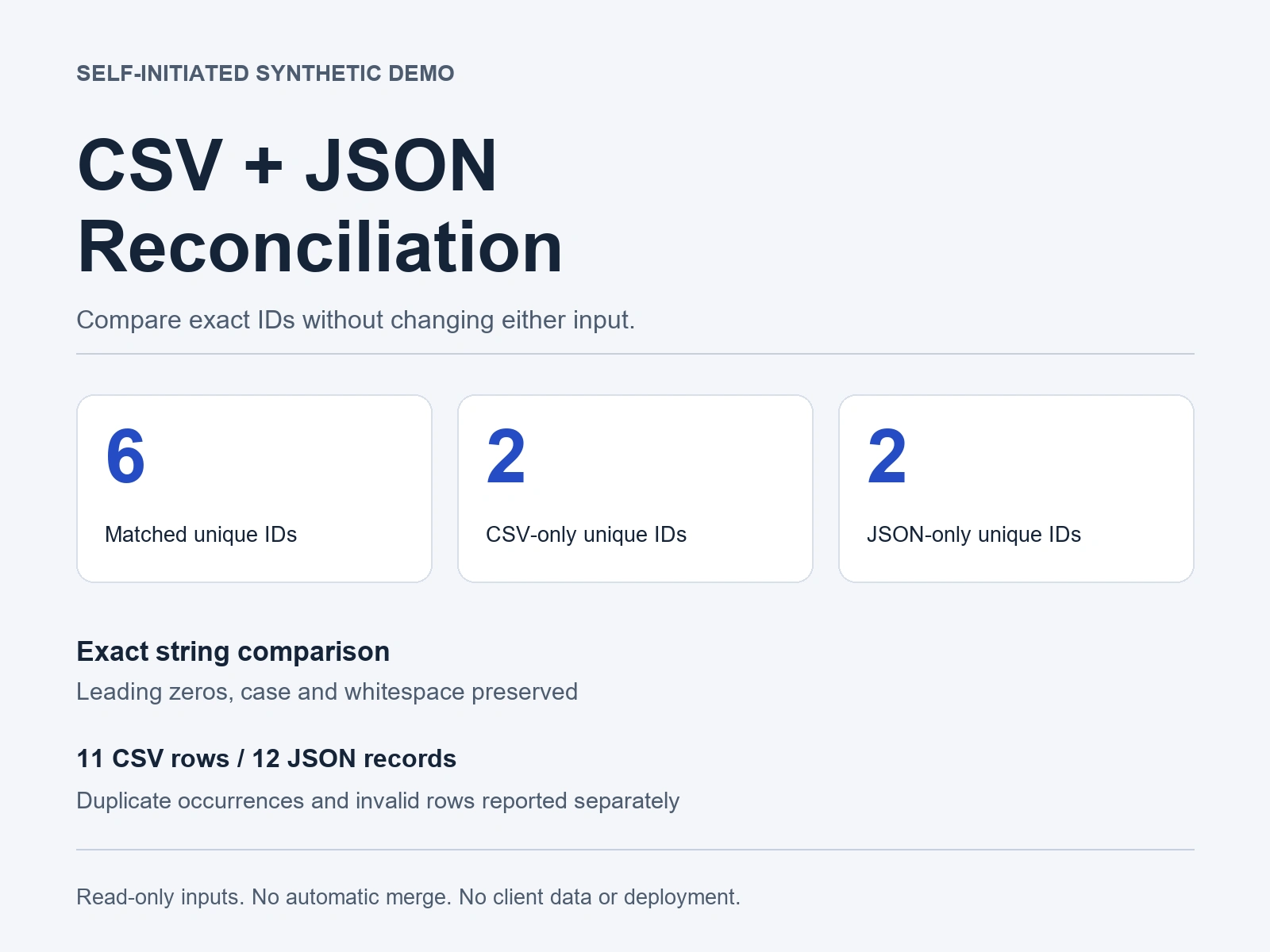
The demonstration contains 11 CSV data rows and 12 JSON records. Each side has 8 unique valid IDs. The comparison finds 6 matched unique IDs, 2 CSV-only IDs and 2 JSON-only IDs. CSV has 1 extra duplicate occurrence; JSON has 2. Each side also has 2 invalid rows. Repeated IDs are counted without assuming their other fields agree.
The JSON report includes full ID differences, duplicate occurrences, invalid-row references and source hashes. It can be traced back to the unchanged input files. Existing output files are refused. Malformed or ambiguous input stops processing without producing a report.
Eight core tests passed, including exact-ID distinctions, quoted CSV fields, invalid-row accounting, unchanged inputs and refused overwrite. The sample demonstrates inventory reconciliation, separate from cleanup. It does not prove payload equality, repair data, stream large files or establish customer results or earnings.
Eight core tests and six independent audit checks passed.
Like this project
Posted Oct 8, 2026
Synthetic CSV/JSON ID comparison: 6 shared unique IDs, 2 unique to each side. Inputs unchanged; duplicate and invalid-row reports. 8 core plus 6 audit tests.
Likes
0
Views
0