OSINT & Investigative Research Tool Database

Stefa Groves

The Problem
Investigative research tools are scattered across hundreds of websites, GitHub repos, Reddit threads, Bellingcat guides, and word-of-mouth recommendations. There's no single place where an investigator can look up the right tool for a specific task, know whether it's free or paid, and understand what it actually does in plain language.
I needed that resource for my own work. It didn't exist the way I wanted it, so I built it.
What I Built
A searchable, filterable HTML database of 170+ OSINT and investigative research tools. Every tool is categorized by use case, tagged by cost tier (free, freemium, paid), and described in plain language with enough detail that an investigator can decide in seconds whether it's relevant to their case.
The database covers:
Missing persons & unidentified remains — NamUs, Doe Network, NCMEC, INTERPOL Yellow Notices, ICRC Family Links, Trace Labs, Locate International
Facial recognition & image search — PimEyes, FaceCheck.ID, Yandex Images, TinEye, reverse image search tools, AI-generated image detection
DNA & genetic genealogy — GEDmatch, AncestryDNA, FamilyTreeDNA, 23andMe, DNA Painter, WATO probability calculator, Genetic Affairs clustering, MyHeritage
People search & skip tracing — TruePeopleSearch, Spokeo, Pipl, TLOxp, Accurint/LexisNexis, IDCrawl, Epieos
Geolocation — GeoSpy, Picarta, Oceanir, Google Earth historical imagery, What3Words, Sanborn Fire Insurance Maps
Web & social media intelligence — Wayback Machine, Archive.is, social media monitoring, username enumeration (WhatsMyName, Namechk, KnowEm), YouTube subtitle search (Filmot), export tools
Domain & website analysis — WHOIS, DNS Dumpster, urlscan.io, Web-Check.xyz, phishing detection
Court, government & financial records — PACER, OpenCorporates, OpenSecrets, Congressional stock trades, SEC EDGAR full-text search
Cryptocurrency & financial crime — Arkham Intel, Bitcoin Who's Who, blockchain wallet tracing
Maritime, flight & vehicle tracking — MarineTraffic, Flightradar24, ADS-B Exchange, VesselFinder, Equasis, autoDNA VIN checks
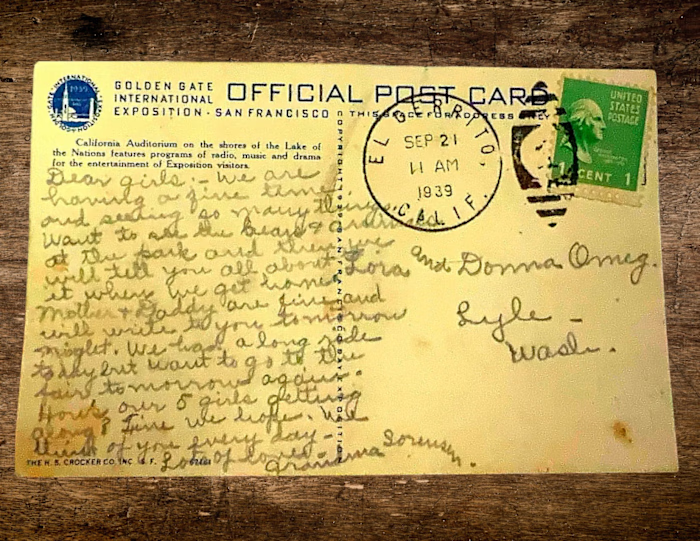
Historical & ephemera research — Chronicling America, Newspapers.com, GenealogyBank, Newberry Library postcard collection, Playle's RPPC dating guide, David Rumsey Map Collection, EphemeraSearch, Library of Congress postcard guides
Genealogy & vital records — Ancestry, FamilySearch, Find A Grave, FreeBMD, FreeCEN, ScotlandsPeople, Ellis Island, Castle Garden, Fold3 military records, state and county archives
Network visualization & case management — Maltego, Obsidian with OSINT templates, OSINTracker, Cytoscape, Draw.io, SIERRA
Data breach & dark web — Have I Been Pwned, IntelligenceX, Hudson Rock, XposedOrNot
Healthcare & toxicology — MalaCards, DisGeNET, OMIM, PubChem, CDC WONDER, PharmGKB
Anti-trafficking & organized crime — STOP THE TRAFFIK, Tesari, Coalition of Cyber Investigators, BIRN, Missing Migrants Project
How It Works
The database is a single-page HTML application with real-time filtering. Click a category tag and the list filters instantly. Every entry links directly to the tool. Cost tiers are color-coded. Descriptions are written by me based on actual use or thorough evaluation, not copied from marketing pages.
I built it with Claude as a development partner, but every tool in the database was either found through my own research, used in my own investigations, or evaluated against my own criteria before being included. The descriptions reflect how an investigator would actually use each tool, not how the tool markets itself.
How I Maintain It
New tools get added as I discover them through my own work, OSINT community channels (r/OSINT, r/RBI, OSINTech Substack, Bellingcat), and direct research. I evaluate each tool before adding it: Does it work? Is it free or does it require access? What's it actually useful for? What are its limitations?
The database updates automatically every 5 minutes when I push changes. I've been building and maintaining it for several months and it continues to grow.
Who This Is For
Investigators who need the right tool for a specific task and don't want to spend an hour searching for it
Legal teams conducting due diligence who need to know what's available in open-source research
Journalists doing verification work who need quick access to the right resource
Nonprofits working missing persons, trafficking, or fraud cases with limited budgets
Anyone learning OSINT who wants a curated, honest starting point instead of an overwhelming list of links with no context
Like this project
Posted Jul 20, 2026
A custom-built, searchable database of 170+ OSINT and investigative research tools organized by use case, cost tier, and access level. Maintained and updated regularly.