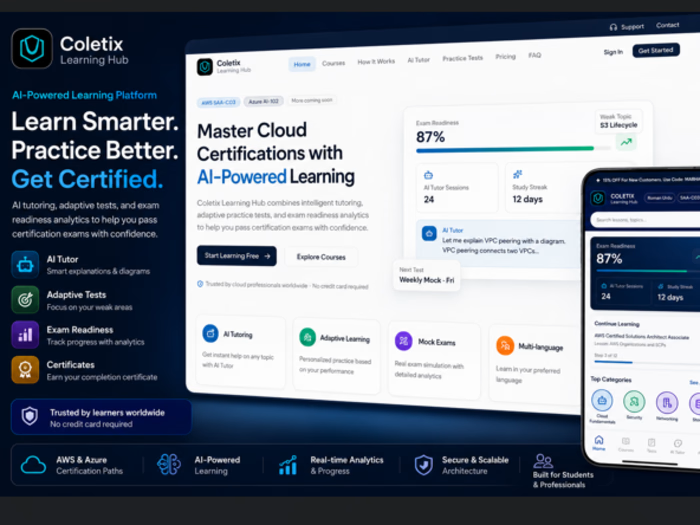
Coletix AI is an AI-powered

Muhammad Shoukat


Coletix AI is an AI-powered software development platform designed to provide a structured environment for planning, building, testing, reviewing, and improving modern software products.
Developed as a proprietary product by DevSell, Coletix AI addresses a fundamental challenge in modern software development: turning complex product requirements into reliable, structured, production-oriented software through an AI-assisted development workflow.
Rather than treating AI as a simple code-generation tool, Coletix AI is designed around a broader software engineering lifecycle. The platform can take a project from initial requirements and clarification through technical analysis, architecture planning, implementation, verification, review, and bounded repair.
The platform is designed to support different categories of software, including websites, mobile applications, SaaS products, and complex custom software systems.
This makes Coletix AI an example of advanced custom software development focused on AI-assisted engineering, workflow orchestration, project memory, controlled execution, and production-oriented software delivery.
The Challenge
Traditional software development often involves disconnected stages. Requirements may be documented separately from architecture decisions, implementation may happen without sufficient validation, and debugging can become an iterative process without a structured feedback loop.
AI coding tools can accelerate individual development tasks, but generating code alone does not solve the broader engineering problem.
A production software platform needs more than code generation. It requires:
Structured project requirements
Requirement clarification
Technical analysis
Architecture and system planning
Controlled implementation
Persistent project context
Approval gates
Execution controls
Verification
Testing and evaluation
Review workflows
Error handling
Bounded repair
Security considerations
Multi-tenant isolation
Resource and capacity management
Coletix AI was engineered around these requirements.
The Solution
Coletix AI introduces a structured AI-assisted software development workflow that connects product requirements with engineering execution.
The workflow is designed around several stages:
Project Intake → Clarification → Expert Analysis → Architecture & Blueprint → Build Specification → Approval → Implementation → Verification → Review → Bounded Repair
This approach provides a more controlled development lifecycle than treating an AI system as an unrestricted autonomous coding assistant.
The platform maintains project context and provides mechanisms for controlling execution, approvals, budgets, capacity, checkpoints, and evaluation. These capabilities are intended to make AI-assisted development more structured, observable, and suitable for complex software projects.
Core Product Capabilities
AI-Assisted Software Engineering
Coletix AI is built around AI-assisted engineering rather than simple prompt-to-code generation.
The platform provides an environment in which AI can participate in multiple stages of software development, including requirement understanding, technical analysis, architecture planning, implementation, verification, and review.
This allows the development workflow to focus on the complete software lifecycle rather than isolated coding tasks.
Project Intake and Requirement Clarification
A successful custom software project starts with understanding the problem correctly.
Coletix AI provides a structured project intake workflow designed to capture requirements and clarify ambiguities before implementation begins.
This helps transform high-level product ideas into more structured engineering requirements.
Expert Analysis and Architecture Planning
Before implementation, the system can move through analysis and architecture-oriented stages.
The objective is to establish a technical blueprint before significant implementation work begins.
This workflow can cover areas such as:
Application architecture
Backend services
Frontend architecture
Database requirements
API structure
Service boundaries
Execution requirements
Integration requirements
Security considerations
Deployment considerations
Build Specifications
Coletix AI separates planning from implementation through build-oriented specifications.
This creates a clearer transition between what the software should do and how the system should implement it.
Approval Gates
A significant part of the platform's architecture is controlled execution.
Approval gates can be used to prevent important development stages from proceeding without the required authorization.
This creates a more predictable workflow for complex software projects where uncontrolled autonomous execution could introduce unnecessary risk.
Implementation and Execution
After planning and approval, implementation can proceed through the platform's development workflow.
The underlying architecture incorporates execution and orchestration technologies designed for multi-step AI workflows and software engineering tasks.
Verification and Evaluation
Coletix AI includes verification-oriented stages rather than treating implementation as the final step.
The platform incorporates checkpoints and evaluation mechanisms to support validation of development outcomes.
This creates a feedback loop between implementation, verification, review, and repair.
Review and Bounded Repair
When problems are identified, the platform is designed around controlled repair rather than unrestricted repeated modification.
This bounded repair approach helps maintain greater control over changes and provides a structured path from issue detection to correction.
AI Orchestration Architecture
Coletix AI incorporates modern AI orchestration technologies to support complex, multi-stage development workflows.
The platform includes integration foundations for:
LangGraph — used as part of the durable workflow-orchestration architecture.
Mastra — incorporated into the expert-agent, memory, and evaluation architecture.
Cline SDK — integrated into the development-agent execution architecture.
These components are combined with Coletix's broader application infrastructure rather than functioning as isolated AI features.
The architecture is designed to support durable workflows, project context, agent coordination, checkpoints, evaluation, and controlled execution.
Technology Stack
Coletix AI uses a modern full-stack architecture designed for scalable custom software development.
Frontend
React
Used for interactive application interfaces and component-driven frontend development.
Next.js
Used for the modern web application architecture and frontend application delivery.
Backend
Node.js
Provides the server-side JavaScript runtime.
NestJS
Provides a structured backend architecture for APIs, services, modules, and application-level business logic.
Programming Language
TypeScript
Used across the application architecture to provide strong typing and maintainability for a complex software platform.
Database
PostgreSQL
Used as the relational database layer for structured application data.
Prisma
Used as the database ORM and application data-access layer.
Caching and Queues
Redis
Used for high-speed data operations and infrastructure components requiring in-memory storage.
BullMQ
Used for background jobs and queue-based task processing.
Infrastructure
Docker
Used for containerized application and infrastructure deployment.
AI and Agent Technologies
LangGraph
Durable AI workflow orchestration.
Mastra
Agent, memory, and evaluation architecture.
Cline SDK
AI-assisted development and execution capabilities.
Project Architecture
The architecture was designed around separation of concerns between the product interface, application services, persistent data, asynchronous processing, AI orchestration, and execution infrastructure.
At a high level, the system connects:
User Interface → Application/API Layer → AI Orchestration → Agent/Execution Layer → Background Jobs → Database & Project Memory → Verification & Evaluation
This architecture allows the platform to handle more than simple synchronous requests.
Complex development workflows can require multiple operations, background tasks, checkpoints, state transitions, and verification stages. The architecture therefore incorporates queue-based processing, persistent project context, and workflow orchestration.
Project Memory
One of Coletix AI's important architectural concepts is persistent project memory.
Complex software development requires continuity.
Requirements, decisions, architecture information, project state, previous work, and evaluation results can all become important context for later stages.
Coletix AI incorporates project-memory concepts to help maintain continuity across development workflows instead of treating every AI interaction as an isolated request.
Multi-Tenant Architecture
Coletix AI was designed with multi-tenant isolation as an important architectural consideration.
A multi-tenant software platform must maintain logical separation between different users, workspaces, projects, and associated data.
The architecture therefore considers tenant isolation as part of the platform rather than treating it as an afterthought.
Execution Controls
AI-powered software development requires appropriate controls around execution.
Coletix AI incorporates mechanisms related to:
Approval gates
Budgets
Capacity controls
Checkpoints
Idempotency
Evaluations
Project state
Controlled repair
These controls help create a more predictable environment for AI-assisted development.
Why This Is Custom Software Development
Coletix AI demonstrates custom software development at the platform level.
The project was not limited to creating a conventional website or implementing an isolated AI chatbot. It required designing and engineering an integrated software platform involving frontend applications, backend services, database architecture, asynchronous processing, AI orchestration, project memory, agent execution, security considerations, multi-tenant architecture, and controlled development workflows.
The product architecture was designed around a specific software development problem and its associated engineering requirements.
This is what makes Coletix AI a strong example of custom software development for AI-powered products.
Development Workflow
The development methodology behind Coletix AI emphasizes progressive engineering rather than unrestricted feature implementation.
A typical workflow can be represented as:
1. Project Intake
Capture the initial software requirements and project objectives.
2. Clarification
Resolve ambiguous requirements and establish a clearer product definition.
3. Expert Analysis
Analyze technical requirements and identify implementation considerations.
4. Architecture & Blueprint
Create a structured technical direction for the software.
5. Build Specification
Translate the approved technical direction into implementation requirements.
6. Approval
Apply appropriate approval gates before execution.
7. Implementation
Execute the development work using the platform's engineering and AI capabilities.
8. Verification
Validate the resulting implementation.
9. Review
Evaluate the implementation against requirements and expected behavior.
10. Bounded Repair
Address identified issues through controlled corrective workflows.
This lifecycle creates a more systematic approach to AI-assisted custom software development.
Engineering Challenges
Building Coletix AI involved several engineering challenges.
The first was coordinating AI agents and development workflows across multiple stages while maintaining persistent state.
The second was creating an architecture capable of handling asynchronous operations and background workloads.
The third was maintaining project context across development sessions.
Another challenge was implementing controls around AI execution. Autonomous systems need boundaries, particularly when they can influence source code, project state, or development resources.
The platform therefore required architecture for approvals, checkpoints, idempotency, evaluation, and bounded repair.
Finally, the system needed to bring these capabilities together into a coherent product rather than a collection of disconnected AI utilities.
Security and Reliability Considerations
Security and reliability were treated as architectural concerns throughout the platform.
Important considerations include:
Tenant isolation
Controlled execution
Authentication and authorization boundaries
Project-level data separation
Approval mechanisms
Idempotent operations
Checkpoints
Evaluation workflows
Controlled repair
Resource and capacity controls
For an AI-powered development platform, these controls are particularly important because software-generation workflows can involve complex state transitions and potentially high-impact operations.
Product Scope
Coletix AI is designed to support a broad range of software development scenarios.
The platform can be applied to projects such as:
Custom websites
Web applications
Mobile applications
SaaS platforms
AI-powered applications
Business software
Complex custom software systems
Multi-service applications
Agentic software workflows
Its architecture is intended to provide a common development environment while supporting different types of software projects.
Business and Product Value
Coletix AI demonstrates how custom software development can evolve beyond conventional application development.
For businesses, the important value is not simply generating code faster. The larger opportunity is creating a structured development workflow where requirements, architecture, implementation, verification, and improvement are connected.
For development teams, this can provide a more systematic environment for AI-assisted engineering.
For complex projects, persistent context, approval gates, checkpoints, evaluations, and controlled execution can help reduce the risks associated with unstructured AI development.
Outcome
Coletix AI was developed as a proprietary AI-powered software development platform by DevSell.
The resulting system combines a modern full-stack application architecture with AI orchestration, agent capabilities, persistent project context, asynchronous processing, multi-tenant considerations, and controlled software-development workflows.
The project represents DevSell's capability to design and build complex custom software products from the underlying architecture through the application layer and AI engineering infrastructure.
No fabricated performance statistics, customer numbers, awards, revenue figures, ratings, or artificial success metrics are used in this case study.
Like this project
Posted Aug 22, 2026
Coletix AI is an AI-powered software development platform designed to provide a structured environment for planning, building, testing, reviewing, and improv...
Likes
1
Views
1