BidBite — A Reverse Marketplace for Food

Muhammad Hasnat Akhtar


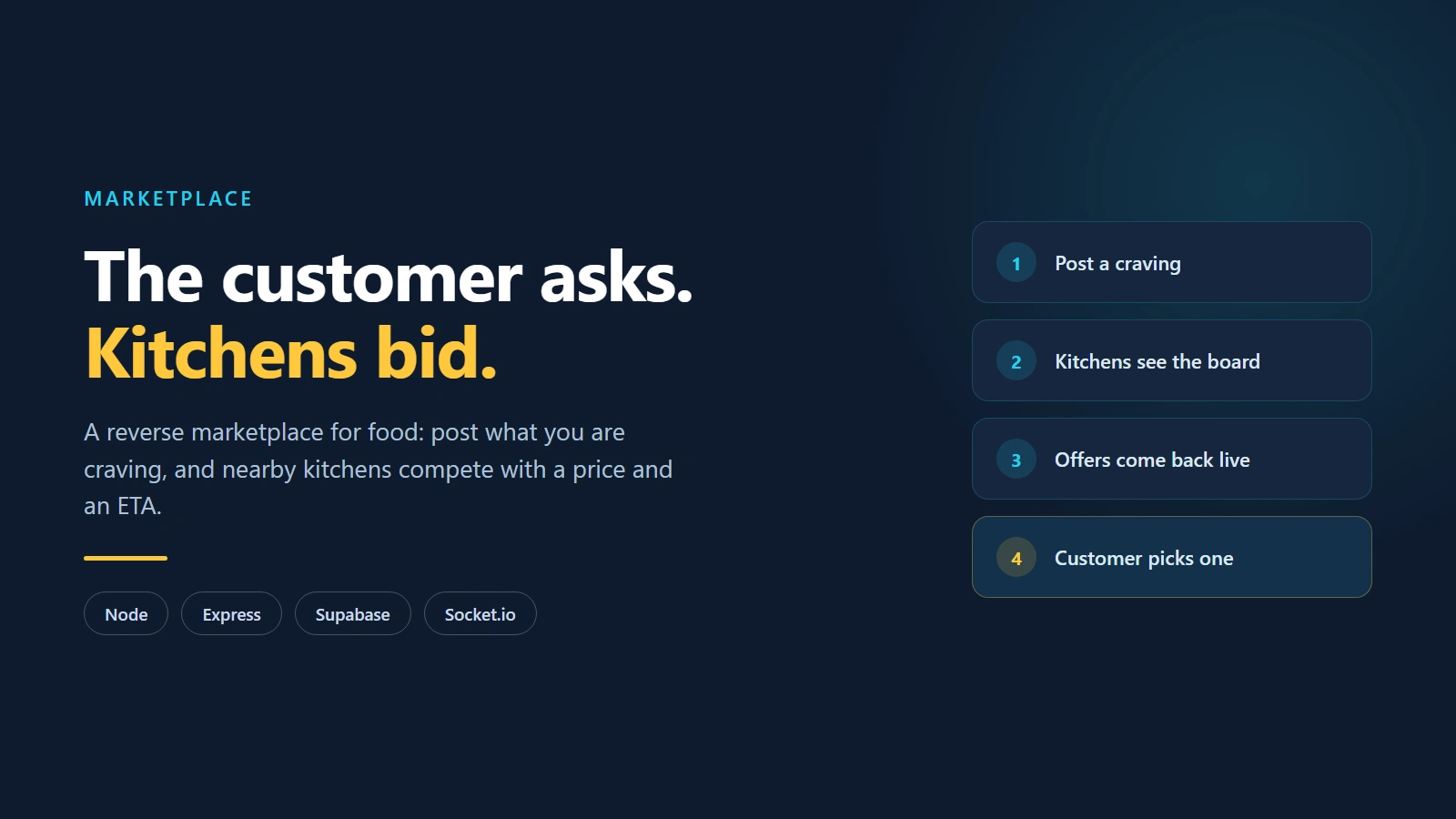
Every food app works the same way: you pick a restaurant, then you pick a dish. BidBite turns that around. The customer says what they want, and the kitchens compete for it.
What I built here
Two apps on one backend, as my own product.
The customer posts a craving — what they feel like eating, roughly what they want to spend, and where they are. Nearby kitchens see it on a live load board and answer with an offer: a price, an estimated time, and a note if they want to say something about it. The customer picks one, and that offer becomes the order.
The kitchen side is a full operator app rather than a notification: a load board filtered by distance and category, the kitchen's own profile and photos, offers it has out, and the jobs it is currently running.
How it is built
Node and Express on the backend, Supabase Postgres for the data, and Socket.io for the part that has to feel live — an offer landing on a customer's screen while they are still looking at it is the whole product, and polling does not do that.
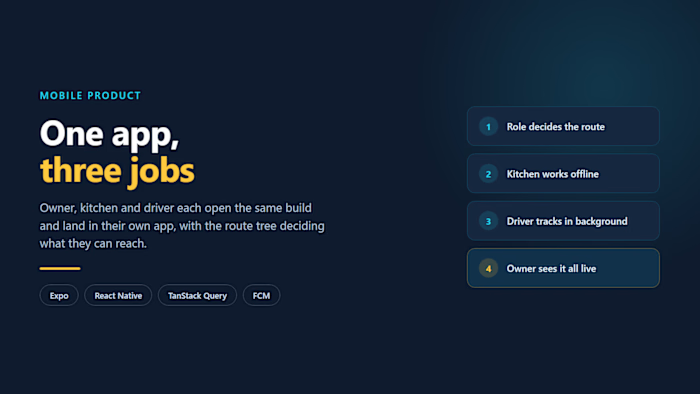
Both apps are React Native on Expo, sharing one API.
The part that took the most care
A marketplace has two kinds of account on the same routes, and that is exactly where this class of product leaks. So the end-to-end suite does not just walk the happy path. It runs two kitchen accounts at once and asserts that the second one cannot read, revise, chat on, or deliver the first one's work — and that a customer's token is rejected on kitchen routes, and the other way round.
That suite is the regression lock. It exists because an identity bug in a marketplace is not a glitch; it is one account reading another account's business.
Honest scope
This is my own product and it is still pre-launch. The number I care about is not downloads — it is whether enough kitchens are on the board before the first customer ever posts, because a marketplace with no supply is just a form that nobody answers.
Not client work. The architecture — a live board, competing offers, and hard separation between two kinds of account — is what I would build for any marketplace where both sides act.
Like this project
Posted Oct 15, 2026
My own product: instead of browsing menus, a customer posts what they are craving and nearby kitchens bid for it with a price and an ETA.