Built with Framer
Parley: AI Agent Template for Framer

Alex Prokhorov


Type: Framer template, AI agent / SaaS
Deliverable: 11-page production template, free on the Framer Marketplace
Tools: Figma, Framer, Claude / Claude Code
The opportunity
Every AI startup in 2026 ships the same website. Black background, purple gradient, a glowing orb floating in the void, a headline like "Intelligence, redefined." We kept seeing founders reach for AI website builders, get handed that exact cliché, and ship it anyway because the alternative was starting from nothing.
We saw a gap. Not another dark, sci-fi AI landing page, and not a single hero section masquerading as a template. A warm, light, fully built product site for AI agent and SaaS startups, with every page a real company actually needs. We called it Parley.
Phase 1: references and niche
Before we drew anything, we defined who this was for. We worked with Claude as a research partner to pull and cluster reference sites across the AI, SaaS, and startup categories, then mapped what every one of them did the same way. The pattern was obvious: dark themes, neon accents, orbs, and almost no attention paid past the fold.
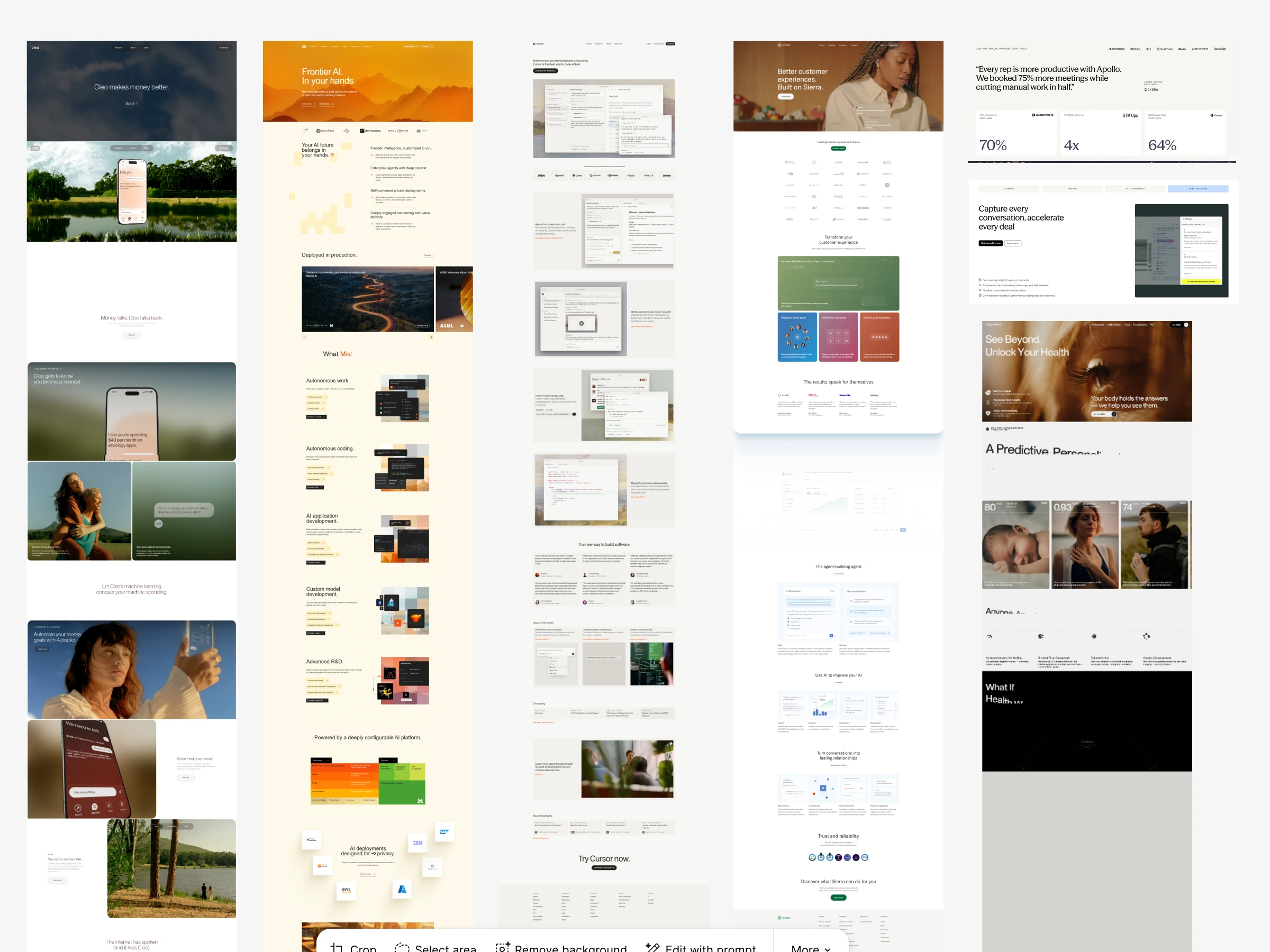
Early mood board for Parley
That gave us our wedge. Parley would be the warm, human, light-mode answer to a category that had collectively agreed to look like a spaceship dashboard. We narrowed the audience to early-stage AI agent and SaaS founders, the people who need a credible site live this week, not next quarter.
In Figma we built the design direction around that decision. Warm neutrals instead of black. Real product storytelling instead of vague "intelligence" copy. A type and spacing system deliberately closer to a finished product than a pitch deck. The Figma file became the source of truth for the eleven pages we knew the product needed.
Phase 2: parallel prototyping as a team
We did not design in a vacuum and hand off. We built and tested in parallel.
The visual system went into Framer for the real layout and responsive work, while we used Claude Code to spin up quick interactive prototypes of the trickier ideas: how the workflow pages should reveal information, how the pricing toggle should feel, how an AI-agent product explains itself without a wall of text. Running both tracks at once let the team pressure-test concepts as working things, not static frames, and kill the ones that did not earn their place before they cost us Framer build time.
The eleven-page architecture came out of that process: Home, a Workflows overview with three dedicated workflow pages, Pricing, Contact, a CMS-driven Blog, Waitlist, Thank You, Terms, and a real 404. Every page got the same attention, including the ones most free templates skip. We checked every breakpoint on tablet and phone twice.
Phase 3: productizing and Framer 3.0
Turning a good design into a template is its own discipline. We rebuilt the file as a clean, duplicatable Framer product: structured CMS for the blog, swap-ready content, organized styles, and pricing and waitlist flows wired to work out of the box. The goal was that a founder could duplicate Parley, change the copy, connect the CMS, and ship in an afternoon.
Then Framer 3.0 landed with Agents, AI that designs on the canvas. Rather than treat it as a competitor to a handmade template, we used it to enhance Parley, leaning on the new tooling to tighten the build and to make the template a stronger starting point for founders who will customize it with Agents. The positioning held: AI gets you most of the way, taste gets you shipped.
Results
Parley launched free on the Framer Marketplace and found its audience fast. It has drawn 12,287 impressions and 1,196 listing views from 803 unique viewers, and 76 founders have remixed it into their own sites, a high view-to-build rate for a free template. It is listed across AI, SaaS, Startup, and Technology, and ranks among the top free templates in its niche.
What it proves
Parley is the bet we keep making: pick a clear point of view, design against the category instead of with it, and use AI to move faster without giving up taste. The warm AI template in a sea of dark ones, eleven real pages deep, built by a team and a model working in parallel.
Like this project
Posted Jun 22, 2026
The warm, light AI agent template that refused to look like one. 11 production pages, free on the Framer Marketplace. Built with Figma, Framer, and Claude Code.
Likes
9
Views
114
Timeline
May 1, 2026 - Jun 1, 2026
Clients
Apollo Studio