Google Ads Reporting & Performance Platform

Atul L Ranjan
Verified


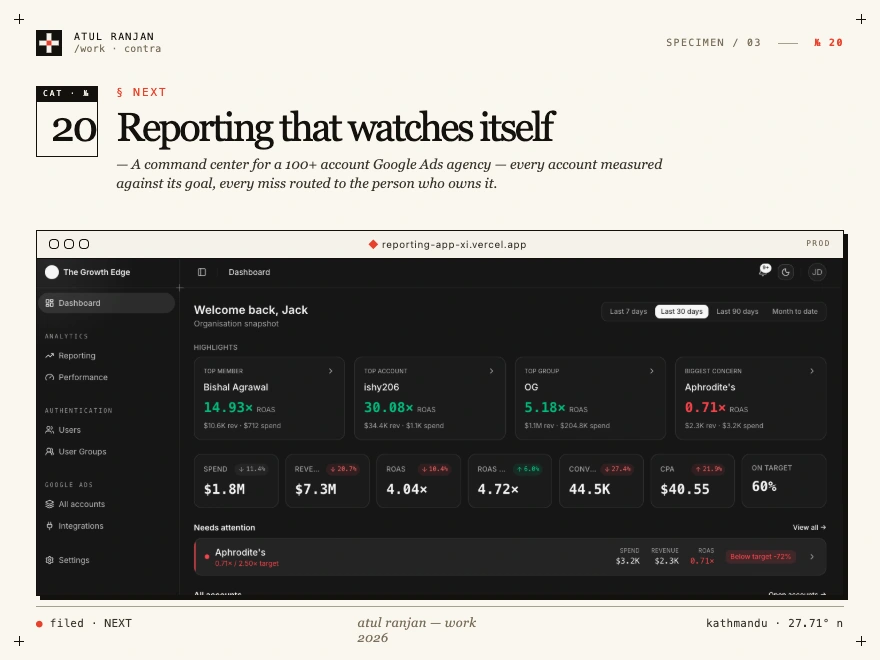
The Growth Edge — Reporting & Performance Command Center
A unified Google Ads reporting, goal-tracking, and tiered-alerting platform that turns raw ad spend into accountable, role-scoped action.
Overview
The Growth Edge is an internal reporting and management dashboard I designed and built for a
Google Ads agency. It pulls performance data from across the agency's entire book of accounts,
measures that data against the specific goals set for each client, and automatically surfaces
underperformance to the right person — admin, pod manager, or media buyer — before it becomes a
problem the client notices first.
The core idea: an agency managing 100+ ad accounts can't manually eyeball every metric every day.
The platform does the watching, the math, and the routing, so humans only spend attention where it's
actually needed.
The Problem
A growing Google Ads agency runs into the same wall every time it scales:
Data is scattered. Spend, conversions, ROAS, and revenue live across Google Ads, Triple Whale, and the client's store. Nobody has one screen that tells the truth.
Goals are implicit. Each client has a target (a ROAS floor, a spend ceiling, a revenue goal), but those targets live in spreadsheets and people's heads — not in anything that can check itself.
Accountability is fuzzy. When an account slips, who's supposed to act? The buyer running it? Their pod manager? The admin? Without a clear routing model, alerts get ignored or everyone assumes someone else has it.
It doesn't scale linearly. Doubling the number of accounts shouldn't double the number of people staring at dashboards.
The Solution
A single platform that aggregates performance data, layers per-client goals on top of it, and runs a
tiered alerting flow — underperformance is detected automatically, scored for severity, and
routed up the hierarchy (media buyer → pod manager → admin) based on who owns the account and how bad
the miss is.
What it does
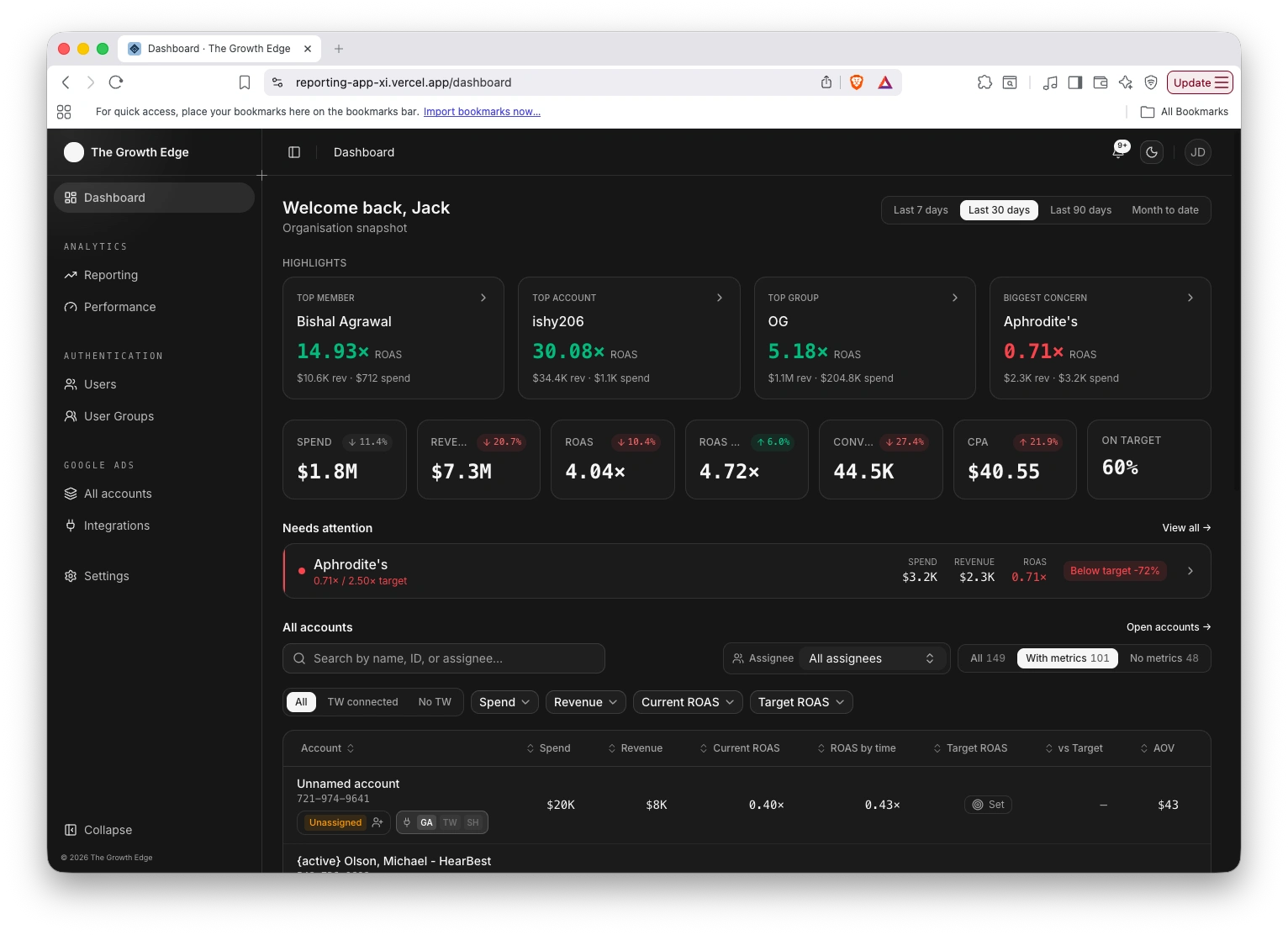
Aggregates ad performance across the agency's full account list on an automated sync schedule.
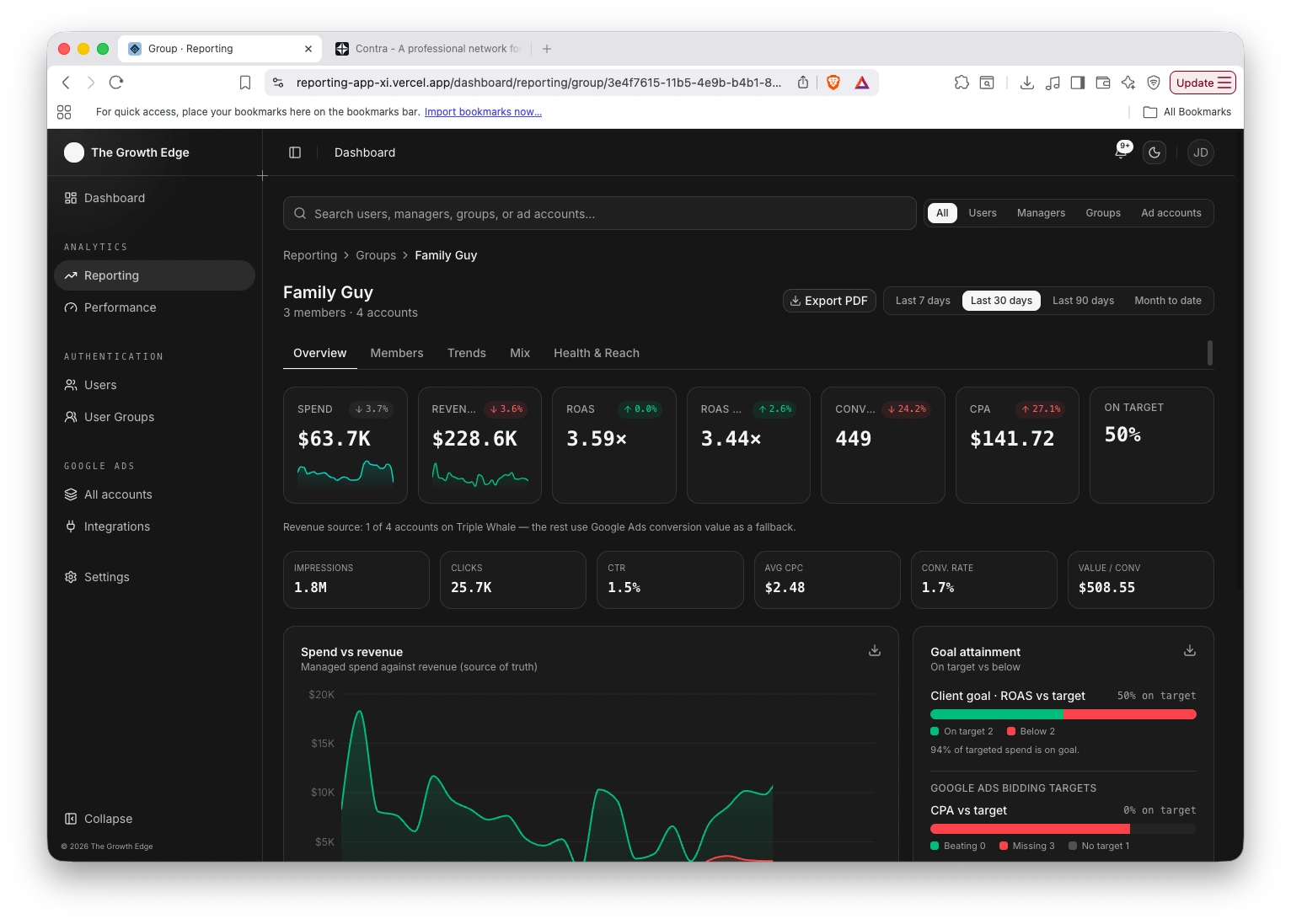
Tracks per-account goals, including manually-set target ROAS, and colors live actuals against those targets so a miss is visible at a glance.
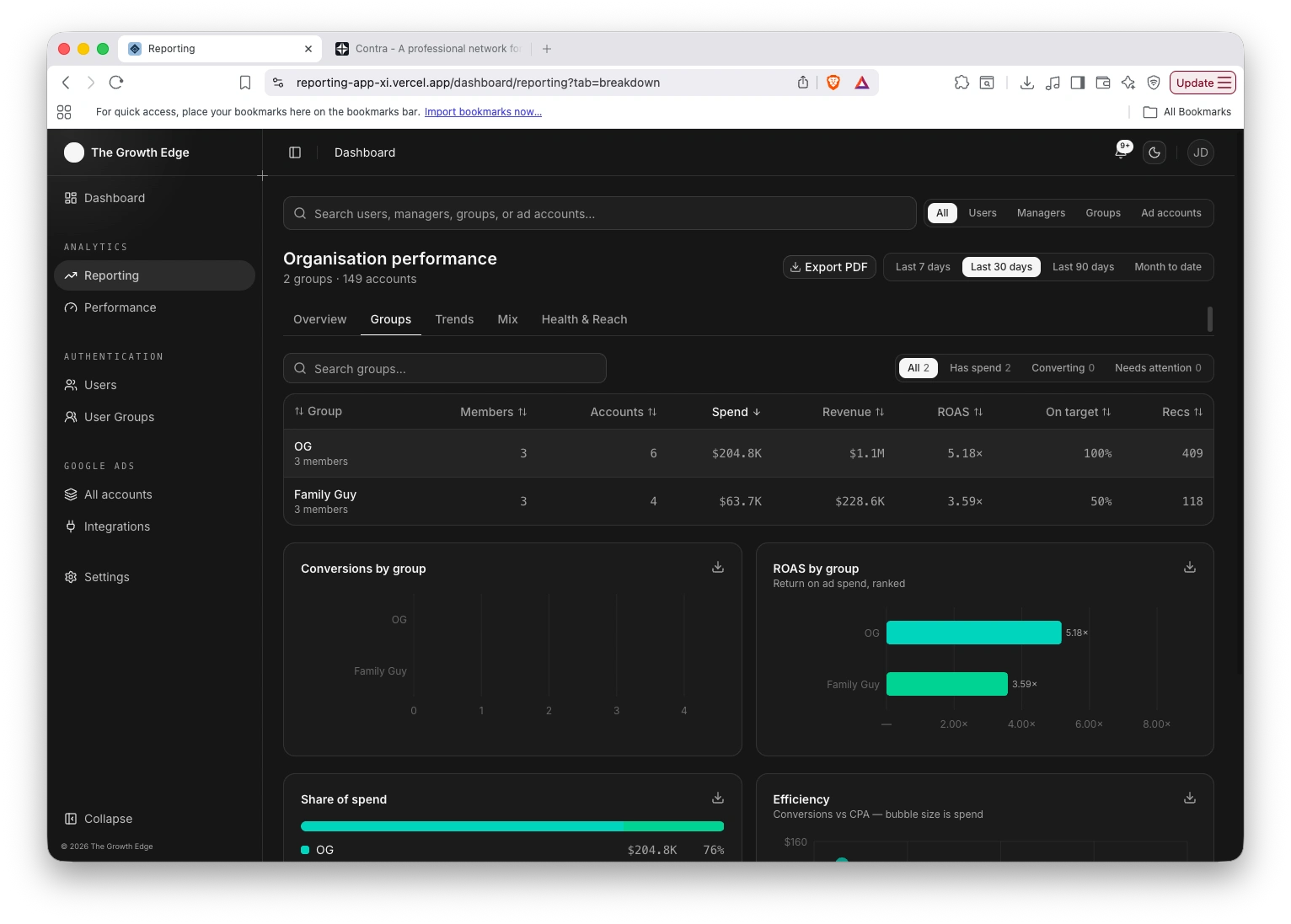
Drills down through the org hierarchy — organization → pod/group → member → individual account — so leadership can zoom from "how's the whole agency doing" to "this one account is bleeding" in a few clicks.
Surfaces underperformance in a dedicated Performance view that walks groups → members → accounts and flags the red ones.
Routes alerts to the right role, scoped by an access model that mirrors the real org chart.
Pulls revenue truth from Triple Whale (a rich ~49-metric dashboard per account) for source-aware ROAS, not just what the ad platform self-reports.
Who Uses It (Roles)
The platform is invite-only and built around three roles that map to how the agency actually
operates:
Role In the agency What they see Admin Agency operator Everything — all pods, all accounts, all alerts Leader Pod manager Their pod's members and accounts; alerts escalated to them Member Media buyer The accounts assigned to them; alerts they own first
Account access is granted three ways — direct admin grant, direct user assignment, or pod-level
assignment — and surfaced as inline tags right on the accounts table.
How It Works (Architecture at a glance)
Scheduled sync runs a lightweight set of conversion, reach, and management reports across all ~112 accounts in roughly a minute, keeping the dashboard fresh without hammering the Google Ads API.
On-demand deep sync — heavier, detailed per-account reports are fetched lazily the first time someone opens that account's workspace, so we only pay for detail people actually look at.
Goal evaluation compares live metrics against each account's targets and assigns severity.
Alert routing sends each flagged issue to the correct role based on ownership and severity.
Per-account workspace — an 8-tab dashboard (performance, conversions, reach, activity, revenue, and more) that auto-syncs its detailed data on first view.
Technology
This was engineered as a modern, server-first Next.js application with a tight, intentional stack:
Framework: Next.js 16 (App Router, Server Components, Turbopack)
Language: TypeScript (strict mode)
Styling: Tailwind CSS v4 (CSS-first
@theme), shadcn "base-luma" design system on @base-ui/react + class-variance-authority, light/dark/system theming with switchable accent palettesDatabase: PostgreSQL via Supabase, accessed through
@supabase/supabase-js with a service-role client for privileged work and an SSR cookie client for session-bound readsData layer: hand-written SQL migrations with Postgres RPC functions powering the hierarchy, reporting, and dashboard reads
Auth: Supabase Auth (
@supabase/ssr cookie sessions) wrapped in a custom invite-only flow with admin / leader / member roles and a client-scoped access hierarchyIntegrations: Google Ads API (live Basic Access tier, multi-account), Triple Whale for revenue and source-aware ROAS
Email: nodemailer over Gmail SMTP for all transactional mail (invites, resets)
Automation: Vercel cron jobs for the scheduled syncs, each gated behind a bearer secret
Hosting: Vercel
Extras: an MCP server for programmatic access to the reporting layer
The stack is deliberately lean — server-rendered by default, database queries never exposed to the
client, every route and action behind an auth check, and credentials read encrypted from the database
per request rather than cached.
The Outcome
The agency gets one screen of truth: live performance, measured against real goals, with
underperformance automatically flagged and pushed to the person responsible for fixing it. Instead of
scaling headcount with account count, the agency scales attention — humans look only where the system
says to look.
Designed and developed by Atul Ranjan.
Like this project
Posted Jun 22, 2026
Internal Google Ads agency dashboard: aggregates ad performance, tracks per-client ROAS goals, and auto-routes underperformance alerts to the right team.
Likes
0
Views
20
Timeline
May 21, 2026 - Jun 17, 2026
Clients
GrowthEdge