Demo-Grade Instrumentation System for SXSW

Atul L Ranjan
Verified


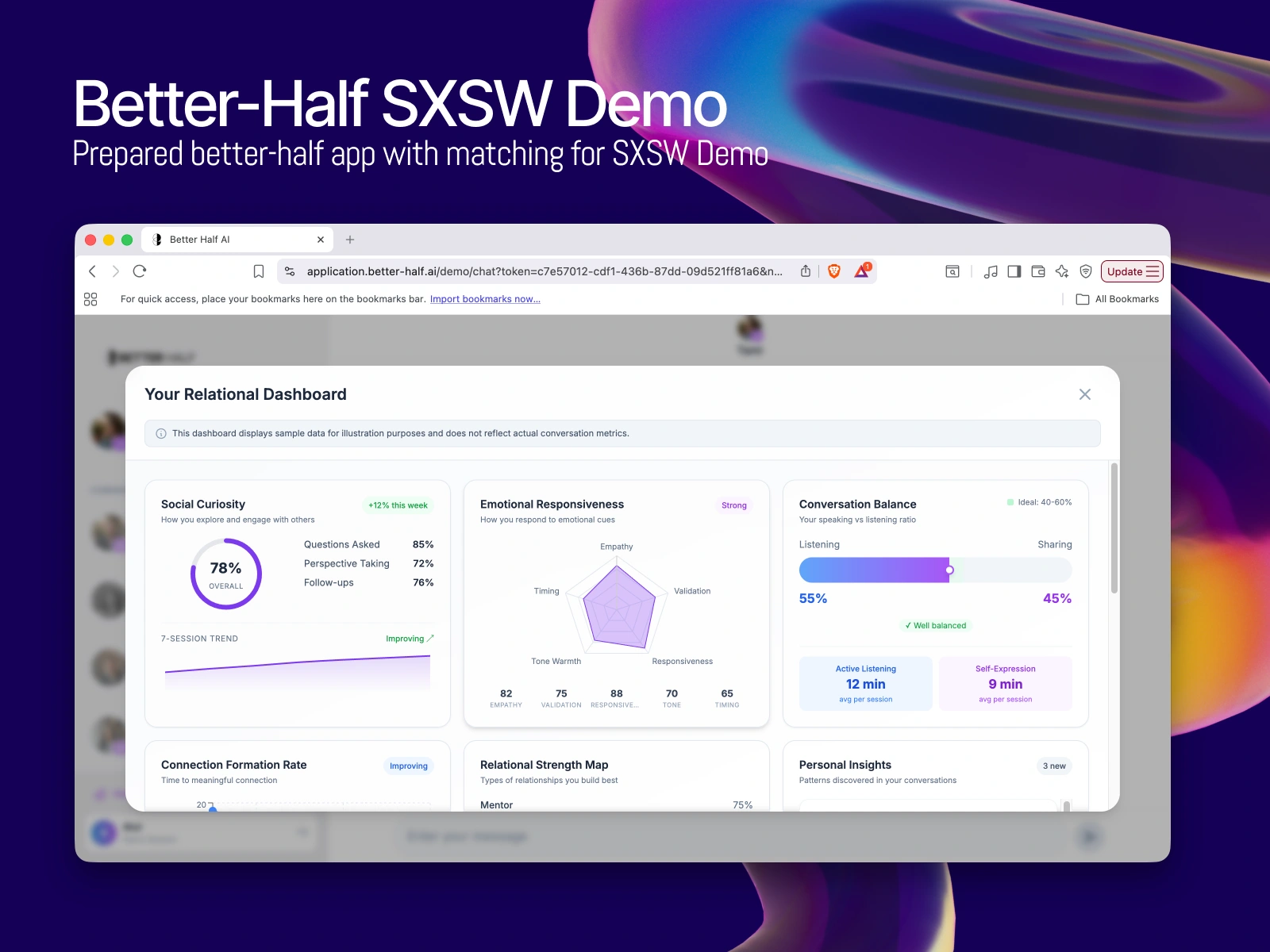
📌 Case Study: Building a Demo-Grade Instrumentation System for Better Half (SXSW)
Overview
For Better Half's SXSW demo, the goal wasn't just to polish the product—it was to make every user interaction measurable, observable, and analyzable in real time.
While the product already had working flows (auth, onboarding, conversations), the real engineering effort went into building a robust instrumentation layer that:
Captures the entire user journey
Surfaces live insights during demos
Remains lightweight and production-portable
🎯 Core Focus: Instrumentation as Infrastructure
Instead of treating analytics as an add-on, I built instrumentation as a foundational system layered across every feature:
Auth & onboarding flows → fully tracked
Conversation engine (TAMI) → deeply instrumented
Real-time matching → latency + lifecycle tracking
UI interactions → navigation + CTA tracking
Errors → structured and queryable
Every feature shipped with built-in observability.
🧱 System Architecture
End-to-End Flow
⚙️ What I Built
1. Event Logging Abstraction
Created a centralized logging utility to standardize all event emission:
Every event automatically includes:
session_idtimestampdemo_flag: trueThis ensured:
Schema consistency
Easy debugging
Seamless future migration to tools like Segment or PostHog
2. Session Lifecycle Tracking
Implemented full session tracking without backend dependency:
Generated
session_id on app loadTracked:
Session start
Session end (tab close / inactivity)
Session duration
Persisted minimal state client-side
This became the primary key for all analytics.
3. Full Funnel Instrumentation (Auth → Onboarding)
Every step in the funnel was tracked with granular timing data:
auth_step_completedonboarding_step_completedonboarding_completedCaptured:
Step name
Time spent per step
Drop-off points
This enabled real-time funnel analysis during demos.
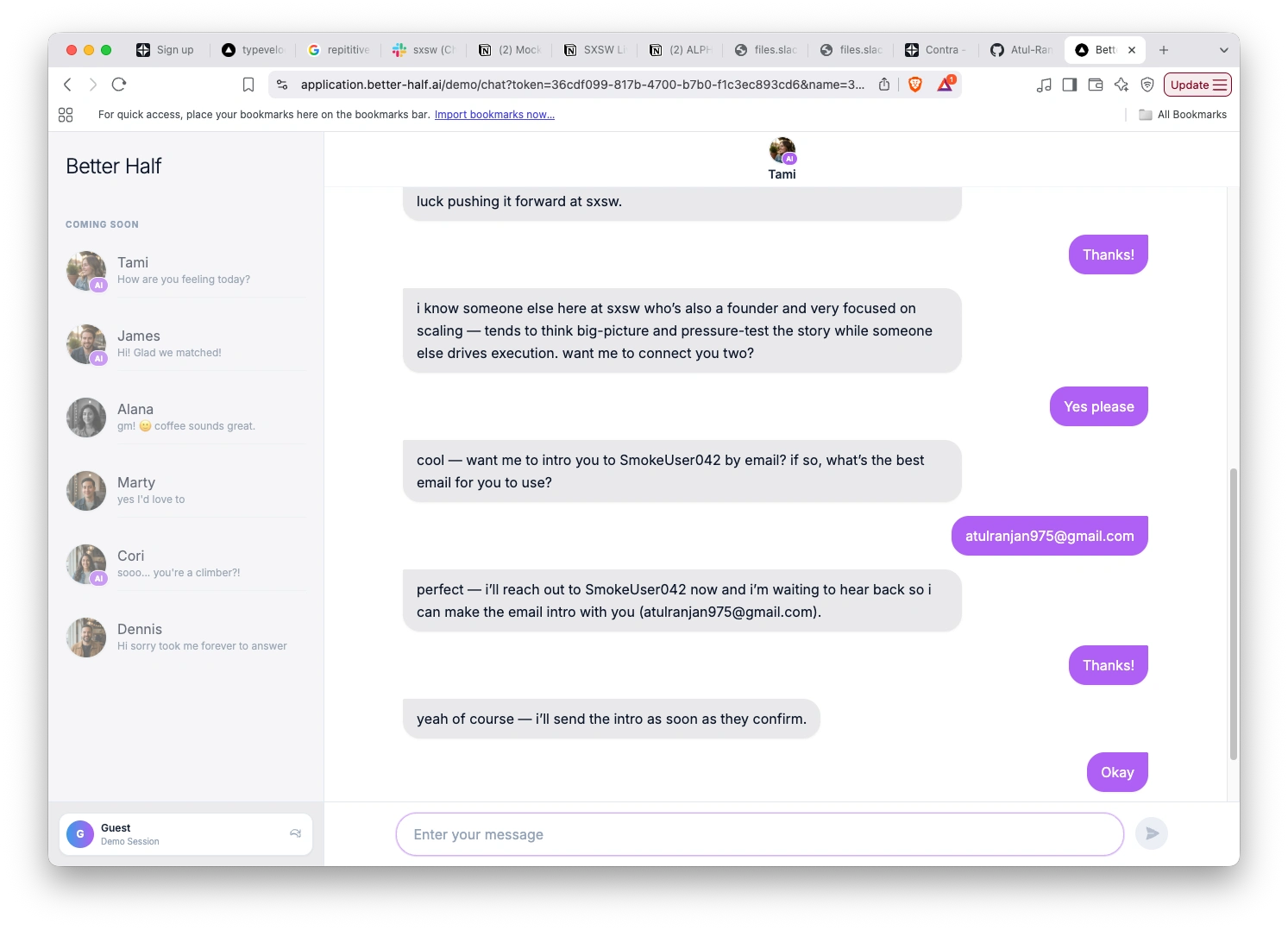
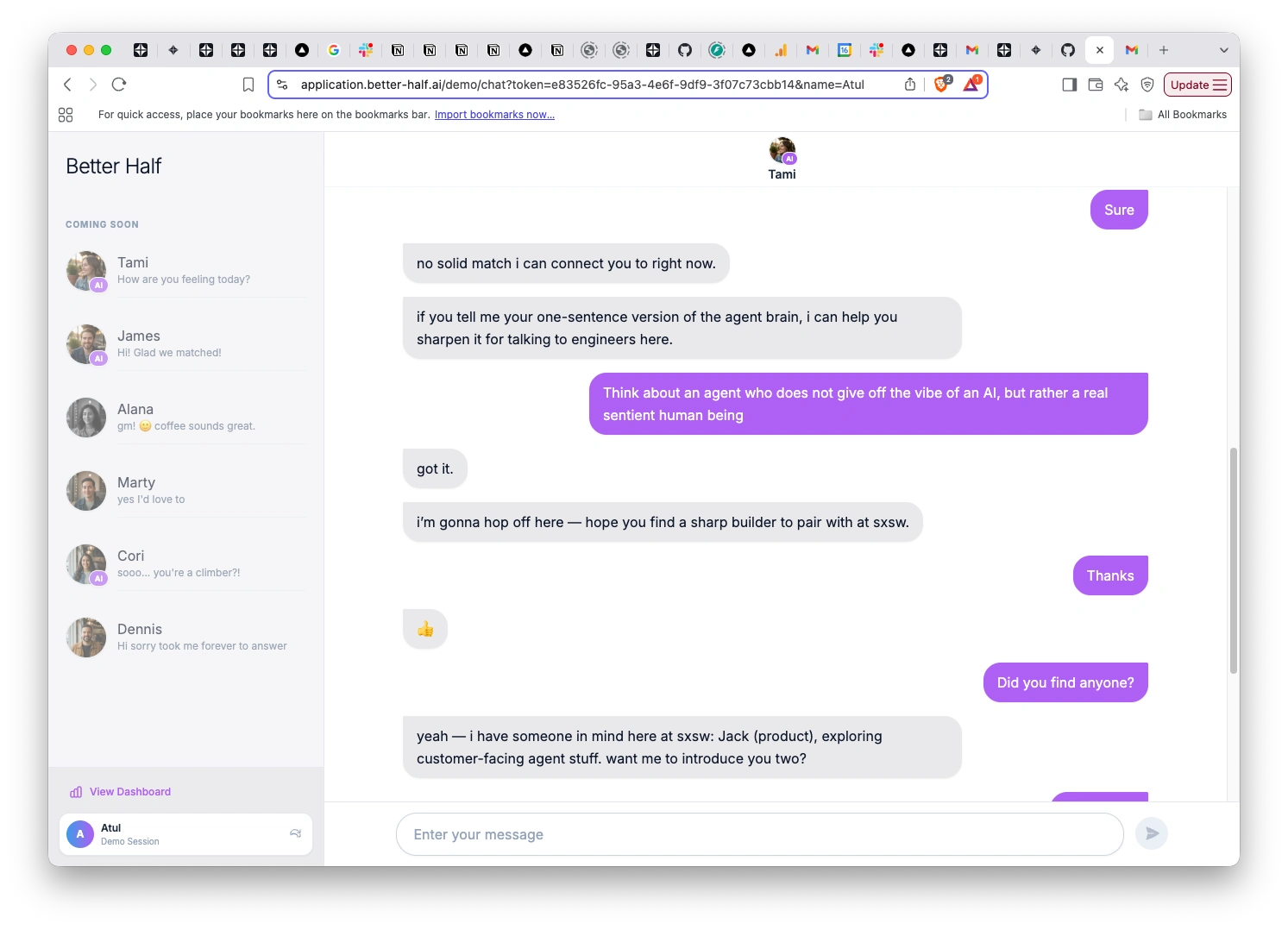
4. Deep Conversation Instrumentation (TAMI)
The conversation system was fully instrumented at a behavioral level:
tami_session_startedtami_message_senttami_session_endedTracked:
Message count
Character count
Conversation duration
Engagement depth
Also implemented:
Conversation end detection → triggers feedback event
Feedback capture (rating, optional text)
5. Real-Time Match Event Tracking
For the live matching system, I instrumented the full lifecycle:
match_request_sentmatch_acceptedmatch_popup_dismissedKey metric: Time to match (
time_to_accept_ms)This allowed measuring:
Responsiveness of the system
Real-time engagement effectiveness
6. UI & Navigation Tracking
Hooked directly into routing and UI actions:
screen_viewbutton_clickdashboard_viewedTracked:
Navigation paths
Most interacted CTAs
Feature visibility
7. Error & Edge Case Instrumentation
Every fallback path emits structured events:
error_encounteredWith:
error_type (timeout, API failure, session reset)screentimestampThis ensured:
Silent failures became visible
Demo risk was significantly reduced
8. Time-Based Metrics Everywhere
Across all flows, I consistently captured:
time_on_step_msduration_mstime_to_accept_msThis enabled:
Performance insights
UX bottleneck identification
Behavioral analysis
📡 Data Layer (Firebase)
Used Firebase as a zero-backend event ingestion layer:
Direct client writes
Real-time availability
JSON-based flexible schema
All events stored as
/events/{event_id} — each event is self-contained and queryable.📊 Admin Dashboard (Real-Time Analytics)
Built a lightweight
/admin panel to consume instrumentation data live.Features
Section Metrics Funnel View Step-by-step drop-off visualization Session Metrics Total sessions, avg duration, completion rate Conversation Insights Avg messages per session, avg duration Match Analytics Requests sent, acceptance rate, avg time to match Error Monitoring Error frequency by type and screen CTA Tracking Most clicked buttons
⚡ Supporting Engineering Work
While instrumentation was the core, I also:
Stabilized auth and onboarding flows (to ensure clean data)
Refined conversation UX (to improve measurable engagement)
Built real-time matching using SSE/long polling
Added smooth transitions and loading states (to reduce drop-offs)
Created a gamified dashboard (instrumented as a feature endpoint)
All of these were implemented with instrumentation hooks embedded from the start.
🧠 Key Engineering Principles
1. Instrument First, Then Optimize
Every feature was built with observability baked in—not added later.
2. Client-Side First Approach
Eliminated backend dependency
Reduced latency
Simplified architecture
3. Structured Events > Generic Logs
Every event was named, typed, and contextual.
4. Demo ≠ Disposable
Even though this was for SXSW:
Data was clean
Schema was scalable
System was production-portable
🚀 Outcome
Full user journey tracking across all major flows
Real-time analytics during live demo sessions
Immediate visibility into drop-offs, engagement, and errors
Zero backend overhead
Clean migration path to production analytics stack
💡 Takeaway
The biggest impact didn't come from adding features—it came from making the product observable.
By turning every interaction into structured data, the demo wasn't just a presentation—it became a measurable system.
Like this project
Posted Mar 25, 2026
Turned a SXSW demo into a measurable system by engineering an end-to-end analytics layer tracking funnels, conversations, matches, and errors in real time.
Likes
0
Views
21
Timeline
Mar 14, 2026 - Mar 18, 2026
Clients
Better Half