Of Grief and Graveyards: An Essay on Cemeteries and Grief

João Araújo

Of Grief and Graveyards
I’ve found that I like cemeteries. That might be a strange idea to some, as I’ve often found when speaking of this newfound interest of mine, but I should not be surprised. After all, we humans are often inclined not to dwell on our mortality, much less on its reminders. But, there is a beauty in them; the remembrance of finality and the lingering presence of a memory—history, a life not quite forgotten.
Though I understand why one would call it morbid, my curiosity has always been rooted in understanding, in knowing. As with most things in my life, I seek to understand. But I cannot know what I have never felt.
If I were to divest myself of my empathy, I would point out how burials are mostly inefficient. To encase a corpse in clothes, a tight and dark wooden box, and to then lay it on the ground… it seems wasteful. As if wasting perfectly good fabrics and wood on the uncaring dead wasn’t enough, we then build effigies of stone to invoke loving imagery, as if to protect the ephemeral thought of a soul.
Though a pretty thought, it simply is an evolved but historied human practice — one born out of the necessity to remember where a corpse was left to rot. Then, after all that effort and symbolism, we proceed to exhume the remains, like a pantomime built on grief, lest public health be put in jeopardy. If the practice was rare, perhaps the waste could be forgiven. We are, after all, emotional creatures, but we do it en masse! And now, as a younger generation faces a housing crisis, this cold part of me can’t help but wonder about the real estate occupied by many cold stones, reminders that mark where a corpse once was, rarely returned to the cycle of nature.
Of course, I am quite attached to my empathy.
Cemeteries, like funerals, are not for the dead, though we can at times think them to be. In such ceremonies, we claim to be “laying our dearly departed to rest”, regardless of disparate religious or spiritual beliefs, but the only rest we are seeking is our own. Saying goodbye is only the first step towards it, I’ve come to find.
In the face of grief, we seek to cope with what was lost, as love perseveres within us; and in the stones we leave to mark a grave, we seek to honour and remember. The stones, be they simple and smooth — stacked upon each other — or be they carved into a beautiful memory or belief, are the next step; the only step we can take in the journey that is remembering.
So, perhaps I do understand it, in a way — this dance macabre we perform when a life is lost — but I do not know it. I am ignorant of grief, though I have witnessed the grief of others.
I have seen the face of human death, cold and locked into unliving stillness. I saw it on corpses laid on open caskets, of people I knew only briefly and not fully. I saw the weight of lost time; it hung on silence and silent cries, across austere church rooms, cold but filled by a lingering love; a love not given when there was still time.
I have seen heartbreak under the weight of grief; it burrowed into me, in the form of the little girl I knew, now a woman, sister to the brother I chose. She had lain atop the coffin’s glass, weeping, begging for her grandfather to speak to her one last time — and to listen to her when she needed him most. I have witnessed, questioned, and tried to help bear the weight of grief — all the while knowing I’d soon feel its pull.
Death looms in my family; I know it.
I see it as the frail bodies of my kin dwindle, their life growing more difficult to bear with each passing day. It lurks in the dark corners of the mundane, the normalcy of life. It is a wordless reminder; a struggle to stand, a lingering pain born of a life well lived. It is a tired sigh, a chagrin, in the realisation of how a body can fail the mind, and how the mind can fail the soul.
Of course, I am not the only one to see it, though, at times, it might feel like it. I see the worry it causes in those around me, those who have seen death before — many more times than I — and how they, deep within, worry how this death will affect them, and how they are helpless to stop it, and what lays in waiting beyond the fast-approaching, crashing wave of grief.
Though I may be nearing this event horizon, I haven’t crossed it. And though the pain of grief eludes me, at this time, a part of me still ponders its depth and the hollowness that death brings.
I don’t seek it. I don’t want it. I don’t wish it upon myself, or anyone, but the morbid curiosity lingers. I know it is coming, and I still seek to understand it.
It is a teasing, daredevil thought; it preys upon my consciousness. Like standing upon a dangerously tall ledge, wondering what falling would feel like. This errant thought courts me and teases me. It brings me to cemeteries like a fear of heights can bring us to where we might fall. It is a question I seek to answer, despite knowing the pain that it will bring.
I remember passing the high, dark-stone walls of Agramonte Cemetery, at the centre of the city of Porto, and having a wandering eye for its treetops and grey-slated mausoleums. I had no family there interred — though my partner at that time did — but I still felt this darkened curiosity calling. I always wondered what names I would find there, engraved on cold stone, and questioned if I would ever feel anything for them.
Still, I have never crossed its threshold. Perhaps that is why I didn’t hesitate to explore another garden of the dead when I visited Amsterdam.
Beth Haim was a strange beauty to visit. A cemetery covering over ten acres, this “house of life” holds a corner of Portuguese-Jewish history and the ends of certain branches of many family trees. Though nearly all graves were marked by beautiful carvings and inscriptions upon marble and stone, dedicated to the dead, what fascinated me most about this place was what lay below the verdant ground.
When visiting, you could find the beautiful carvings and ponder upon them, and then question why so much land was dedicated to so few graves — with so much space between them, like an empty garden — only to marvel at the truth. Beth Haim holds more than twenty-seven thousand graves, all hailing from different points in history across four centuries, most of them unknown and hidden underground.
I walked across the green grass and naked trees. The winter air embraced me with the appropriate cold touch, I felt, to mourn lives I had never known. It was then that I felt, and wondered, at the weight in that silent and serene garden — the weight of the names forgotten, lying beneath the dirt and my feet. So many stories lost, unable to be remembered, with no stones to mark their graves.
At some point, I found myself with a pen in hand, scribbling away at my small notebook, writing the few names I could find. I told myself it was for inspiration, to source names for characters in a story I would one day write. I realise that was a lie I had told myself, unaware of why I had done it.
Now, I see it for what it was: an effort to keep those people alive, in a fashion. Not forgotten–if only for a while longer. It was, perhaps, a fruitless effort, but it was one I was compelled to do.
That solemn feeling followed me for a while, receding into the beginnings of this essay — a thought still bubbling in my mind, at the time — until it found me again, in Prague.
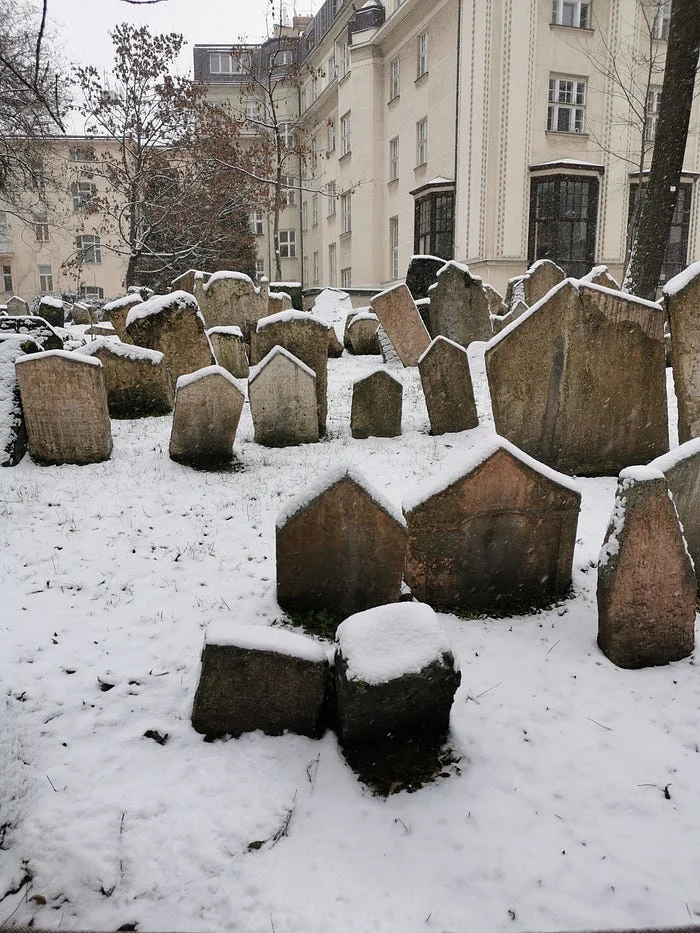
The Old Jewish Cemetery was, like much of that beautiful city, breathtaking. I had travelled there during December and was lucky to see how snow crowned the city’s rooftops, its gardens and its streets. And though I distinctly remember falling in love with many aspects of Prague, and its history, it was in the cemetery that I found both awe and solemn mourning — in the heavy silence of the past, laid dead on a snowy grave.
I walked the stone path across the cemetery, feeling a quiet, distant loss. Once again, that feeling had found me, not within the borders of my home country, nor within the confines of my familiar comforts, but in the distant and cold, unfamiliar resting place of memories and family ties — all of them foreign to me.
It remains a strange wonder to me how that feeling of loss came over me. To this day, I know not if what came over me was the weight of humanity there interred, the weight of many lives lived and the stories they carried with them, or if only for a moment I contemplated my mortality, in wonder and with most human empathy and curiosity, through the lives represented in each snow-covered stone.
I still have no answers, but as I ponder these memories, with words chosen to not only represent them but to remind me of that solemn feeling, it occurs to me that all these musings are but a contemplation of finality. Not its meaning, but what remains after it.
Though writing remains a passion born of the heart, for the longest time, I had found a practicality in it, beyond expression. I thought that, if my name and work were to be seen and recognised and remembered, perhaps in them I would have left a legacy. Perhaps then, finality would not be so final.
I’m not sure if I still think like this, nor am I sure if I care for such things, though this exercise in remembering might be the dying embers of that idea, rekindled. What I do see is how this whole thought, put into the written word, does serve to remember the lives laid there in these gardens of graves I have visited. In a way, I remember those who were lost — even if I don’t know their names.
Perhaps that is all there is to it — to grief. Despite the pain that we face in it, the solemn hurt that remains in the absence of a life, at the end of it all, there is only the memory. If that is so, I think we needn’t carry that weight alone; if even I, a stranger, can feel the loss of lives that met their end far before my life came to be, then remembering doesn’t end. Perhaps, death need not be so final after all.
Like this project
Posted Jul 12, 2025
An essay exploring the beauty and meaning of cemeteries and grief.
Likes
0
Views
23