Information Design & Infographics

Matej Dimoski

Concept Work | Unused Concept
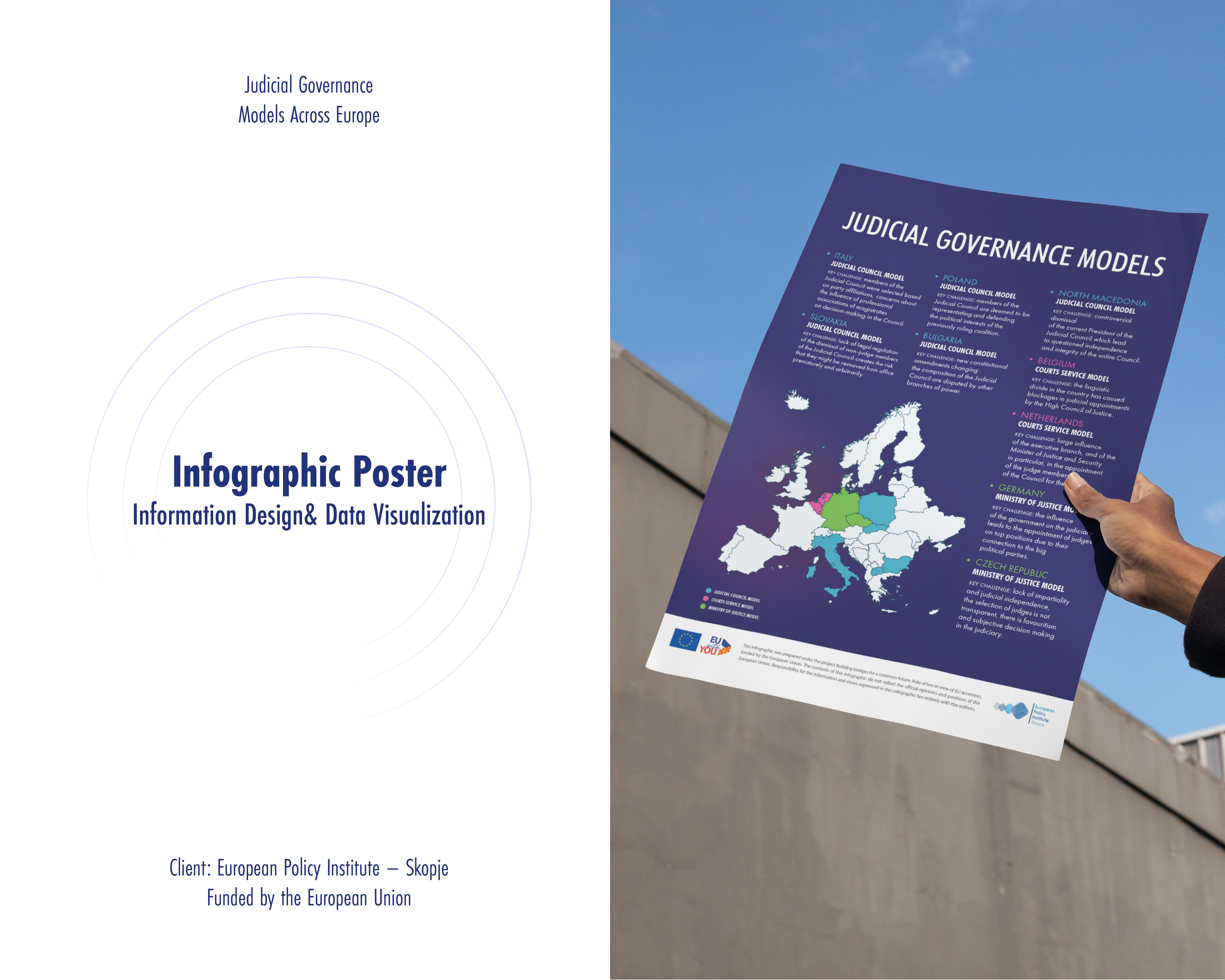
Judicial Governance Models Across Europe | Mapped & Visualized
01 | The Challenge
Making legal complexity accessible at a glance
The goal was to distill publicly available comparative judicial governance data from 9 European countries, each with different institutional models and unique systemic risks, into a single poster that policy-makers, media, and the public could all immediately understand.
The design had to carry institutional credibility while remaining visually engaging enough for conference use, social distribution, and print. No room for ambiguity. No room for decoration without purpose.
02 | Skills Applied
What this piece demonstrates
Information ArchitectureData VisualizationVisual DesignCartographic MappingTypographic HierarchyPrint-Ready Production
03 | Process
From public data to designed clarity
1 Research & Content Strategy
Reviewed publicly available EU reports on judicial governance structures. Identified three governance model categories and mapped the key institutional challenges per country into scannable, parallel-structure text blocks.
2 Visual System
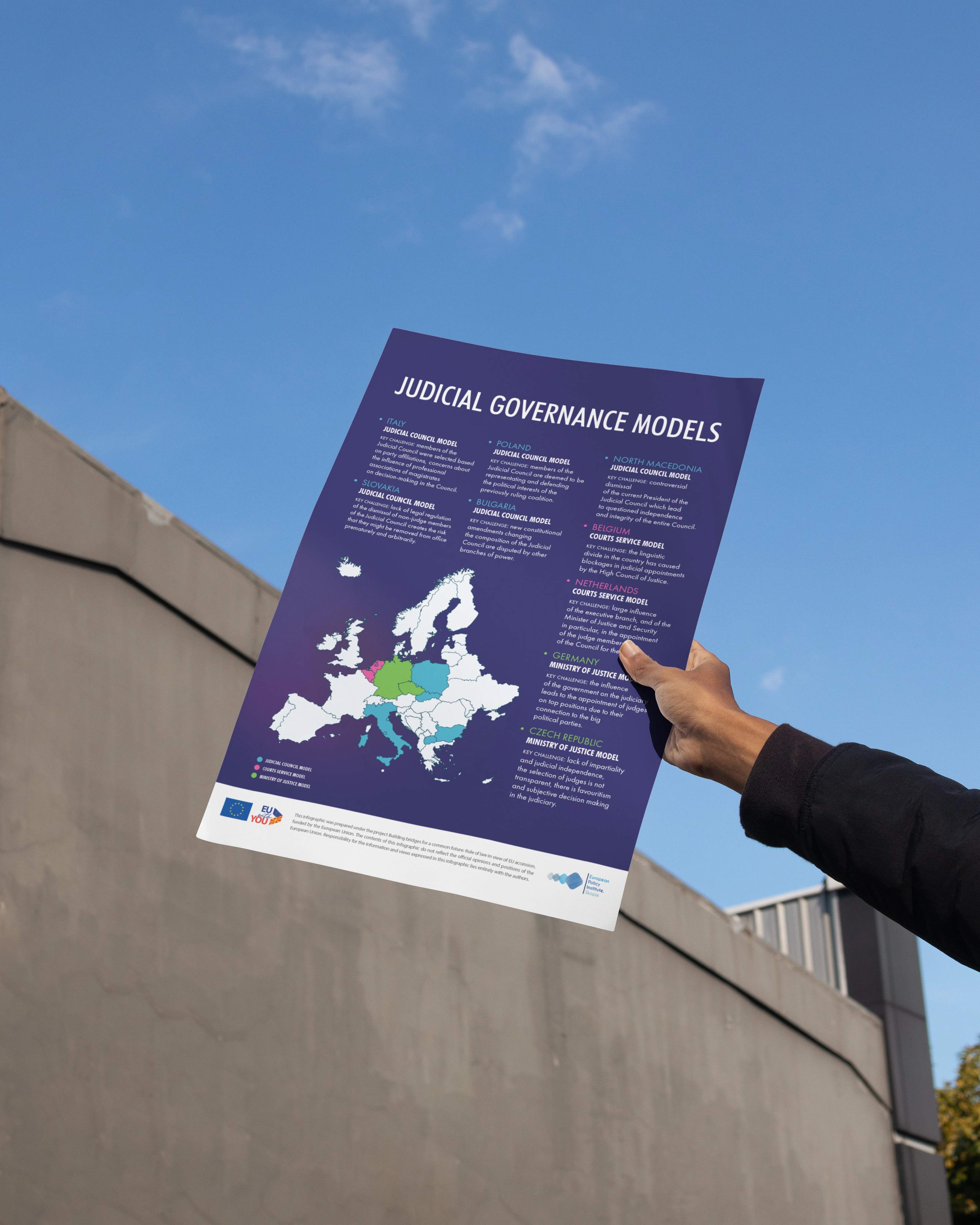
Designed a color-coded model taxonomy (Council / Courts Service / Ministry) anchored to a custom European map with per-country highlighting for instant pattern recognition.
3 Production & QA
Refined typography, alignment, and spatial hierarchy for both large-format print and digital distribution. Files prepared in print-ready and web-optimized formats.
04 | Key Design Decisions
Why it works
Three-model taxonomy, one map. Rather than presenting nine separate country profiles, I grouped them under three judicial governance models (Judicial Council, Courts Service, Ministry of Justice) and color-coded the map accordingly. This lets the reader see structural patterns across Europe instantly, before reading a single word.
Parallel "Key Challenge" format. Every country entry follows an identical structure: model label → key challenge. This consistency removes cognitive load and makes cross-country comparison effortless — exactly what policy audiences need.
NOTE: This is an unpublished concept piece. It was developed as a design proposal but was not selected for final use. All data referenced is drawn from publicly available European Commission and Council of Europe sources. This piece is shown here solely to demonstrate my design process, information architecture skills, and visual communication approach.
Like this project
Posted May 25, 2026
Created a conceptual visual model for European judicial governance system.
Likes
0
Views
6