Building the Digital Growth Architecture Behind Exit Algorithms

Raya Digital



Building the Digital Growth Architecture Behind Exit Algorithms
How I connected Pete Vera’s website, podcast, YouTube, lead generation, and email into one clearer growth system
Project Overview
Pete Vera is the Managing Partner of GreenRock Logistics and the host of Exit Algorithms, a podcast focused on helping business owners increase company value, reduce owner dependence, and prepare for a future sale or private equity investment.
Pete did not have a lack of expertise or content.
He already had both.
He had strong industry experience, relationships, podcast episodes, interviews, and a growing body of content around business valuation, operations, private equity, and exit planning.
The issue was that all of those things were living in different places.
The website was doing one job and the podcast was doing another.
YouTube existed, but it was not yet being used as intentionally as it could be.
There were external features and recognition that were valuable, but not really being leveraged.
And there was no strong path taking someone from:
“I found Pete”
to
“I understand what he does”
to
“I trust his expertise”
to
“I want to stay connected.”
So my role was to bring the pieces together.
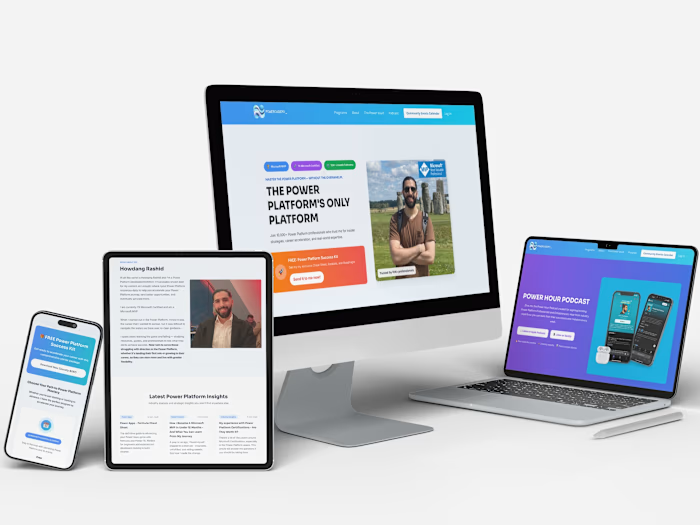
I worked across the website, podcast, YouTube channel, lead-generation funnel, email nurture system, positioning, and content architecture to build a much more connected digital ecosystem around Exit Algorithms.
The Challenge
There were already plenty of good assets but they just were not working together yet.
That is a very different problem from starting from scratch.
The website needed clearer positioning and better pathways for someone landing there for the first time.
The podcast already contained a lot of valuable conversations, but the way those episodes were positioned could do more to support discoverability and Pete’s authority.
YouTube needed more consistency.
The business had earned external recognition, but those credibility signals were scattered.
And most importantly, there needed to be a way to turn someone casually listening to a podcast episode or browsing the website into an actual owned audience.
Because attention is useful.
But if every visitor leaves without subscribing, downloading something, or taking another step, you are constantly starting over.
So this was not simply:
redesign the website
or
optimize YouTube.
The actual question was:
How do we connect Pete’s expertise, content, authority, audience, and future opportunities into one system?
My Role
I worked as the digital systems and content strategist across the project, which meant I was involved in both the thinking and the implementation.
That included:
website strategy and restructuring
brand and authority positioning
podcast content architecture
YouTube optimization
thumbnail direction
lead magnet strategy and landing page development
email capture and nurture automation
conversion pathways and calls to action
third-party recognition and social proof
project coordination and implementation
Basically, I was looking at the whole digital journey rather than treating each channel as its own little island.
The Strategy
The biggest positioning shift was simple:
Pete was not just building a podcast.
He was building an authority platform for business owners thinking seriously about company value, private equity, operational maturity, and eventually exiting their business.
That became the organizing idea behind the whole ecosystem.
Instead of thinking:
website
podcast
YouTube
lead magnet
email
as five separate projects, I mapped the journey between them.
Someone might first discover Pete through a podcast interview.
Or YouTube.
Or search.
Or an external feature.
From there, the content needed to establish expertise around the questions owners actually care about before a sale.
Then the website needed to make Pete and Exit Algorithms easy to understand.
Then there needed to be a useful next step for the person who was interested, but nowhere near ready to book a call.
That became the lead magnet.
Then email could continue the conversation.
Then, when someone was genuinely ready for a deeper conversation, there was a much more natural path toward it.
The system became:
Discovery → Authority → Trust → Email Capture → Nurture → Deeper Engagement
Much better than simply publishing content and hoping somebody eventually raises their hand.
Website and Positioning
I reworked the website structure and messaging around the actual concerns of established business owners.
Things like:
increasing company valuation
reducing key-person risk
building stronger operational systems
understanding what investors look for
preparing for acquisition or private equity
creating a business that can operate without the founder being involved in everything
The podcast also needed a clearer job.
Instead of simply being presented as a collection of interviews, Exit Algorithms became part of Pete’s authority platform.
The conversations with investors, M&A advisors, operators, founders, and private equity experts all reinforce a much bigger message:
What actually makes a company more valuable and transferable?
That gave the podcast a much clearer place inside the brand.
I also strengthened calls to action throughout the website because one of my pet peeves is getting to the bottom of a page and thinking:
Okay... now what?
Every important page should know where it is trying to send the visitor next.
Building the Authority Layer
Pete had already received recognition from outside platforms.
That matters.
But only if people can actually see it.
Exit Algorithms had been featured or recognized by platforms including Babyboomer.org, Acquisition Aficionado, and Million Podcasts, where the show had been listed among notable 3PL podcasts.
I brought those credibility signals into the wider website and content experience.
Not because we needed a decorative logo graveyard. 😂
The point was to use external recognition where it actually supported trust.
If somebody is discovering Pete for the first time, signals showing that his work is being noticed elsewhere help answer a very normal question:
Why should I listen to this person?
That is the job of social proof.
Podcast and YouTube Content System
The podcast already had the raw material.
What it needed was a more intentional system around how that material was presented.
I reviewed the existing podcast and YouTube content and worked on:
stronger titles
more search-aware YouTube descriptions
clearer episode hooks
consistent calls to action
thumbnail direction
better topic organization
repeatable standards for future episodes
I wanted the content to be positioned around real business questions, not generic founder advice.
The strongest themes were things like:
private equity valuation
owner dependence
operational risk
acquisition readiness
executive leadership
investor evaluation
preparing a company for sale
Those are specific.
They also happen to be the exact kinds of questions Pete’s audience is already thinking about.
So the job became making sure the packaging matched the quality of the conversations.
Building the Lead-Generation Funnel
The next problem was simple:
What happens when somebody likes what Pete has to say but they are not ready to speak with him?
We needed somewhere for that interest to go.
So I built the funnel around his lead magnet:
10 Steps to Increase the Value of Your Business
The idea was not to create another generic PDF people download and never open.
It needed to be a useful starting point for owners who wanted to understand what actually affects business value before beginning a formal exit process.
I created the landing-page structure and messaging around it, including:
the value proposition
benefit-focused copy
opt-in positioning
lead magnet presentation
calls to action
thank-you and delivery flow
connection back to Pete’s broader expertise
That gave the website a middle step.
Not everyone needs to go:
website → BOOK A CALL RIGHT NOW
Sometimes the much smarter journey is:
website → useful resource → email relationship → trust → conversation later
Email Nurture
Once somebody joined the email list, I did not want the relationship to stop at:
Here is your PDF. Bye. 😂
So I created a four-email nurture sequence inside Squarespace’s native email marketing system.
The emails continued the same conversation the lead magnet started.
They helped subscribers think more deeply about:
company value
owner dependence
transferability
operational strength
acquisition readiness
The goal was not to immediately push someone into a sales conversation.
It was to keep building trust and give Pete a repeatable way to stay connected with people after they discovered him.
That is the difference between having traffic and actually building an audience.
The Result
By the end of the project, Pete no longer had a website over here, a podcast over there, a YouTube channel somewhere else, and a lead magnet floating around separately.
The pieces had jobs.
And more importantly, they connected.
He now had:
a more strategically positioned website
clearer messaging for business owners and potential acquisition partners
a podcast that functions as part of his authority platform
a more cohesive YouTube presence
repeatable thumbnail and content standards
stronger use of external recognition and social proof
a properly positioned lead magnet
an email capture and nurture pathway
clearer calls to action
a stronger foundation for future content, partnerships, offers, and business opportunities
The biggest shift was not any one page or marketing asset.
It was the architecture between them.
Someone can now discover Pete through content, understand what he talks about, see the depth of his expertise, move into the website, join the email list, continue learning from him, and eventually take the next step when the timing is right.
That is what I wanted the system to do.
Because good digital strategy is rarely about adding more random marketing.
It is usually about making sure the things you already have actually lead somewhere.
Services Delivered
Digital Ecosystem Strategy · Website Strategy · Squarespace Implementation · Content Architecture · Podcast Strategy · YouTube Optimization · Lead Magnet Funnel · Email Marketing Automation · Conversion Copywriting · Authority Positioning · Customer Journey Design · Digital Systems Integration
Like this project
Posted Aug 22, 2026
Connected Pete’s website, podcast, YouTube, lead magnet and email into one authority system built to grow trust, capture leads and create opportunities.