Built with Kajabi
Building a Hybrid Coaching Program in Kajabi

Raya Digital

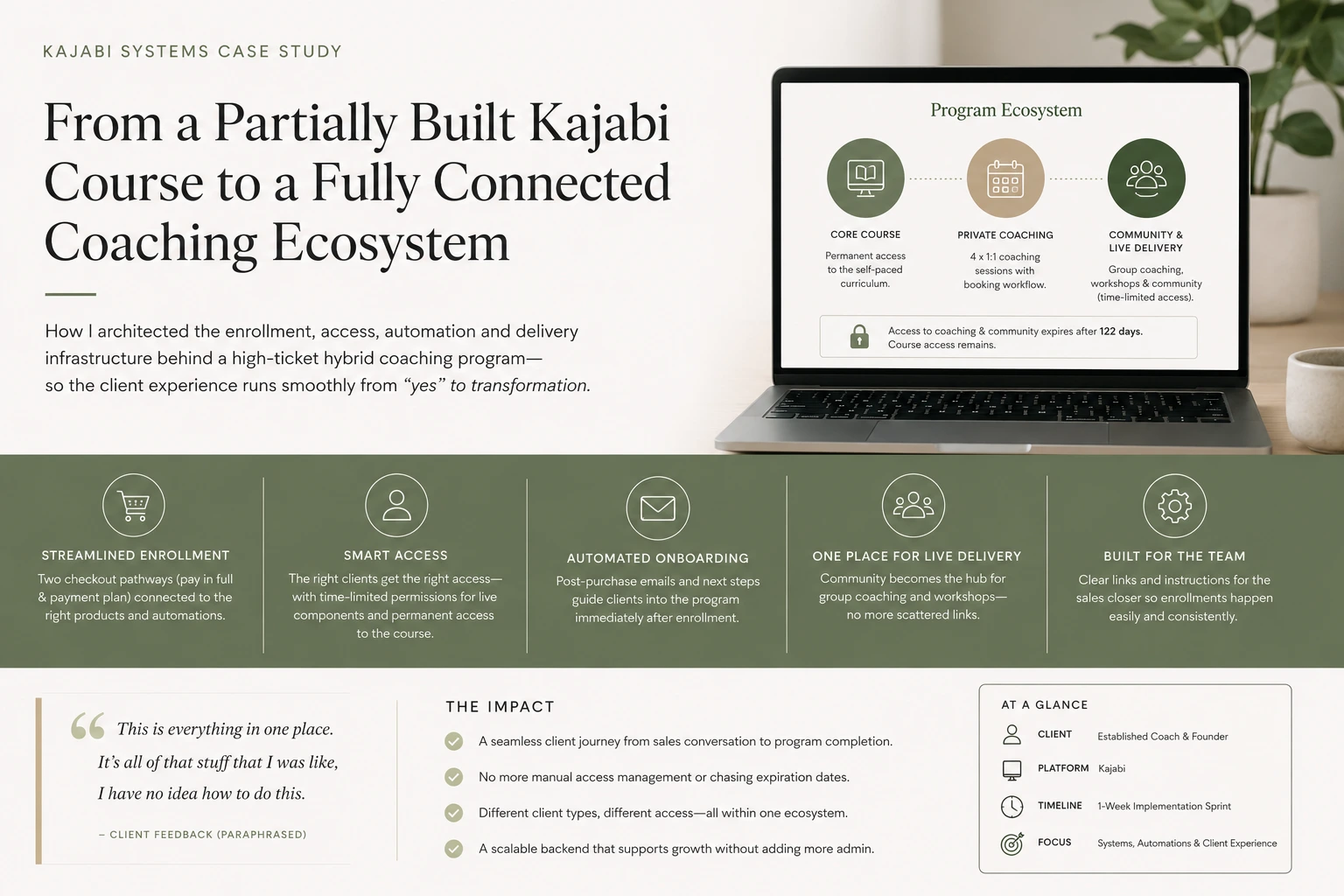
From a Partially Built Kajabi Course to a Fully Connected Hybrid Coaching Ecosystem
What actually goes into building the backend of a high-ticket hybrid coaching program
Client: Established Coach & Founder
Platform: Kajabi
Project: Kajabi Systems & Automation Sprint
Scope: Offer architecture, checkout, automations, coaching, community, onboarding and client access
The Situation
The client came to me while her business was in a bit of a transition.
Her one-to-one coaching practice was reaching capacity, and she was moving toward a 16-week hybrid coaching program that combined a digital course, private coaching, group coaching, workshops and community.
The course itself was already underway. She had created a lot of the curriculum and was still recording some of the remaining content.
But everything around the course?
That was the part that still needed to be figured out.
Because having a course inside Kajabi is one thing.
Actually turning it into a program people can buy, access, move through, book sessions for, join calls for, and eventually complete without the founder manually managing every little thing is something else entirely.
There were a lot of practical questions underneath the offer.
Someone says yes. Great.
Now what?
How do they pay?
What exactly gets unlocked?
Where do they book their four private coaching sessions?
Where do the workshops live?
Where does group coaching happen?
What happens if an existing one-to-one client needs the course but obviously should not receive another four coaching sessions?
What happens after the 16 weeks are finished?
Do they lose everything? Keep everything?
And because this was rolling enrollment rather than one fixed cohort, how do you make sure all of those timelines work when people are joining on completely different dates?
This was the part she did not want to spend her time figuring out.
She needed to be creating the program itself.
My job was to figure out the machine around it.
So this wasn't really a "set up Kajabi" project.
It was a systems architecture project that happened to be built inside Kajabi.
The Actual Challenge
The program had several different pieces, and they did not all need to behave the same way.
A normal enrollment included:
the core digital course
four private coaching sessions
group coaching
workshops
community access
ongoing access to the educational content
limited access to the live coaching portion of the program
Already, that means you cannot just throw everything into one product and call it a day.
Then there were existing one-to-one clients.
Some of them needed access to the course as an extra resource, but they should not suddenly receive another four coaching sessions because someone clicked the wrong offer.
Then there was rolling enrollment.
One person might start this week.
Someone else might start three weeks from now.
Their access should not expire on the same arbitrary calendar date.
And there was also a sales closer involved who needed to be able to enroll people without needing a Kajabi engineering degree every time someone said yes.
The existing process was largely:
Sales call → Stripe payment link → contract → manually coordinate everything else
Which is perfectly workable for a smaller one-to-one practice.
It starts becoming a pain very quickly when the offer gets more complex.
I Started With the Journey, Not Kajabi
Before building anything, I mapped what was actually supposed to happen to the client.
Because this is where I think a lot of Kajabi builds go sideways.
People start with:
"What products should we create?"
or
"What automation can Kajabi do?"
I wanted to know:
What did the person actually buy?
What should they receive immediately?
What are they buying permanently?
What belongs only to the live 16-week experience?
What does the team need so they aren't manually reconstructing this process every time someone joins?
Once those were clear, the Kajabi structure became much easier to build.
The offer needed to be separated into different components because those components had different jobs.
The Course
The self-paced curriculum was the permanent part.
After clients finished the live program, they should still have access to what they learned.
Private Coaching
The program included four individual coaching sessions, so those needed their own structure and booking pathway.
Community + Live Program
The group coaching, workshops and community were part of the live experience.
Those could expire when the program ended.
This meant one enrollment needed to grant access to several different Kajabi products, each doing something different, instead of trying to force the entire offer into one giant product with one access rule.
That distinction ended up being one of the most important pieces of the build.
Then We Built the Checkout Around the Offer
The next thing I wanted to fix was enrollment.
The checkout shouldn't just collect money.
For a program like this, checkout should start the entire client experience.
I built the primary checkout pathways for the standard payment options and connected them to the correct Kajabi products and automation logic.
So instead of:
someone pays → somebody notices → somebody goes into Kajabi → somebody grants access → somebody sends instructions
the purchase itself could begin that process.
Much cleaner.
But we also needed some flexibility because the sales closer occasionally needed to handle custom payment arrangements.
So I created a separate internal workflow for that.
The closer had designated checkout links and clear instructions for which offers to use, rather than needing to poke around the backend and hopefully choose the right thing.
That gave the team some flexibility without turning every custom arrangement into a custom systems problem.
The Access Logic Was Probably the Most Important Part
One of the biggest things we had to separate was:
program access vs course ownership.
Those are not the same thing.
The client wanted participants to keep the course.
Great.
But she didn't want someone who finished their live engagement to have indefinite access to coaching, workshops and community just because the course lived in the same ecosystem.
So we structured the live components around a 122-day access period while preserving ongoing access to the course itself.
This sounds like a small technical detail.
It isn't.
With rolling enrollment, manually tracking this becomes ridiculous very quickly.
You now have Client A ending on one date, Client B ending twelve days later, Client C ending next month, and someone on the team eventually keeping a spreadsheet called FINAL FINAL ACCESS TRACKER 3.xlsx. 😂
I did not want that.
The access rules needed to understand when somebody joined and behave accordingly.
So they became part of the architecture instead of another admin task.
Not Every Client Needed the Same Path
There was another wrinkle.
Existing one-to-one coaching clients also needed access to the educational material.
But they were not buying the hybrid program.
So they should not automatically receive another private coaching package or be pushed through the exact same enrollment path as a new client.
I created a separate pathway for them.
Same ecosystem.
Different access.
This is one of those things I care about a lot with automation.
Automation is not automatically good just because something happens without a human touching it.
If the wrong person gets the wrong thing automatically, congratulations, you have automated the mistake. 😂
The system still has to understand the business model.
We Gave the Live Program an Actual Home
The live side of the program also needed to stop being a pile of links.
Private coaching had its own booking structure.
The digital course had its own home.
Then community became the central place for group coaching, workshops and the ongoing live experience.
So from a client's point of view, the structure made sense:
Course: Learn here.
Coaching: Book your private sessions here.
Community: Come here for the live program, workshops and group experience.
Much easier than trying to remember which Zoom link was in which email from three weeks ago.
And easier for the team too.
Then Came the Part People Forget: What Happens Immediately After Someone Pays?
This matters a lot to me.
Especially with a high-ticket offer.
Someone should not hand you thousands of dollars and then immediately wonder:
"Um... now what?"
There needs to be a bridge between:
I've paid
and
I know exactly what I'm supposed to do next.
So the post-purchase experience was built around getting the client into the right places quickly.
Course.
Coaching.
Community.
Next steps.
The relevant automations were connected directly to the offers, so access could begin from the purchase rather than somebody manually remembering to add the person later.
Again, none of this is glamorous.
It is also the difference between a program that feels put together and one that starts creating admin problems the second somebody buys it.
The Founder and Team Still Needed to Know How to Use It
I am very against building gorgeous complicated backend systems that only make sense to the person who built them.
Because then technically, yes, the system works.
Until I leave. 😂
So part of the project was making sure the business could actually operate what I built.
That included:
direct links for standard enrollments
separate pathways for existing clients
internal checkout logic
instructions for the sales closer
clarity around where offers and automations lived
walkthroughs showing how the different pieces connected
The sales closer didn't need to understand the entire Kajabi architecture.
She needed to know what link to use, when to use it and what would happen next.
The founder didn't need to become a Kajabi technician either.
She needed to understand the logic well enough to run her program.
That was the goal.
Leave infrastructure behind, not dependency.
The Result
By the end of the sprint, this was no longer a partially built course sitting inside Kajabi with a bunch of operational questions around it.
It was a functioning hybrid coaching ecosystem.
A standard client could now move through:
Sales conversation → checkout → payment → access → onboarding → course → private coaching → community + live delivery → completion → continued course access
without the founder having to manually piece the journey together every single time.
Different payment options were accounted for.
Different client types were accounted for.
Different access periods were accounted for.
Existing clients had their own pathway.
The closer had a cleaner enrollment process.
The founder could focus more on delivering the actual program instead of constantly thinking:
"Wait, did we give this person access?"
"When are they supposed to lose community?"
"Did they get coaching too?"
"Which checkout did we send?"
All of those tiny questions are the things that eventually make a program exhausting to run.
The point of the system was to get them out of her head.
This Wasn't Really a Kajabi Setup
Yes, technically the work happened in Kajabi.
But "Kajabi setup" doesn't really describe the project.
What was actually built was:
Offer Architecture
Figuring out what the client was actually buying and how each piece of the program should behave.
Sales Infrastructure
Creating checkout pathways the founder and closer could actually use.
Access Architecture
Separating permanent course ownership from time-limited live-program access.
Automation
Connecting purchases to access, permissions and onboarding.
Delivery Infrastructure
Giving the course, coaching, community and workshops clear homes.
Client Experience
Making sure the person buying the program actually knew where to go after they paid.
Operational Handoff
Making sure the founder and sales closer could run the system without needing me standing beside them forever.
And I think that's the bigger point.
Putting a course online is relatively easy.
Building the infrastructure around a real offer, especially one with multiple delivery methods, client types, payment arrangements and access rules, is where the actual systems thinking starts.
The course was already becoming the product.
My job was to build the system that made the product actually operable.
Like this project
Posted Aug 22, 2026
How I turned a partially built Kajabi course into a connected hybrid coaching system with checkout, automations, coaching, community and onboarding.