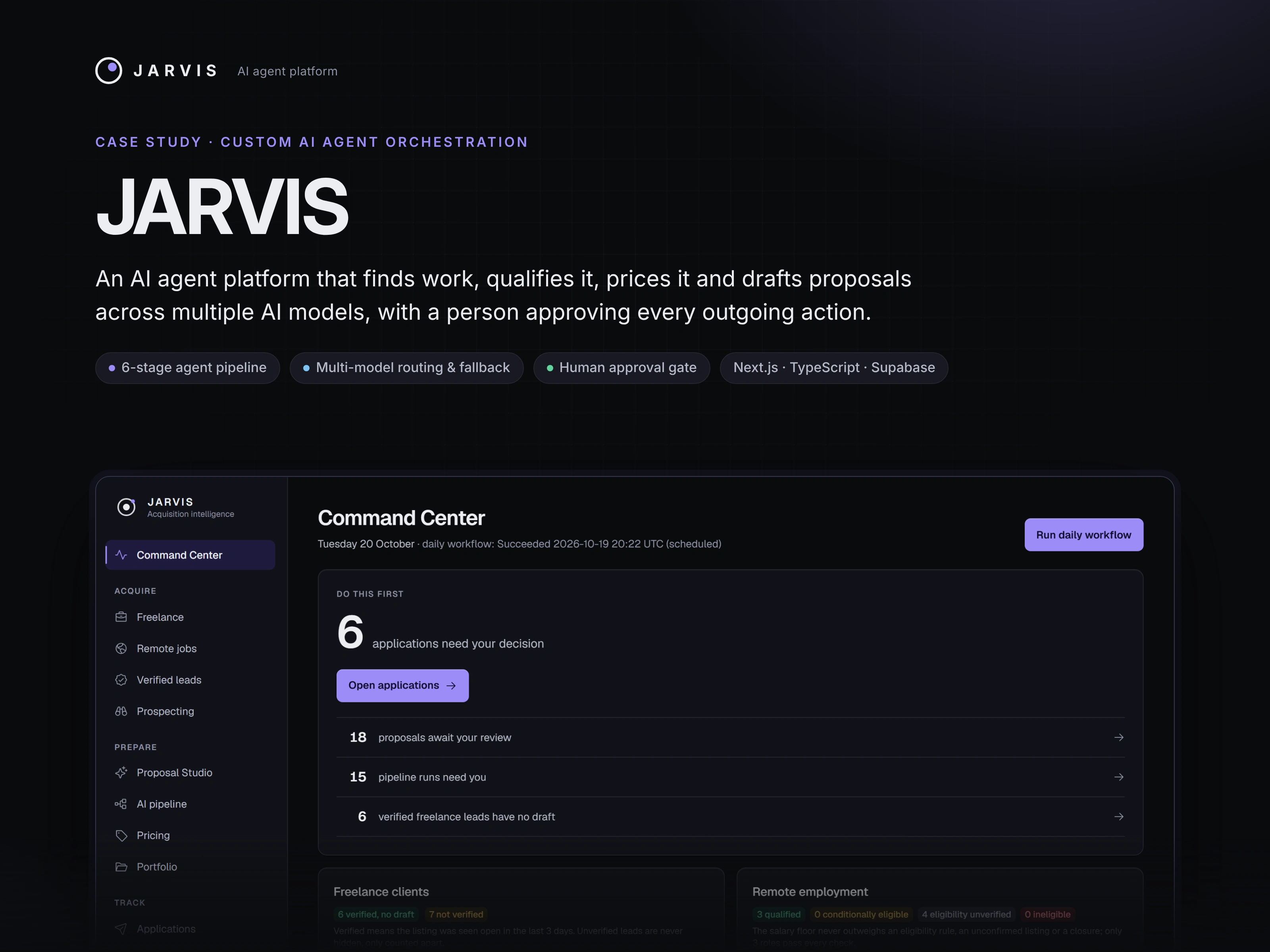
JARVIS — Custom AI Agent Orchestration & Automation Platform

Kanishk Dixit


The problem
Finding good freelance clients is slow, repetitive work: checking dozens of job boards, judging which leads are real and worth the time, estimating a fair price and writing a tailored proposal for each one.
A standalone chatbot can write text, but it cannot remember which leads were already handled, check whether a listing is still open, keep prices consistent, or stop itself from inventing experience you do not have. That needs a system, not a prompt.
The vision
JARVIS is my own engineering project. It works like a small team of AI specialists that does the research and preparation while a person stays in charge. It discovers opportunities, screens and scores them, prices the work, drafts a proposal, checks every claim, and then waits. Nothing is sent, submitted or approved without the owner's click.
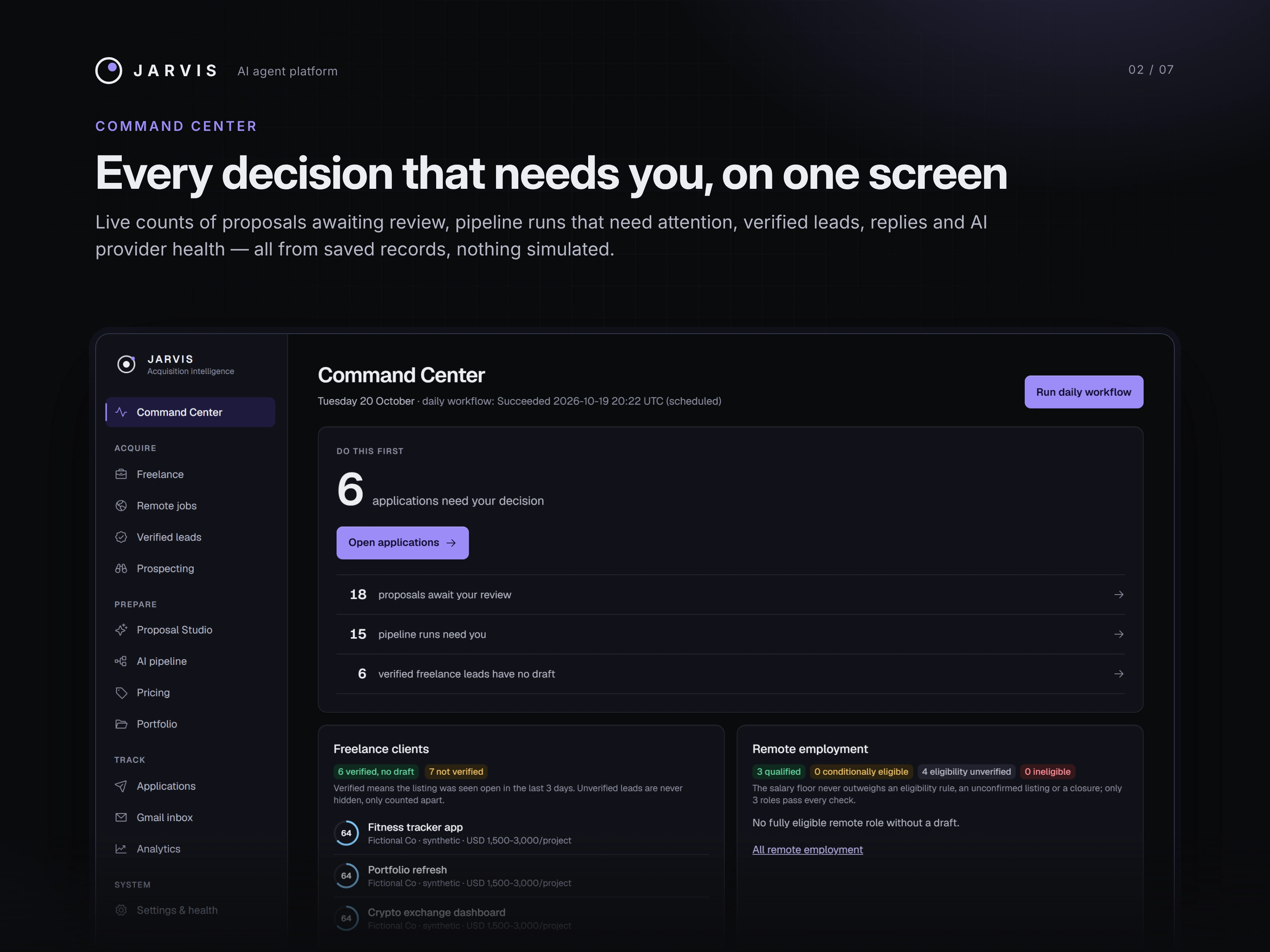
Command Center: proposals awaiting review, pipeline runs that need attention, verified leads, replies and AI provider health in one view. Real JARVIS screen with fictional demo data.
Engineering: AI only where it adds value
Each lead runs through six saved stages. Scout and Researcher are plain code with no AI: they confirm the listing is open, check eligibility and pull out the client's real requirements. The Pricing Analyst makes one model call to split the work into packages; code then calculates hours, contingency, timeline and milestone prices so they always add up to the quote. The Writer makes one call per draft, and a Reviewer running on a different AI provider gives a second opinion. The final stage is a human.
Every step is stored with its model, token count, timing and any errors.
Finished steps are reused, so a failed run resumes exactly where it stopped.
Prompts are cached by content, so retries do not spend tokens twice.
A clean run uses about three model calls in total.
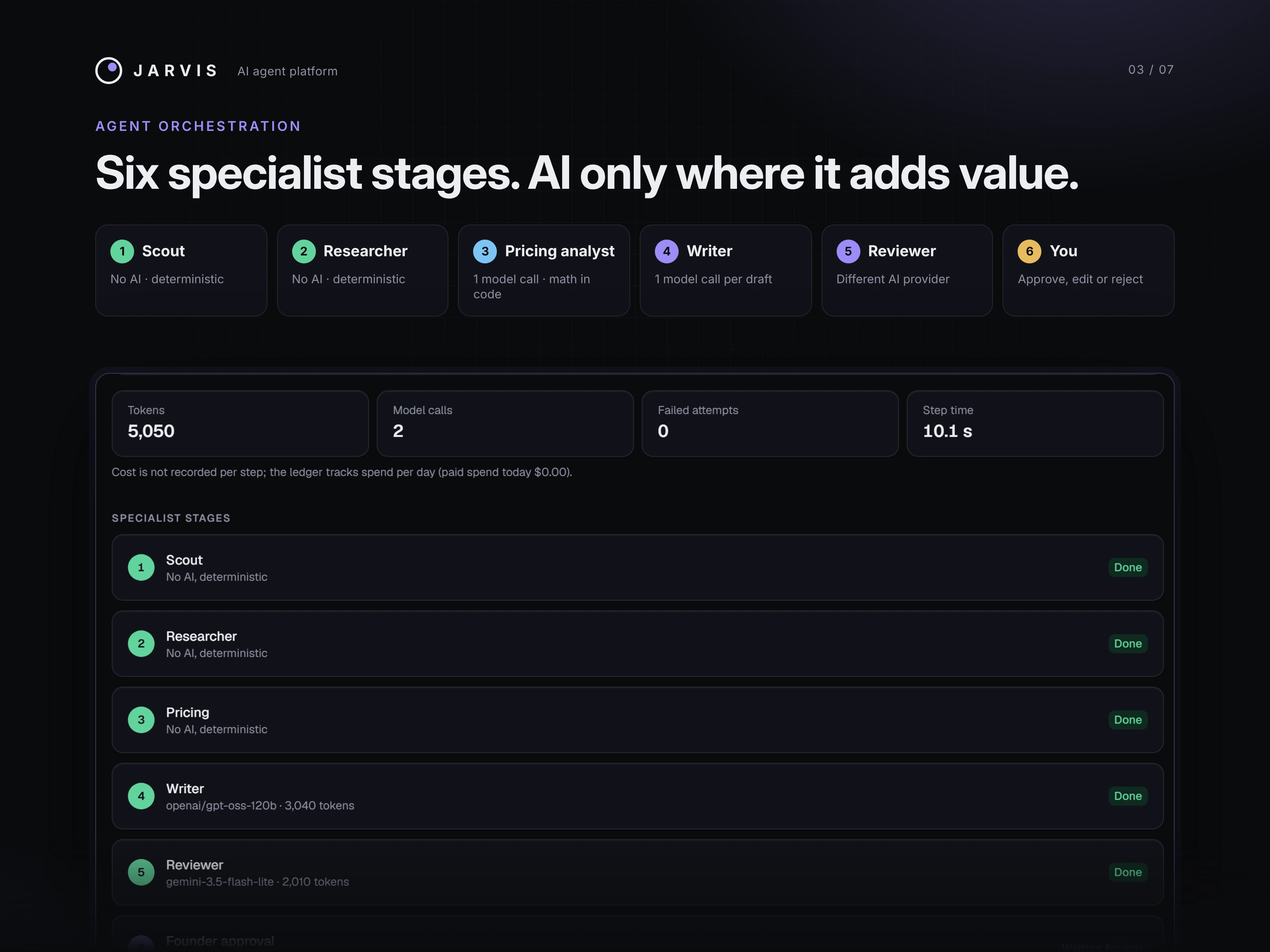
Agent orchestration: Scout, Researcher, Pricing, Writer and Reviewer stages, each saved with its model, tokens and timing, ending at a human approval step.
Every claim is checked before approval
Language models sound confident even when they are wrong. JARVIS sorts every sentence of a draft into verified experience, proposed approach, assumption to confirm, or unsupported. Unsupported claims, such as invented years of experience, a technology credited to the wrong project, made-up metrics or a fixed-price promise on a preliminary estimate, block approval until they are fixed.
When a draft fails, the exact problems go back to the writer for one correction. If it still fails, the next benchmark-approved model gets its turn, and the run stops cleanly if two models fail in the same way.
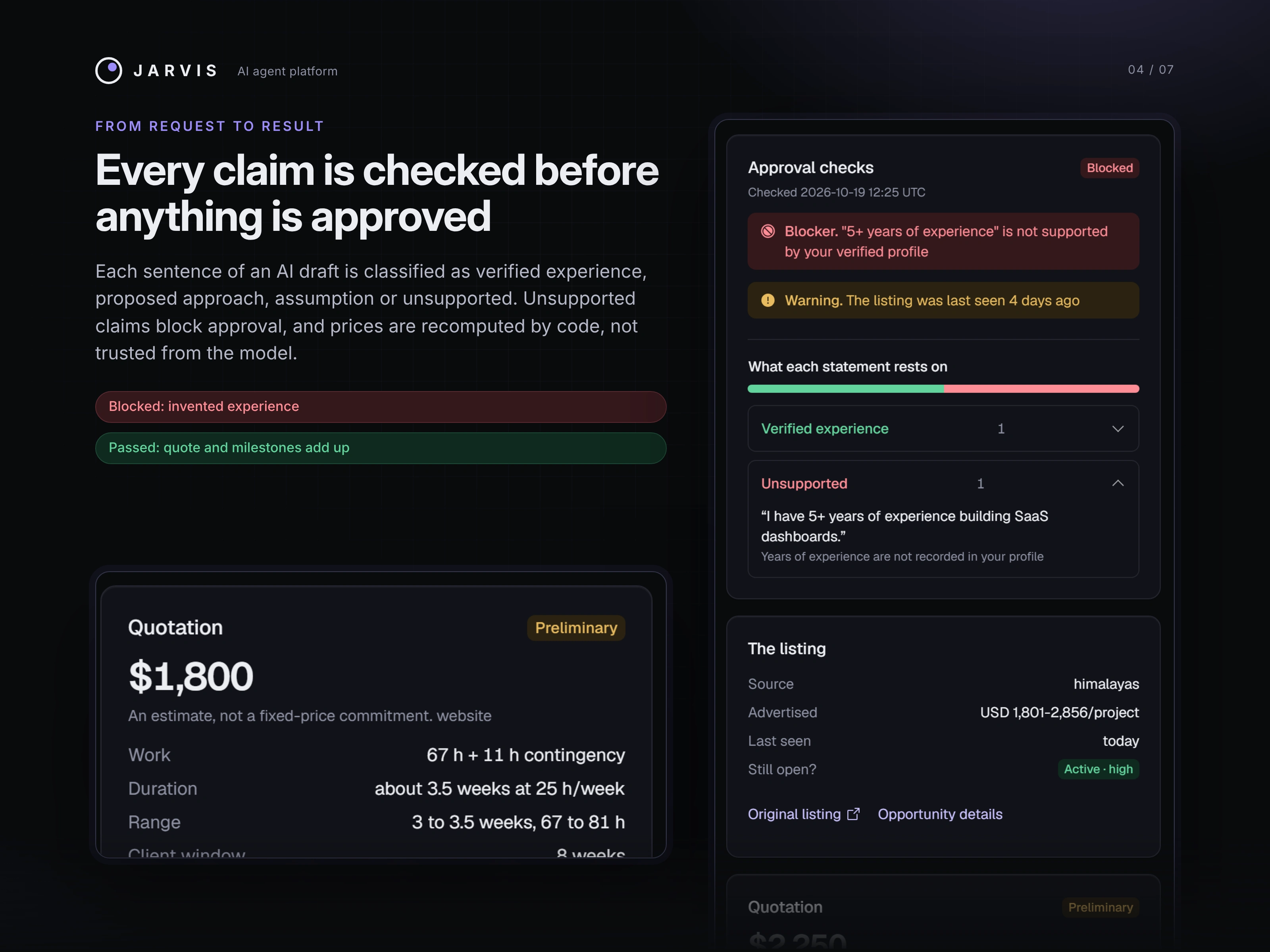
Quality gate: an AI draft claiming experience the profile can't back up is blocked; quotes and timelines are computed by code, not by the model.
Verified integrations
Opportunity sources: Himalayas API, Hacker News "Seeking freelancer" posts (Algolia API), Greenhouse, Lever and Ashby job boards, Remote OK, Remotive, Freelancer.com and Contra listings, plus manual URL import.
AI providers: Google Gemini, Groq (open-weight GPT-OSS models) and Ollama Cloud, behind one router that tracks quotas, rate limits and a daily spending cap per model. Only models that pass a real benchmark may write client-facing text.
Gmail: read-only access to classify replies and link them to applications. It cannot send email.
OpenStreetMap: finds local businesses for outreach research, using only evidence from their public websites.
Platform: Supabase Postgres and Auth, hosted on Vercel, with a scheduled background worker.
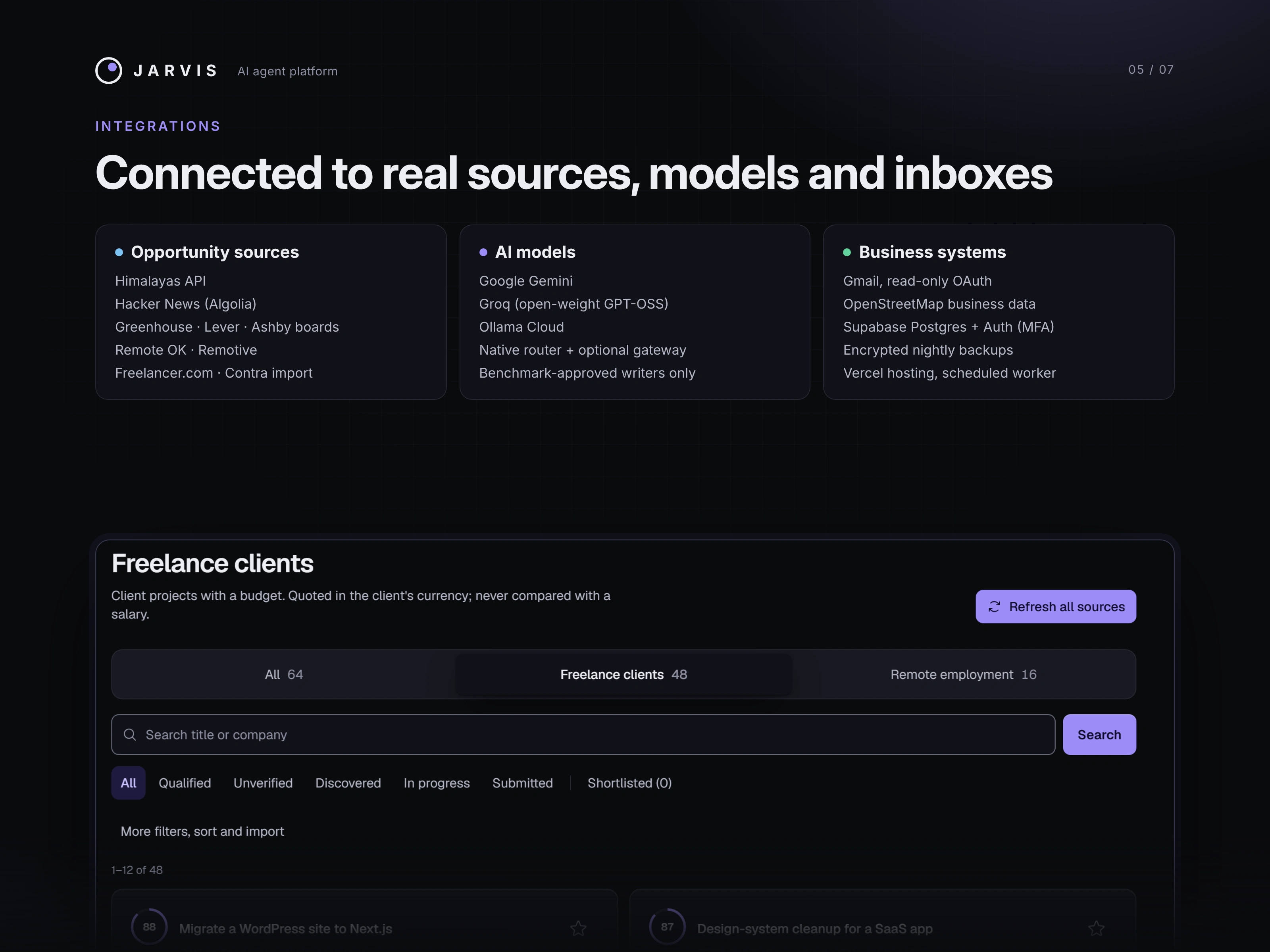
Integrations: job boards, ATS feeds and freelance sources, three AI providers, read-only Gmail and Supabase, with leads scored and screened automatically.
Reliability, security and testing
Circuit breakers per model: three failures in a row pause a model for 15 minutes, doubling up to 4 hours.
Validated output: every AI response must match a strict schema, with one corrective retry before falling back.
Resumable jobs: long workflows run as short, checkpointed jobs on a Postgres queue with leases, so two workers never do the same job twice.
Access control: owner-only sign-in with two-factor authentication, and row-level security that keeps the browser away from the database.
Safe by default: protection against server-side request forgery on every outbound fetch, a strict content security policy, encrypted Gmail tokens and nightly encrypted backups with a tested restore.
Evidence from the project's own reports: 596 unit tests, 600 browser tests passed across four screen sizes, and 46 of 46 live security checks on the hosted app.
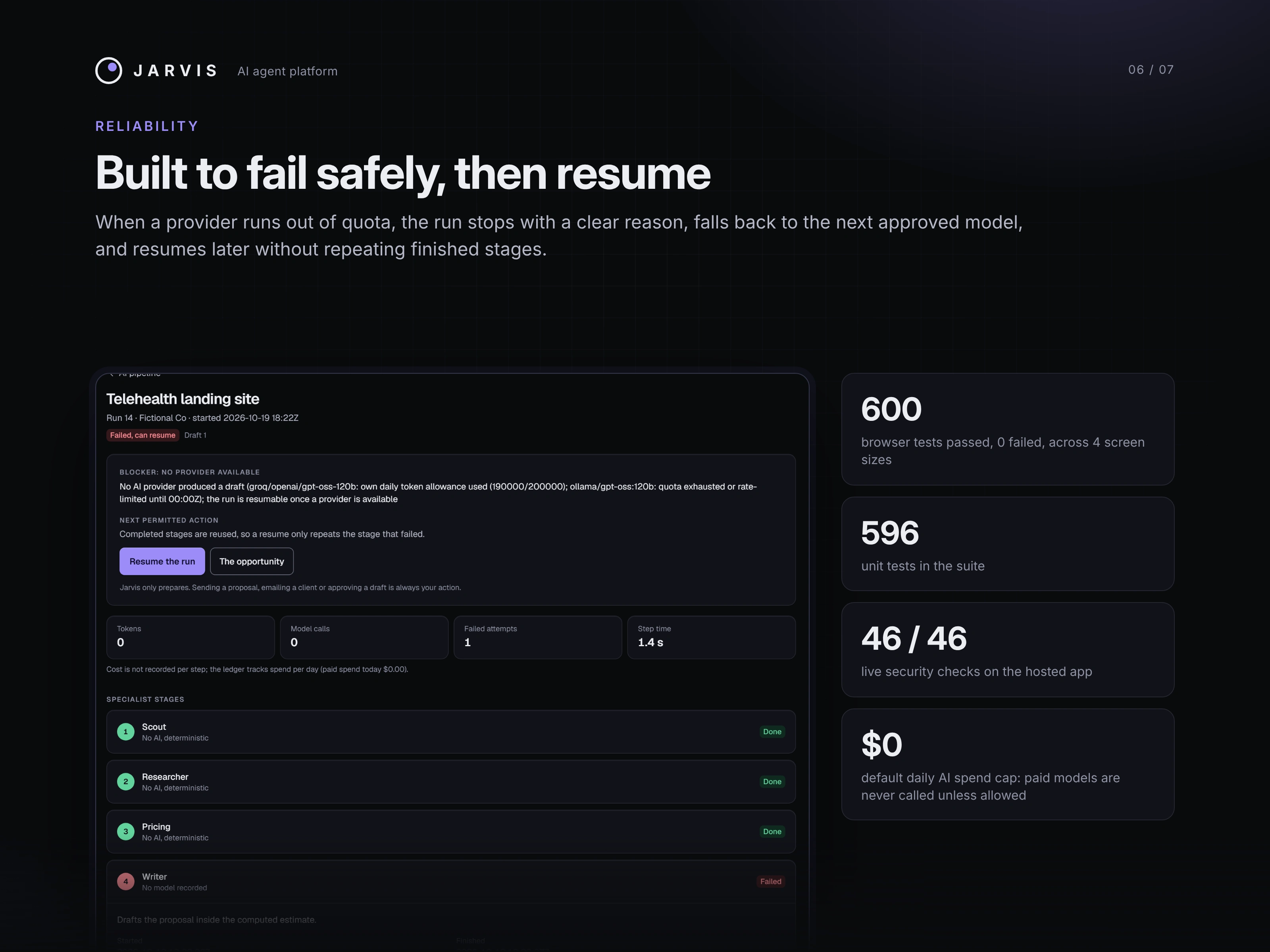
Reliability: when every provider is out of quota the run stops with a clear reason and resumes later, reusing finished stages. Figures come from the project's own test and security reports.
Architecture
A Next.js 16 and TypeScript app handles pages, server actions and API routes. Supabase provides the database, sign-in and scheduling. A multi-provider AI router, guarded data connectors and read-only Gmail sit behind the server, and every outgoing action waits for a person.
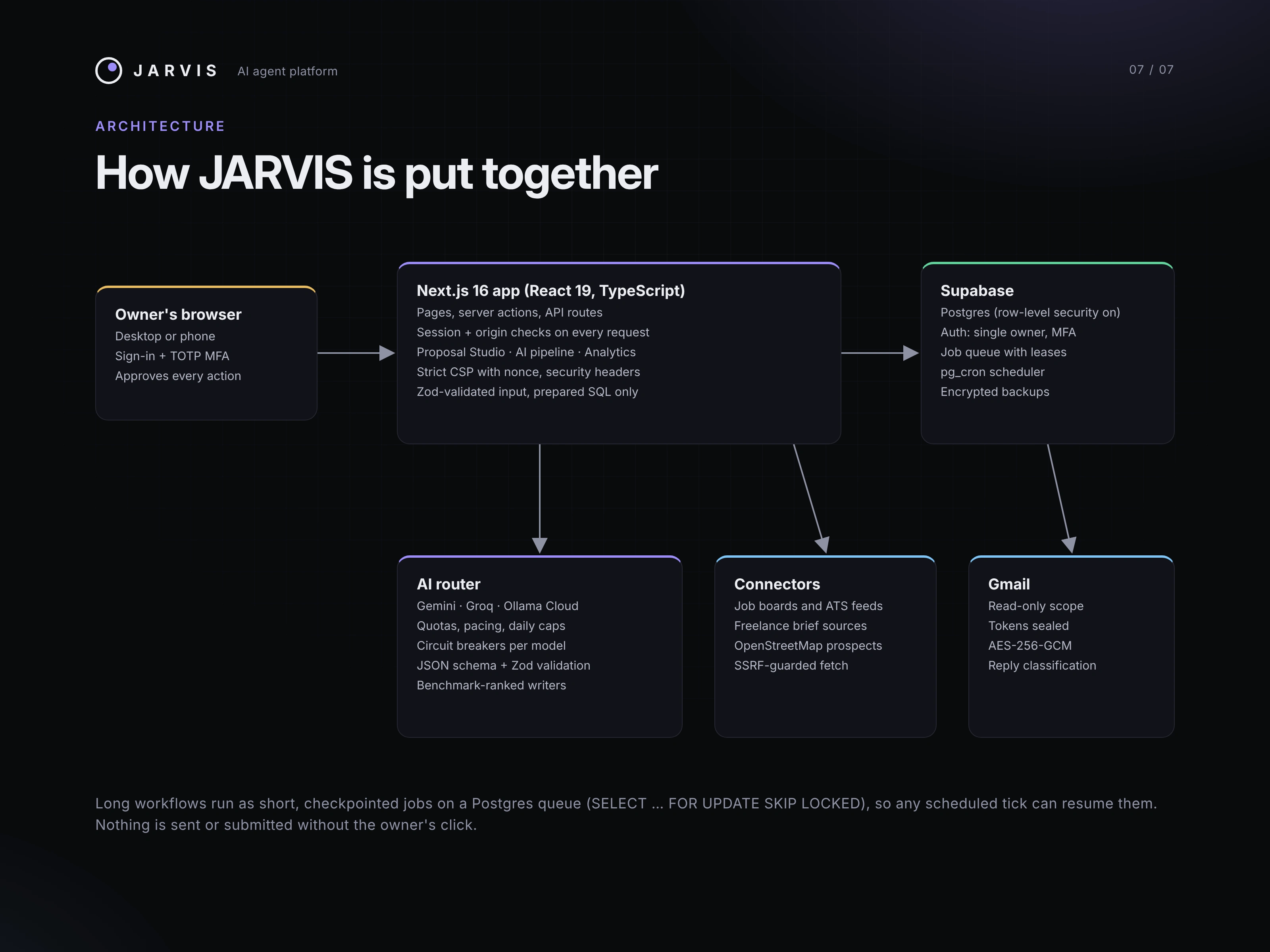
Architecture: Next.js app, Supabase Postgres and Auth, a leased job queue, a multi-provider AI router and guarded connectors, simplified from the project's design docs.
What I can build for your business
The same building blocks fit many businesses. For example:
A lead-qualification agent that reads new enquiries, scores them and drafts replies for your team to approve.
A research assistant that watches sources you care about and summarises what needs attention.
A quoting tool that turns a client brief into a consistent, explainable estimate.
An internal dashboard that shows what needs a decision today, connected to the tools you already use.
Each one is designed around your data, your tools and your approval rules, with AI used where it helps and plain code where accuracy matters.
Good to know
JARVIS is my own project, not paid client work, and it is not for sale. Client projects are custom builds; my private code, credentials and infrastructure are not included.
Screens show fictional demo data. A few parts, such as some extra AI providers and the unattended daily schedule, are still being validated.
Work with me
Need a custom AI agent that does more than answer questions? I build AI systems that connect to your business tools, automate workflows, and help your team operate more efficiently. Start with my Custom AI Agent & Business Automation Platform service, or message me here on Contra to scope your project.
Like this project
Posted Oct 21, 2026
My own AI agent platform: a 6-stage pipeline that finds, scores and prices work, then drafts proposals across AI models with claim checks and human approval.