Startup Idea Validator

Akhil Yadav


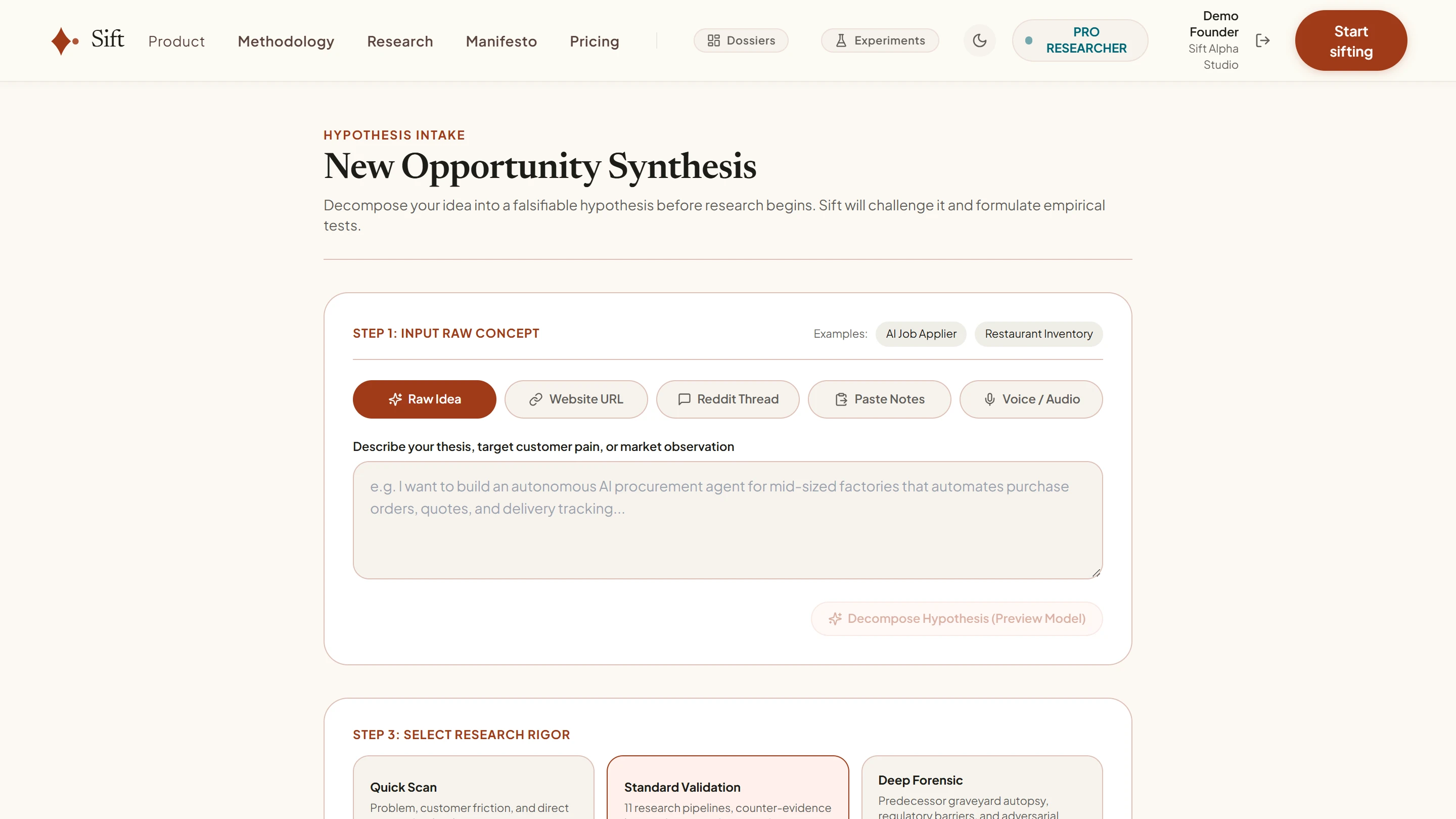
Idea intake screen
Self-initiated portfolio project. Demonstrates implemented functionality and is not presented as a client engagement. Features and integrations are described according to their verified implementation status.
Source code: github.com/akhilyad/Startup-Idea-Validator-BYOK
Overview
Startup Idea Validator is a monorepo for stress-testing early business ideas. A user submits a concept (raw idea, URL, thread, notes or audio), the system breaks it into a falsifiable assumption graph, runs a multi-stage research pipeline, and produces a dossier with unit economics, counter-evidence and proposed experiments. The design goal is a bring-your-own-key tool where ideas stay local.
Problem
Founders tend to hear encouragement. A useful validation tool should challenge the idea and say what would have to be true for it to work.
Solution
A pipeline of eleven research agents (problem, customer, competitors, market, pricing, technology, regulation, economics, go-to-market, defensibility and counter-evidence) feeding scoring, a challenge mode, a thesis document and a list of low-cost experiments, presented in a dossier with tabs for assumptions, evidence, competitors and economics.
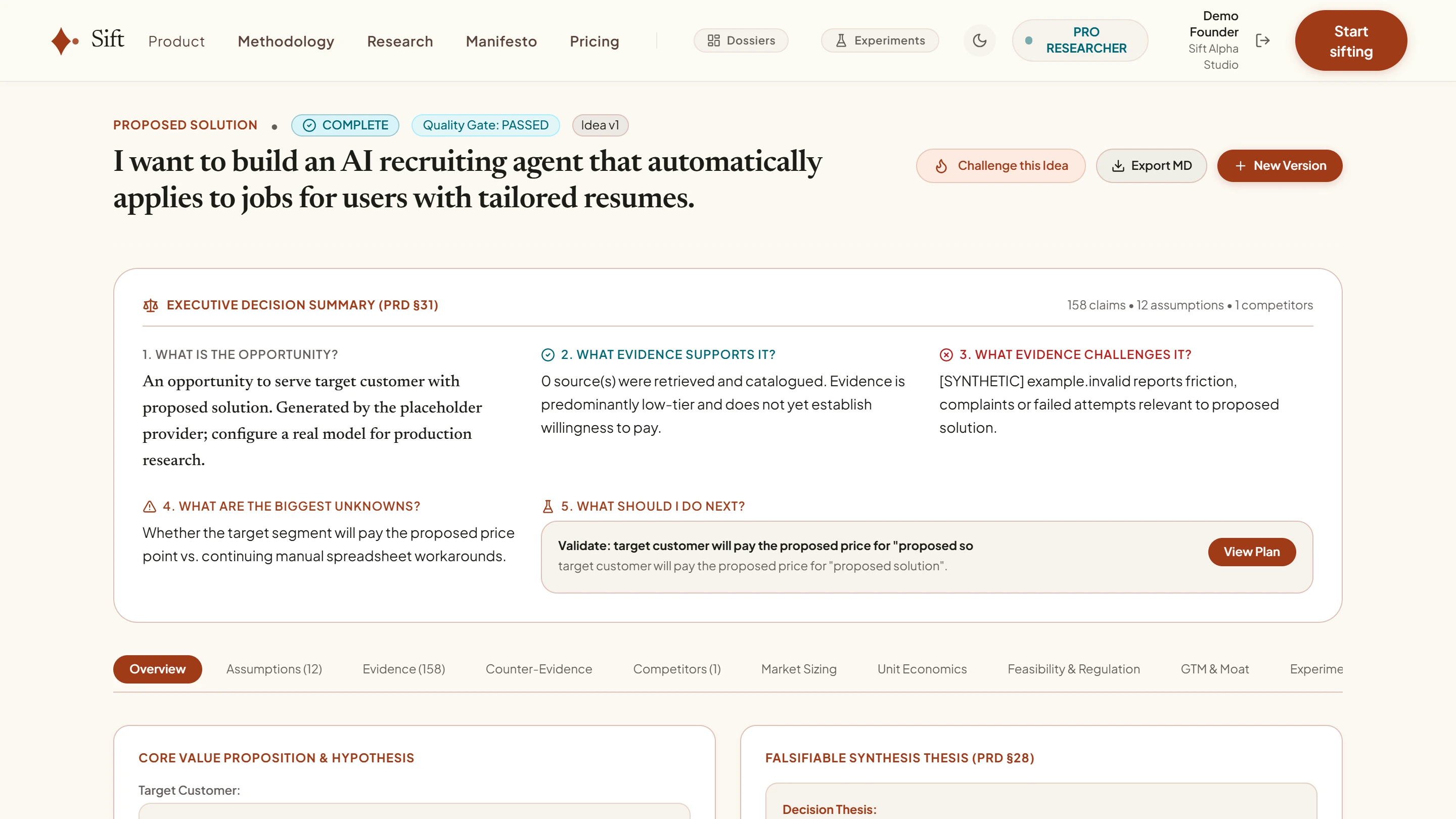
Generated dossier from the placeholder provider
Key features (implemented)
React and Vite web app: idea intake with several input types, research-rigor levels, dossier view, experiments view, markdown export, demo sign-in
Fastify API with authentication, a Prisma data layer (SQLite) and seeded demo data
Research pipeline with eleven agent definitions, evidence extraction and a swappable LLM provider interface
Typed packages for validation, observability, configuration and research
Engineering
Turborepo and pnpm workspaces, strict TypeScript, shared validation schemas. I ran the project locally: the integration test suite passes (8 of 8 tests) and I generated a dossier end to end.
Limitations
Only an offline placeholder model provider is implemented; the repository states that real providers (OpenAI, Anthropic, OpenRouter) would need to be added behind the existing interface
Dossier content, evidence counts and competitor entries produced today are synthetic and labelled as such in the output; the app performs no real market research
The "bring your own key" model described in the project documentation is a design, not a working feature
Like this project
Posted Oct 18, 2026
A TypeScript monorepo (Fastify API, React web app, Prisma) that structures a startup idea into an assumption graph, evidence log and experiments.
Likes
0
Views
0
Timeline
Oct 4, 2026 - Oct 4, 2026