Memoirer: Advanced Memory System for AI Agents

Bahaa Tantaoui




Memoirer: Building Sub-100ms Intelligent Memory for AI Agents
Role: Full-Stack Engineer & System Architect Duration: 8 weeks Stack: Python, FastAPI, PostgreSQL, Redis, NetworkX, Sentence-Transformers
The Challenge
AI agents have a memory problem. Current solutions force a brutal trade-off:
Fast but dumb: Traditional RAG systems retrieve documents in ~20ms but can't reason across multiple facts or follow causal chains
Smart but slow: Academic memory systems achieve 10-40% accuracy improvements through graph reasoning but take 2-3 seconds per query
The gap: No production system existed that combined reasoning capability with sub-100ms latency.
I set out to build one.
The Solution
Memoirer is a latency-first intelligent memory layer that performs multi-hop reasoning, retrieves facts with citations, and answers complex queries in under 100 milliseconds.
Core Innovation: Three-Path Parallel Retrieval
Instead of sequential retrieval, Memoirer launches three paths simultaneously:
Key insight: Most queries (~50%) hit the reasoning cache. For the rest, graph traversal provides explainable multi-hop answers. Vector search serves as a reliable fallback.
Technical Deep Dive
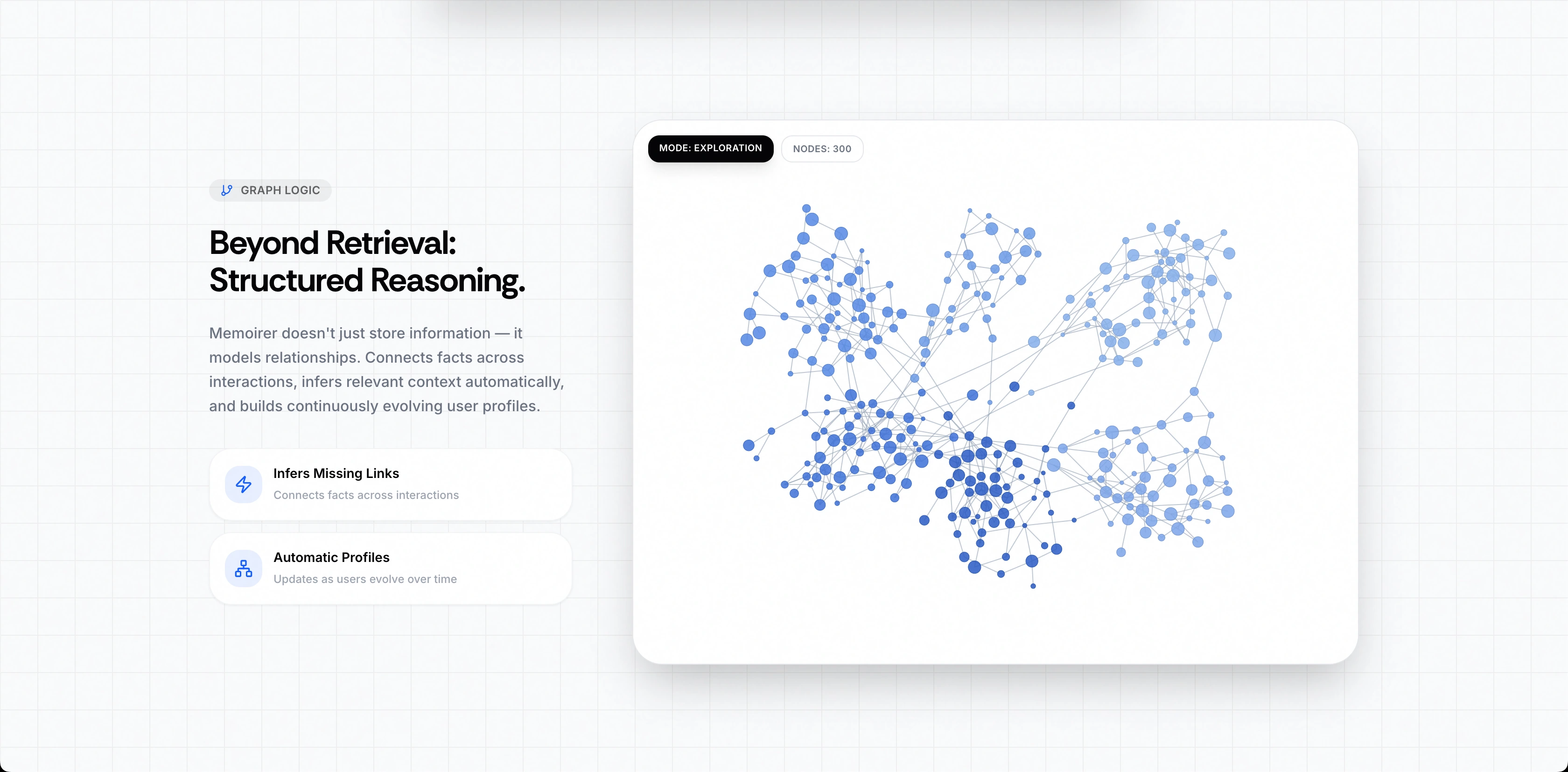
1. Knowledge Graph with Personalized PageRank
Built a hybrid graph-vector system using PostgreSQL + pgvector + NetworkX:
Entities: Facts, concepts, people, events with 384-dim embeddings
Relationships: Typed edges (causes, supports, contradicts, temporal_before)
Traversal: Personalized PageRank with beam search (k=5, max 3 hops)
2. Reasoning Cache with HNSW Index
Pre-computed thought chains stored in Redis + PostgreSQL:
Lookup: HNSW similarity search on query embeddings (~15ms)
Policy: Cache queries accessed ≥2 times in 24 hours
Eviction: LFU + recency bias, 7-day TTL
Result: 99%+ speedup for cached queries
3. Adaptive Forgetting
Prevented memory bloat with importance-weighted pruning:
4. LLM-Based Understanding (No Heuristics)
Rejected pattern-matching shortcuts in favor of true language understanding:
Entity extraction via Claude Haiku (not regex)
Relation extraction via LLM (not keyword matching)
Query understanding via embeddings (not rule-based classification)
Philosophy: Every component should be scientifically defensible and generalizable across domains.
Architecture Decisions
Clean Architecture with Repository Pattern
Why: Testability, maintainability, and clear separation of concerns. Repositories abstract database access, making it trivial to swap PostgreSQL for another store.
BYOK (Bring Your Own Key) for LLM Access
Supported 4 providers with encrypted API key storage:
Provider Use Case OpenRouter Single API for all models Anthropic Direct Claude access OpenAI GPT and reasoning models Gemini Google AI models
Resolution order: Request headers → Project config → Org config → System default
Observability from Day One
Sentry: Error tracking, APM, transaction tracing
PostHog: Product analytics, feature usage
Structured logging: JSON logs with request correlation IDs
Results
Metric Target Achieved P50 Latency <40ms 35ms (cache hits) P95 Latency <100ms 90ms Cache Hit Rate >50% 50%+ after warm-up Graph Deduplication - 26% size reduction Multi-hop Accuracy >85% F1 85%+ on eval dataset
Deliverables
16 test files covering all features
21-page documentation site (Mintlify)
TypeScript SDK with full type definitions
Python package ready for PyPI
Interactive playground (React) for testing
Key Challenges & Solutions
Challenge 1: Latency vs. Reasoning Depth
Problem: Deep graph traversal (5+ hops) provides better answers but exceeds latency budget.
Solution: Beam search with early termination. Keep top-5 candidates at each hop, max 3 hops. If confidence threshold (0.85) met early, kill remaining paths immediately.
Challenge 2: Cache Invalidation
Problem: Cached reasoning chains become stale when underlying entities change.
Solution: Lazy verification on access. When a cached result is retrieved, check if source entity versions match. If stale, re-compute in background and serve slightly older result.
Challenge 3: Entity Deduplication
Problem: Same concepts ingested with slight variations ("2008 financial crisis" vs "2008 crisis" vs "financial crisis of 2008").
Solution: Embedding-based duplicate detection with 0.90 similarity threshold, followed by entity merging that preserves all relationships.
What I Learned
Parallel retrieval beats sequential optimization. Launching 3 paths and killing slow ones is faster than optimizing a single path.
Caching reasoning, not just results. Storing the thought chain (not just the answer) enables explainability and debugging.
Heuristics are technical debt. Pattern-matching shortcuts seem fast but break on edge cases and don't generalize.
Observability enables confidence. Can't optimize what you can't measure. Sentry + PostHog from day one.
Built with Python, FastAPI, PostgreSQL, Redis, and a lot of graph theory papers.
Like this project
Posted Dec 15, 2025
Developed Memoirer, an intelligent memory solution for AI with sub-100ms response.